
Jensen Huang Biography Quotes 11 Report mistakes
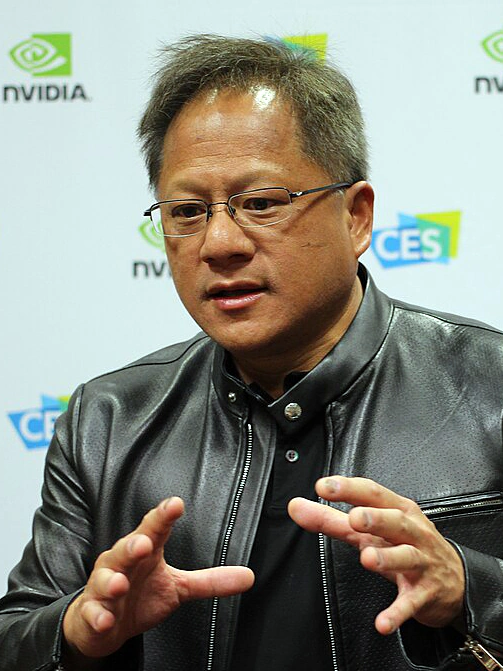
Attr: Maurizio Pesce
| 11 Quotes | |
| Born as | Jen-Hsun Huang |
| Occup. | Businessman |
| From | USA |
| Spouse | Lori Mills |
| Born | February 17, 1963 Tainan, Taiwan |
| Age | 63 years |
| Cite | |
Citation Formats
APA Style (7th ed.)
Jensen huang biography, facts and quotes. (2026, February 11). FixQuotes. https://fixquotes.com/authors/jensen-huang/
Chicago Style
"Jensen Huang biography, facts and quotes." FixQuotes. February 11, 2026. https://fixquotes.com/authors/jensen-huang/.
MLA Style (9th ed.)
"Jensen Huang biography, facts and quotes." FixQuotes, 11 Feb. 2026, https://fixquotes.com/authors/jensen-huang/. Accessed 26 Mar. 2026.
Early Life and Background
Jen-Hsun Huang was born in 1963 in Tainan, Taiwan, into a family shaped by the postwar scramble for stability and education. His early childhood unfolded against the backdrop of Taiwan's export-driven industrial rise, a society that prized engineering competence and upward mobility. That atmosphere mattered: Huang would later treat computing not as an abstract science but as infrastructure - a way to build national-scale capability and, eventually, global platforms.As a boy he spent formative years away from his parents, first in Thailand and then in the United States after the family sought safer footing. In the mid-1970s, Huang and his brother were sent to a boarding school in Kentucky (Oneida Baptist Institute), a small-town institution that could be harsh for immigrant children still learning the local codes. The experience left him with a durable, private toughness - the kind that does not romanticize adversity but metabolizes it into stamina. By the time he later settled in Oregon, he had learned to treat belonging as something earned through performance and reliability, not granted by circumstance.
Education and Formative Influences
Huang came of age as the microprocessor revolution rewrote what a "machine" could be. He studied electrical engineering at Oregon State University (BSEE, 1984), then completed an MSEE at Stanford University (1992), absorbing Silicon Valley's mix of rigorous design culture and impatient entrepreneurship. Between degrees he worked in industry, learning how real products ship - how specifications, cost, thermals, and manufacturing constraints discipline ambition. Stanford added the long view: computing as architecture, and architecture as destiny.Career, Major Works, and Turning Points
Huang worked at LSI Logic and later AMD, building credibility in the pragmatic world of chips before co-founding Nvidia in 1993 with Chris Malachowsky and Curtis Priem. Nvidia began as a bet that graphics would become a general engine of computation, not a decorative accessory. The company's early years were perilous: product missteps and the brutal economics of semiconductors nearly ended it, until the GeForce line (1999) helped define the GPU as a mass-market platform. Under Huang's CEO leadership, Nvidia pushed programmable shading, then introduced CUDA (2006), turning GPUs into a developer-accessible parallel-computing tool. That decision, initially niche, became the hinge: as deep learning surged in the 2010s, Nvidia's hardware-software stack (GPUs, CUDA, cuDNN, networking, systems) positioned it at the center of AI training and accelerated computing, culminating in data center platforms and the H100 era as cloud providers and enterprises rebuilt around AI workloads.Philosophy, Style, and Themes
Huang leads like an engineer who learned the emotional economics of risk: ambition must be paired with endurance. He has spoken plainly about the cost of building at the frontier: “If you want to build something great, you have to be willing to suffer”. In his worldview, suffering is not martyrdom; it is the entry fee for mastery in a domain where physics, competition, and time-to-market punish hesitation. That attitude helps explain Nvidia's long willingness to invest ahead of visible demand - in compilers, libraries, developer relations, and full systems - because the hard part is not the chip alone but the ecosystem that makes it inevitable.His public ideas also map an inner conviction that computing's purpose is changing from calculation to cognition. “AI is the most powerful technology force of our time”. This is not just rhetoric for investors; it is a claim about the direction of human labor and creativity - that intelligence, once scarce and embodied in specialists, will become a widely distributed capability embedded in tools. He frames that shift as a new industrial platform rather than a single product cycle: “AI will be the greatest technology shift in our lifetime”. The subtext is strategic: if intelligence becomes the primary value, then the companies that provide the shovels - compute, networking, software, and reference architectures - become the new utilities.
Legacy and Influence
Huang's enduring impact is the transformation of the GPU from a gaming component into a general-purpose engine that underwrites modern AI, simulation, and high-performance computing. By insisting on a tightly coupled hardware-software platform, he helped set a template for how frontier tech scales: not as isolated breakthroughs, but as ecosystems that make complex capabilities usable by millions. In an era defined by data centers, foundation models, and synthetic worlds, his influence is visible in both the technical stack and the managerial lesson - that long-term bets, made early and defended through adversity, can redraw the map of an industry.Our collection contains 11 quotes written by Jensen, under the main topics: Perseverance - Technology - Saving Money - Artificial Intelligence - Coding & Programming.
Source / external links