
Jeremy Bentham Biography Quotes 17 Report mistakes
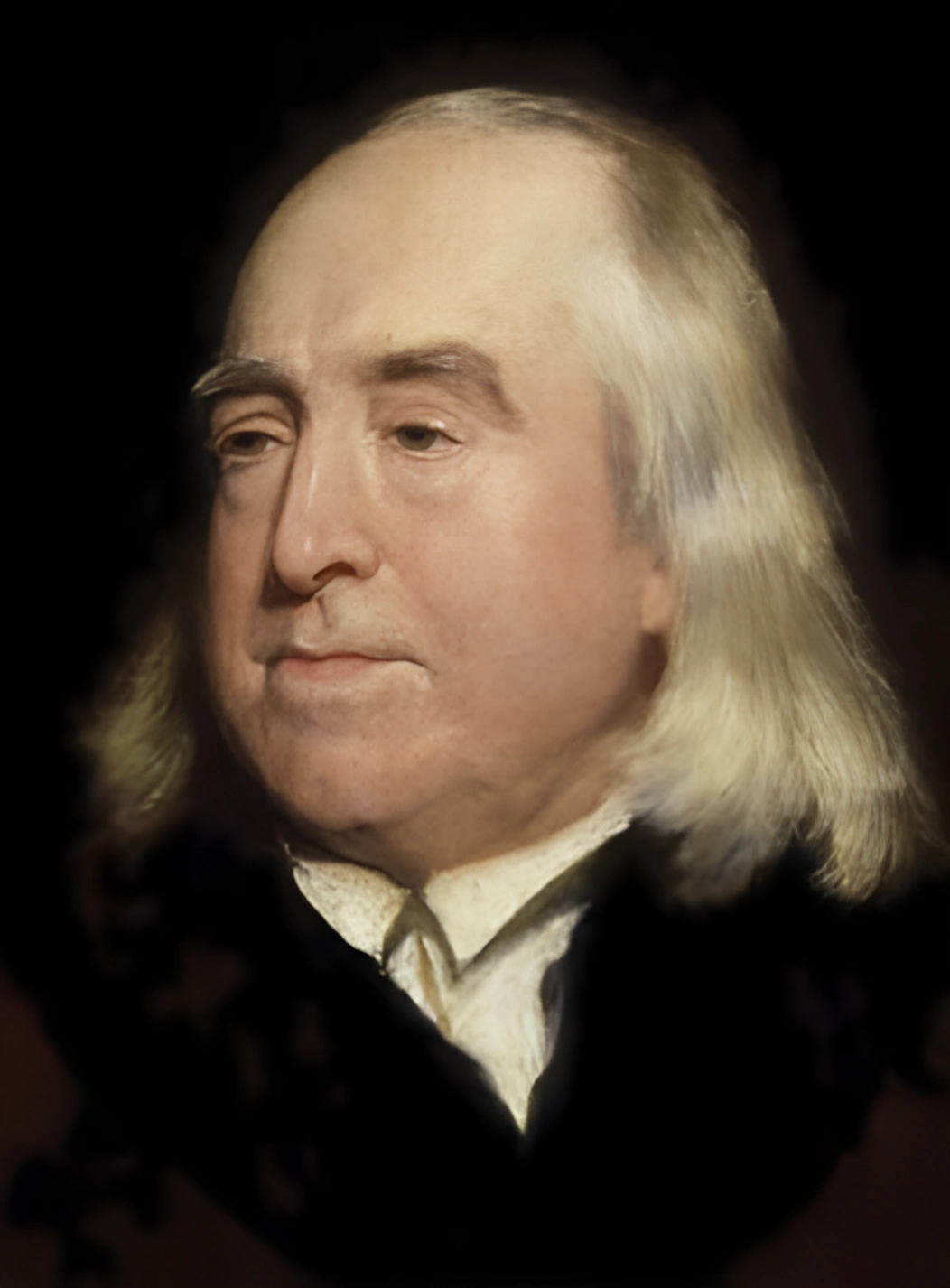
| 17 Quotes | |
| Occup. | Philosopher |
| From | England |
| Born | February 15, 1748 London, England |
| Died | June 6, 1832 London, England |
| Aged | 84 years |
| Cite | |
Citation Formats
APA Style (7th ed.)
Jeremy bentham biography, facts and quotes. (2026, February 11). FixQuotes. https://fixquotes.com/authors/jeremy-bentham/
Chicago Style
"Jeremy Bentham biography, facts and quotes." FixQuotes. February 11, 2026. https://fixquotes.com/authors/jeremy-bentham/.
MLA Style (9th ed.)
"Jeremy Bentham biography, facts and quotes." FixQuotes, 11 Feb. 2026, https://fixquotes.com/authors/jeremy-bentham/. Accessed 5 Mar. 2026.
Early Life and Background
Jeremy Bentham was born on 15 February 1748 in London, England, into a prosperous, legally connected family that embodied the 18th-century confidence in property, order, and advancement. His father, Jeremiah Bentham, worked as an attorney and expected his precocious son to rise within the profession; the household's ambitions were sharpened by the social reality that law and office were among the surest paths to influence in Georgian Britain. Bentham later described himself as an unusually early reader, a child both dazzled by learning and troubled by cruelty, a temperament that would harden into a lifelong preoccupation with pain, punishment, and the uses of power.The England of Bentham's youth was a country of expanding commerce, a multiplying press, and a state that still relied on patronage and archaic legal forms. The criminal law was severe, prisons were chaotic, and parliamentary reform remained largely aspirational. In that setting Bentham's inner life formed around a paradox: he was intensely private, even solitary, yet he dreamed of redesigning public institutions with the precision of an engineer. The tension between personal reserve and public ambition became a defining energy of his work.
Education and Formative Influences
Bentham entered The Queen's College, Oxford, at an exceptionally young age and later trained at Lincoln's Inn, qualifying for the bar though he never embraced practice. Oxford exposed him to Anglican orthodoxy and inherited curricula that struck him as complacent; he left with a distrust of tradition as an argument. The philosophical spark came through reading Enlightenment writers and, decisively, the jurist William Blackstone, whose Commentaries Bentham admired for clarity while rejecting their reverence for the common law. From these years he retained a reformer's suspicion that venerated systems often conceal avoidable suffering.Career, Major Works, and Turning Points
Bentham's career was that of a theorist with a legislator's imagination: he wrote relentlessly, sought patrons, and cultivated reformers at home and abroad. His first major intervention, A Fragment on Government (1776), attacked Blackstone and announced a new standard for judging institutions: utility rather than antiquity. In An Introduction to the Principles of Morals and Legislation (printed 1780, published 1789), he developed the "felicific calculus" and a program for measuring policy by its consequences for pleasure and pain. He pursued applied designs as well, most famously the Panopticon prison scheme (1790s), an architectural and administrative model meant to reduce cruelty and corruption through inspection and incentives, though it was never built as he envisioned. In later decades he became a hub for the philosophical radicals - including James Mill and, indirectly, John Stuart Mill - and produced vast writings on evidence, civil and criminal law, constitutional design, and political economy, much of it edited and published posthumously by John Bowring.Philosophy, Style, and Themes
Bentham's utilitarianism began as psychology: he treated human beings as creatures moved by the twin sovereigns of pleasure and pain, and he insisted that moral and legal language should not mystify that fact. His famous formula, “It is the greatest good to the greatest number of people which is the measure of right and wrong”. , was not a slogan for him but a demand for auditability - to ask, for any rule, who benefits, who pays, and whether alternative arrangements could reduce suffering. This produced a combative posture toward inherited doctrine, especially when it protected privilege by hiding behind Latin tags, procedural labyrinths, or religious tests.His prose could be both technical and volcanic: long chains of definitions, neologisms, and enumerations built to prevent evasion. Yet beneath the apparatus was a moral sensitivity that widened the circle of concern. "The question is not, "Can they reason?" nor, "Can they talk?" but rather, "Can they suffer?"" . That sentence reveals a mind obsessed less with dignity as status than with vulnerability as a shared condition, pushing ethics beyond class, nationality, and even species. The same suspicion of concealed power shaped his jurisprudence: “The power of the lawyer is in the uncertainty of the law”. Bentham's animating fear was that obscurity licenses domination; clarity, publicity, and codification were therefore not merely administrative virtues but instruments of compassion.
Legacy and Influence
Bentham died on 6 June 1832 in London, leaving behind an archive whose scale matched his ambition to be a legislator of the modern world; in keeping with his iconoclastic rationalism, he arranged for his body to be preserved as an "Auto-Icon", now associated with University College London. His influence runs through 19th-century legal reform, the drive for codification, the critique of cruel punishment, and the utilitarian tradition that shaped economics, public policy, and analytic moral philosophy. Admired and criticized in equal measure - for the calculating spirit of his calculus and for the humanitarian impulse behind it - Bentham remains a central figure of the age when Enlightenment ideals were forced to answer a practical question: how to design institutions that measurably lessen suffering.Our collection contains 17 quotes written by Jeremy, under the main topics: Ethics & Morality - Justice - Freedom - Live in the Moment - Reason & Logic.
Other people related to Jeremy: Frances Wright (Writer), Joseph Hume (Scientist), James Mill (Historian)
Jeremy Bentham Famous Works
- 1817 Catechism of Parliamentary Reform (Book)
- 1802 Of Laws in General (Book)
- 1789 An Introduction to the Principles of Morals and Legislation (Book)
- 1787 Defence of Usury (Book)
- 1787 The Panopticon Writings (Book)
- 1776 A Fragment on Government (Book)
Source / external links