
Jesse Jackson Biography Quotes 31 Report mistakes
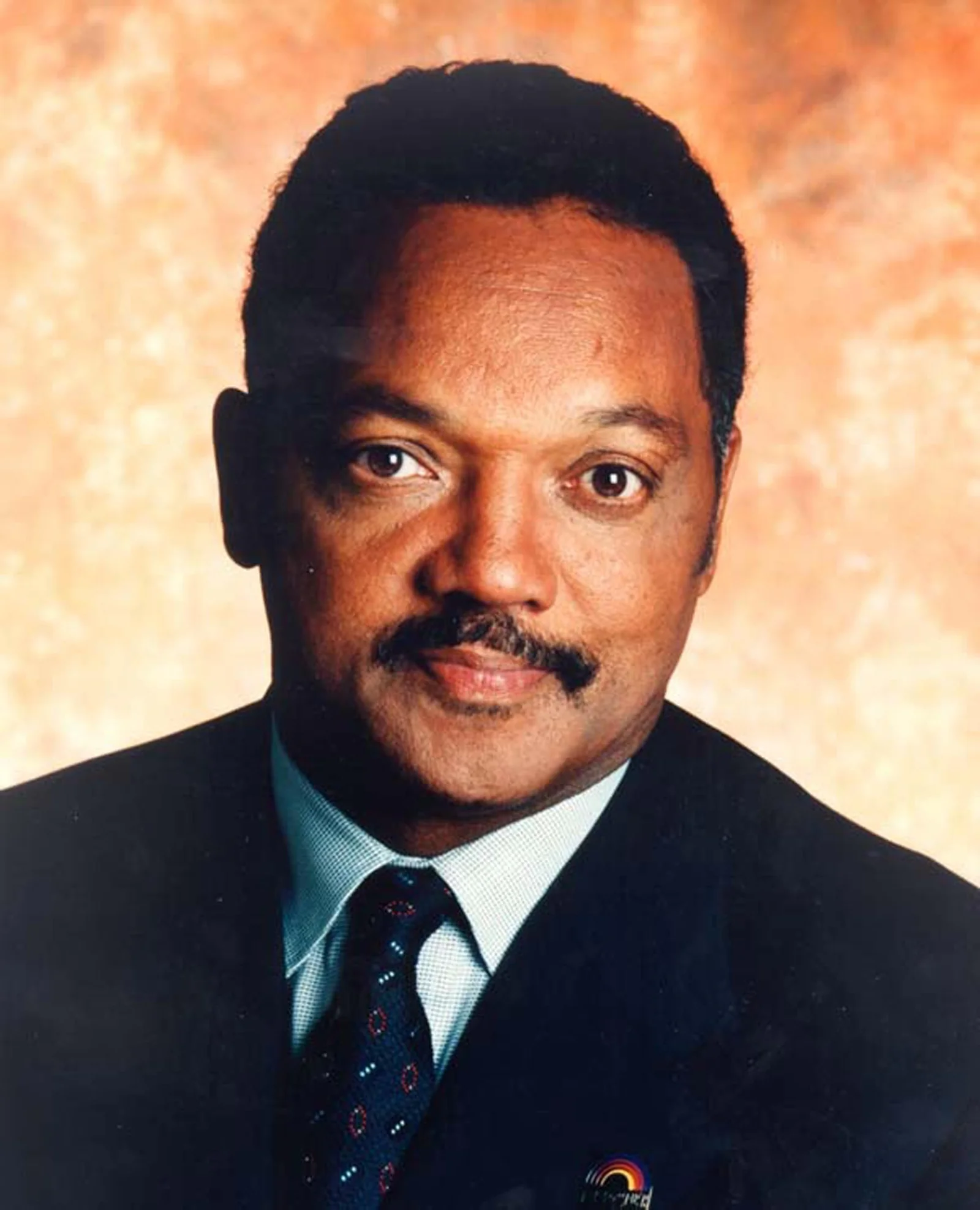
| 31 Quotes | |
| Born as | Jesse Louis Jackson |
| Occup. | Activist |
| From | USA |
| Spouse | Jacqueline Brown (1962) |
| Born | October 8, 1941 Greenville, South Carolina |
| Died | February 17, 2026 |
| Aged | 84 years |
| Cite | |
Citation Formats
APA Style (7th ed.)
Jesse jackson biography, facts and quotes. (2026, February 17). FixQuotes. https://fixquotes.com/authors/jesse-jackson/
Chicago Style
"Jesse Jackson biography, facts and quotes." FixQuotes. February 17, 2026. https://fixquotes.com/authors/jesse-jackson/.
MLA Style (9th ed.)
"Jesse Jackson biography, facts and quotes." FixQuotes, 17 Feb. 2026, https://fixquotes.com/authors/jesse-jackson/. Accessed 26 Mar. 2026.
Early Life and Background
Jesse Louis Jackson was born on October 8, 1941, in Greenville, South Carolina, into the rigid caste lines of the Jim Crow South. Raised largely by Helen Burns and later adopted by her husband, Charles Henry Jackson, he grew up amid the daily humiliations and quiet codes of survival that shaped Black life in the rural-to-small-city South. The distance between formal ideals and lived reality was not theoretical to him - it was the landscape: segregated schools, constrained opportunity, and the ever-present threat of reprisal for those who challenged the order.Jacksons early life also carried a personal undertow: the questions of legitimacy, belonging, and self-definition that often sharpen a young persons hunger for recognition and purpose. Sports offered one avenue of dignity and visibility, but it was the church and the Black civic world around it that provided a deeper script - the language of testimony, call-and-response, and moral urgency. Those formative pressures would later reappear in his public style: a preacherly cadence fused to a organizers instinct for leverage.
Education and Formative Influences
After graduating from Sterling High School in Greenville, Jackson attended the University of Illinois on a football scholarship before transferring to North Carolina Agricultural and Technical State University, where he earned a sociology degree in 1964. He moved to Chicago for theological study at Chicago Theological Seminary (without completing a degree), entering a city whose machine politics, labor traditions, and Black migration history were a living classroom. Under the gravitational pull of the Southern Christian Leadership Conference and the example of Martin Luther King Jr., Jackson absorbed the disciplines of nonviolent protest, coalition-building, and media-savvy moral argument.Career, Major Works, and Turning Points
Jackson joined Kings inner circle and became a prominent SCLC figure during the late 1960s, then founded Operation PUSH in Chicago in 1971 to press for Black economic inclusion through boycotts, hiring campaigns, and corporate negotiations; later, he formed the Rainbow Coalition (1984) to link Black voters with labor, Latinos, farmers, students, and progressive whites. His presidential bids in 1984 and 1988 were turning points: he won primaries and caucuses, registered and mobilized new voters, and pushed the Democratic Party to confront issues of poverty, apartheid in South Africa, and structural racism more directly. Alongside electoral work, he became a high-profile negotiator in hostage and prisoner-release efforts and a perpetual presence in national debates, sometimes praised for access and results, sometimes criticized for self-promotion or controversy - yet rarely ignored.Philosophy, Style, and Themes
Jacksons public philosophy joined uplift with strategy: moral appeal backed by organized pressure. He treated politics as arithmetic as much as ethics, insisting that small, disciplined groups could bend institutions - a belief captured in the maxim, “In politics, an organized minority is a political majority”. Psychologically, this reveals a mind trained not to wait for permission from the majority; it also suggests why he prioritized voter drives, delegate counts, and negotiations with corporate boards. For Jackson, symbolism mattered, but only insofar as it produced material change - jobs, contracts, representation, and policy.His rhetoric blended Black church musicality with an expansive American pluralism. “America is not a blanket woven from one thread, one color, one cloth”. This was not mere multicultural decoration; it was a political argument for coalition as a moral necessity, and it also betrayed an inner anxiety about fragmentation - the fear that communities wounded by exclusion might turn inward and lose power. Jacksons repeated insistence on hope functioned as both therapy and tactic. “Keep hope alive!” The phrase worked because it acknowledged despair as a real adversary while refusing to enthrone it - a stance rooted in a life that began under legalized humiliation and moved, through disciplined spectacle, toward national influence.
Legacy and Influence
Jesse Jacksons enduring impact lies in the infrastructure he helped normalize: modern Black-led voter mobilization, coalition-based presidential campaigning, and the expectation that corporate and political elites could be confronted publicly over inclusion. His 1980s campaigns broadened the Democratic coalitions self-conception and helped prepare the ground for later leaders who translated movement energy into electoral power. Controversies and shifting relevance over decades did not erase the central fact that he expanded the boundaries of who could plausibly run, what issues could be centered, and how moral language could be weaponized for negotiation. In the long arc of US activism, he stands as a bridge figure - from Kings era of civil rights to the era of coalition politics, media activism, and mass voter strategy.Our collection contains 31 quotes written by Jesse, under the main topics: Witty One-Liners - Motivational - Justice - Puns & Wordplay - Never Give Up.
Other people related to Jesse: Bobby Rush (Politician), Jane Byrne (Politician), Al Sharpton (Politician)
Frequently Asked Questions
- Jesse Jackson religion: He is a Baptist minister and has been associated with the Christian faith.
- Had he been hospitalized before his death? Yes. He was admitted to a hospital in November prior to his passing and had been receiving medical care related to his neurological conditions.
- Jesse Jackson cause of death? A specific cause of death was not immediately announced. His family stated that he died peacefully surrounded by loved ones.
- Jesse Jackson children: He has five children.
- Jesse Jackson young: He was born October 8, 1941, in Greenville, South Carolina, and rose to prominence as a civil rights leader in the 1960s.
- Jesse Jackson health: He announced in 2017 that he had been diagnosed with Parkinson’s disease.
- Jesse Jackson Jr: Jesse Jackson Jr. is his son and a former U.S. Representative from Illinois.
- How old was Jesse Jackson? He became 84 years old
Source / external links