
John Cage Biography Quotes 14 Report mistakes
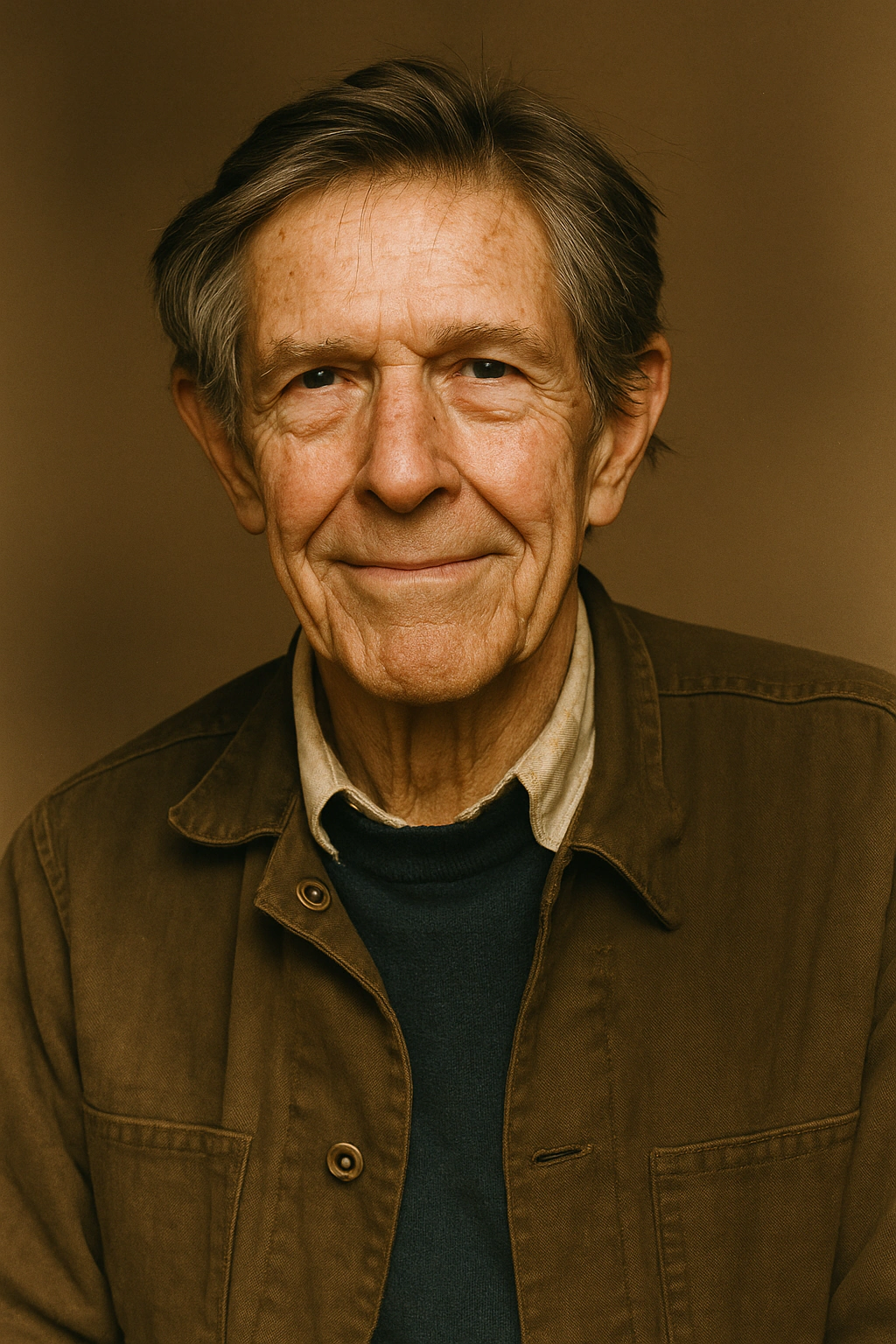
| 14 Quotes | |
| Born as | John Milton Cage Jr. |
| Occup. | Composer |
| From | USA |
| Born | September 5, 1912 Los Angeles, California, USA |
| Died | August 12, 1992 New York City, USA |
| Aged | 79 years |
| Cite | |
Citation Formats
APA Style (7th ed.)
John cage biography, facts and quotes. (2026, February 11). FixQuotes. https://fixquotes.com/authors/john-cage/
Chicago Style
"John Cage biography, facts and quotes." FixQuotes. February 11, 2026. https://fixquotes.com/authors/john-cage/.
MLA Style (9th ed.)
"John Cage biography, facts and quotes." FixQuotes, 11 Feb. 2026, https://fixquotes.com/authors/john-cage/. Accessed 2 Apr. 2026.
Early Life and Background
John Milton Cage Jr. was born on September 5, 1912, in Los Angeles, California, into an America intoxicated with machines, radio, and the promise of modernity. His father, John Milton Cage Sr., was an inventor whose restless tinkering gave the household a practical faith in experiment; his mother, Lucretia Harvey Cage, worked as a journalist and kept a keen ear for public life. Cage grew up amid Southern California's mix of booster optimism and cultural improvisation, where new industries rose beside imported European art music.From early on he was drawn less to virtuosity than to systems - how sounds and ideas could be organized, disrupted, and reorganized. The young Cage wrote and played, but he also absorbed the city's plural soundscape: traffic, engines, speech, and the bright percussion of everyday work. That porous boundary between "music" and the world's noise would become the central drama of his inner life: a desire to escape personal taste and control without abandoning rigor.
Education and Formative Influences
After graduating from Los Angeles High School, Cage attended Pomona College in Claremont (1928-1930), reading widely in literature and ideas rather than committing to a single craft; he left without a degree, then traveled in Europe, sketching, writing, and encountering modernist art before returning to California with a sharpened sense that tradition could be re-edited. In the 1930s he studied composition with Henry Cowell, and briefly with Arnold Schoenberg in Los Angeles - a decisive encounter that taught him structural discipline even as Schoenberg warned him he had "no feeling for harmony". Cage treated that not as a limitation but as liberation: if harmony was a wall, rhythm and timbre could be a door. Around him were the ferment of West Coast modernism and the broader interwar search for new forms, from Bauhaus design to abstract painting, all of which reinforced his belief that method could be reinvented.Career, Major Works, and Turning Points
Cage's early career unfolded through percussion and dance: in Seattle he formed a percussion ensemble at the Cornish School and wrote for choreographer Syvilla Fort, then moved to Chicago and New York, increasingly tied to the experimental stage. In the late 1930s and 1940s he developed the prepared piano, inserting screws, bolts, and objects between strings to turn one instrument into a miniature percussion orchestra; works such as "Sonatas and Interludes" (1946-48) gave this invention a refined, almost ritual poise. A major turning point came through his engagement with Zen Buddhism (via D.T. Suzuki) and with chance procedures - most famously using the I Ching - leading to pieces that displaced personal intention with rule-based openness. In 1952 he premiered "4'33"", a work whose "material" is the ambient sound of the performance space, and in subsequent decades he expanded his practice through the New York School milieu (with figures such as Merce Cunningham, Robert Rauschenberg, and Morton Feldman), lectures, writings, and late number pieces, while living much of his later life in New York and then in the orbit of Stony Point, dying in New York City on August 12, 1992.Philosophy, Style, and Themes
Cage's art was not a rejection of meaning but a redefinition of attention. He trained himself to distrust the reflex of taste - the quick verdict of "beautiful" or "ugly" - because it smuggled the ego back into listening. “The first question I ask myself when something doesn't seem to be beautiful is why do I think it's not beautiful. And very shortly you discover that there is no reason”. That sentence is less an aesthetic slogan than a psychological method: identify the hidden fear beneath judgment, then release it. His embrace of chance was similarly ethical. He did not use randomness to be careless, but to be honest about how much of life arrives unbidden, and how often "control" is simply a story we tell after the fact.In sound, this became a style of clear procedures and porous results: time brackets, chance-derived charts, silences that behave like frames, and instruments treated as sources rather than sacred objects. Cage's most provocative claim was that the composer need not "express" so much as facilitate hearing. “I have nothing to say, I am saying it, and that is poetry”. The paradox reveals his inward stance: he wanted to subtract the self until the world could be heard without his commentary. Even his humor served this discipline, puncturing seriousness so the listener could meet the moment as it is. “I can't understand why people are frightened of new ideas. I'm frightened of the old ones”. For Cage, the old ideas were not merely historical styles but mental habits - certainty, hierarchy, and the belief that art must stand apart from daily experience.
Legacy and Influence
Cage remains a hinge figure in postwar culture: a composer who made procedure, listening, and context into compositional materials, and in doing so re-routed the history of music. His impact runs through minimalism, sound art, conceptual art, experimental performance, and the aesthetics of recording and installation; "4'33"" became a permanent reference point in debates about silence, authorship, and the social theater of the concert hall. Equally enduring is his model of the artist as a disciplined practitioner of attention - someone who could borrow from Asian philosophy without turning it into mere exotica, collaborate across media without diluting form, and insist that the world is already sounding, if we can bear to hear it.Our collection contains 14 quotes written by John, under the main topics: Wisdom - Music - Live in the Moment - Poetry - Embrace Change.
Other people related to John: Yoko Ono (Artist), Nicolas Cage (Actor), Jasper Johns (Artist), Keith Haring (Artist), Fred Frith (Composer), Henry Flynt (Artist), Marcel Duchamp (Artist), David Tudor (Musician), Harold Budd (Composer), Bruce Nauman (Sculptor)
Frequently Asked Questions
- John Cage education: Briefly at Pomona College; studied with Henry Cowell and Arnold Schoenberg; largely self-taught.
- John Cage Music: Experimental; uses chance operations, indeterminacy, prepared piano, electronics, and ambient sound.
- John Cage compositions: Notable: 4'33, Sonatas and Interludes, Music of Changes, Imaginary Landscape No. 4, Concert for Piano and Orchestra.
- John Cage 4'33: A 1952 silent piece in three movements; performers make no intentional sounds, framing ambient noise as music.
- How old was John Cage? He became 79 years old
Source / external links