
John Carmack Biography Quotes 14 Report mistakes
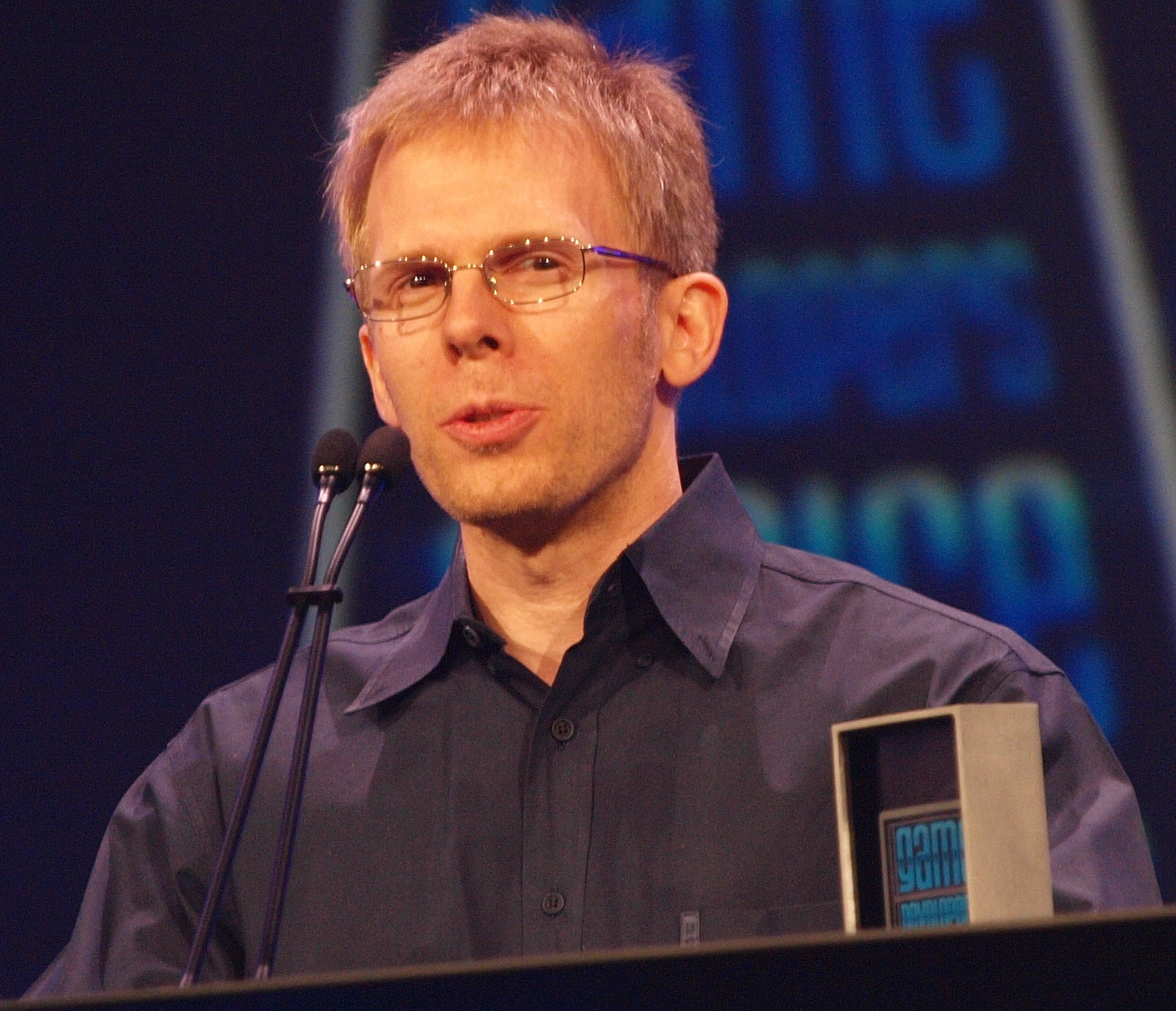
Attr: Official GDC, CC BY 2.0
| 14 Quotes | |
| Born as | John D. Carmack |
| Occup. | Scientist |
| From | USA |
| Spouse | Katherine Anna Kang (2000-2021) |
| Born | August 20, 1970 Shawnee, Oklahoma, USA |
| Age | 55 years |
| Cite | |
Citation Formats
APA Style (7th ed.)
John carmack biography, facts and quotes. (2026, February 11). FixQuotes. https://fixquotes.com/authors/john-carmack/
Chicago Style
"John Carmack biography, facts and quotes." FixQuotes. February 11, 2026. https://fixquotes.com/authors/john-carmack/.
MLA Style (9th ed.)
"John Carmack biography, facts and quotes." FixQuotes, 11 Feb. 2026, https://fixquotes.com/authors/john-carmack/. Accessed 26 Mar. 2026.
Early Life and Background
John D. Carmack was born on August 20, 1970, in Shawnee Mission, Kansas, and grew up in the Kansas City area in a late-Cold War America where personal computers were shifting from hobbyist curiosities to household machines. His childhood was marked by a mix of fascination with systems and impatience with constraints. He gravitated to any environment where rules could be tested, optimized, or bypassed, an orientation that later surfaced as a distinctive engineering temperament: allergic to ceremony, hungry for measurable progress, and convinced that most barriers were temporary misunderstandings.That temperament brought consequences. As a teenager he was involved in a break-in at a school to steal Apple II computers, an episode that resulted in time in juvenile detention. The experience did not romanticize rebellion so much as reinforce a harsh lesson about tradeoffs: the quickest path can cost years, while disciplined work compounds. Afterward, he refocused on building rather than taking, and he began treating programming as a moral practice - a way to make order, to earn autonomy, and to test himself against reality.
Education and Formative Influences
Carmack attended the University of Missouri-Kansas City briefly but left without a degree, typical of a generation of self-taught programmers for whom documentation, source code, and late-night experimentation were more compelling than formal curricula. His real education came from early PC hardware limits and the demoscene-style drive to do more with less: assembly language, memory maps, frame timing, and the hard truth that an idea did not matter unless it ran fast. By the late 1980s and around 1990, he had moved through small jobs into Softdisk in Shreveport, Louisiana, where tight schedules and modest machines forced him to develop the habits that defined him - relentless iteration, empirical testing, and a deep respect for tooling.Career, Major Works, and Turning Points
At Softdisk he met John Romero, Adrian Carmack, and Tom Hall; together they formed id Software in 1991 and helped redefine the modern video game industry with technical breakthroughs and a new distribution model. Carmack built engines that made the PC feel like a new medium: the smooth-scrolling "Commander Keen" (1990), the faux-3D speed of "Wolfenstein 3D" (1992), and the networked, mod-friendly shockwave of "Doom" (1993), followed by the true 3D architecture of "Quake" (1996) and later advances across "Quake II" (1997), "Quake III Arena" (1999), and the "Doom 3" engine (2004). He famously pushed open standards, helped popularize modding, and released key engines as open source, while also attracting controversy in an era of cultural panic about violent games. In 2013 he left id to become CTO at Oculus VR, channeling his obsession with latency and human perception into virtual reality; after Oculus was acquired by Facebook, he continued there for years, then departed to pursue independent research, including work on general AI at Keen Technologies.Philosophy, Style, and Themes
Carmack has often presented himself less as an artist than as an applied scientist of interactive systems, and that self-conception explains his career choices: he follows the most interesting constraints. His style is minimalist, instrument-driven, and grounded in the belief that progress is mostly subtraction - fewer layers, fewer assumptions, shorter feedback loops. He argues that management of attention is the core discipline: “Focus is a matter of deciding what things you're not going to do”. In his work, the philosophy becomes visible in the product - clean performance budgets, ruthless optimization, and a willingness to discard cherished features if they interfere with frame rate, responsiveness, or shipping.Psychologically, his most persistent theme is respect for fundamentals, as if ethics and efficiency meet at the same point: understand the machine, then earn every abstraction you add. That is why he has defended the craft itself as character-forming: “Low-level programming is good for the programmer's soul”. Even his notorious skepticism toward narrative in games reflects an engineer's triage rather than contempt for art; he treated story as optional compared to interaction, and he said so with provocation: “Story in a game is like a story in a porn movie. It's expected to be there, but it's not that important”. Underneath is a mind that trusts measurable experience more than prestige, and prefers problems that can be tested, timed, and improved.
Legacy and Influence
Carmack's enduring influence extends beyond any single franchise: he helped set the technical expectations for real-time 3D, multiplayer networking, and the idea that engines are platforms, not just internal tools. His public talks, code releases, and detailed technical writing trained generations of programmers to think in systems - cache coherency, latency, numerical stability, and the costs hidden inside convenient APIs. In a culture that often mythologizes innovation, he modeled a different heroism: intellectual honesty, obsessive iteration, and the belief that hard problems yield to patient measurement. Whether remembered as the quiet force behind "Doom" and "Quake" or as a driving engineer in the VR renaissance, he remains a rare figure whose biography is written in frame times, toolchains, and the conviction that reality rewards those who keep testing.Our collection contains 14 quotes written by John, under the main topics: Witty One-Liners - Motivational - Art - Science - Decision-Making.
John Carmack Famous Works
- 2011 Rage (Video game)
- 1999 Quake source code release (Software release)
- 1997 Doom source code release (Software release)
- 1997 Quake II (Video game)
- 1996 Quake (Video game)
- 1994 Doom II: Hell on Earth (Video game)
- 1993 Doom (Video game)
- 1992 Wolfenstein 3D (Video game)
- 1990 Commander Keen (series) (Video game)
Source / external links