
John F. Kennedy Biography Quotes 94 Report mistakes
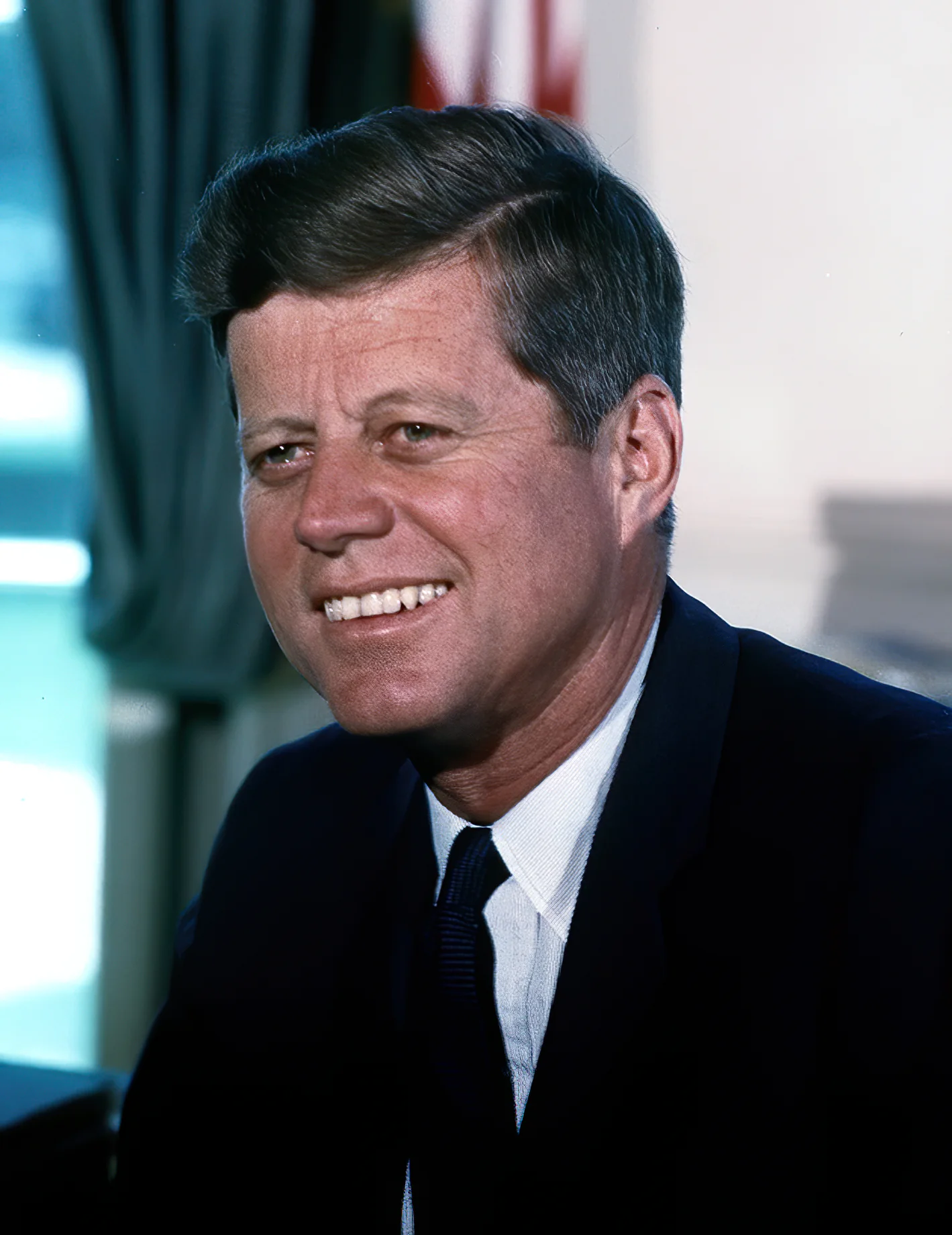
| 94 Quotes | |
| Born as | John Fitzgerald Kennedy |
| Occup. | President |
| From | USA |
| Born | May 29, 1917 Brookline, Massachusetts, U.S. |
| Died | November 22, 1963 Dallas, Texas, U.S. |
| Cause | Assassinated |
| Aged | 46 years |
| Cite | |
Citation Formats
APA Style (7th ed.)
John f. kennedy biography, facts and quotes. (2026, February 2). FixQuotes. https://fixquotes.com/authors/john-f-kennedy/
Chicago Style
"John F. Kennedy biography, facts and quotes." FixQuotes. February 2, 2026. https://fixquotes.com/authors/john-f-kennedy/.
MLA Style (9th ed.)
"John F. Kennedy biography, facts and quotes." FixQuotes, 2 Feb. 2026, https://fixquotes.com/authors/john-f-kennedy/. Accessed 5 Mar. 2026.
Early Life and Background
John Fitzgerald Kennedy was born on May 29, 1917, in Brookline, Massachusetts, into a Catholic family whose wealth and ambition made politics feel less like a profession than a destiny. His father, Joseph P. Kennedy Sr., was a financier and later a prominent Democratic insider; his mother, Rose Fitzgerald Kennedy, brought the pedigree of Boston's Irish-American political class. The household prized competition, public service, and the idea that the Kennedys were meant to do consequential things - an atmosphere that hardened vanity into drive and turned private insecurity into performance.Kennedy's early life was shaped as much by fragility as by privilege. Chronic illness - bouts of severe pain, infections, and later the back problems that would shadow him - cultivated a stoic mask and a hunger to prove vigor where he often lacked it. With an older brother, Joseph Jr., groomed as the family standard-bearer, Jack learned to win attention through wit, charm, and a cool intelligence that could disarm rivals. The 1930s, with depression at home and fascism abroad, framed his adolescence in an era when moral decisions suddenly had geopolitical weight.
Education and Formative Influences
After schooling in New England and time at the Choate School in Connecticut, Kennedy studied briefly at Princeton and then at Harvard, where he absorbed history and international relations as living forces rather than academic subjects. His father's diplomatic posting as US ambassador to the United Kingdom exposed him to European appeasement and the twilight of prewar elites; Kennedy's 1940 Harvard thesis, later published as "Why England Slept", reflected an early instinct to translate policy failure into narrative, diagnosing democratic complacency and the costs of hesitation. The blend of privileged access and skeptical observation trained him to read institutions unsentimentally, even as he publicly celebrated them.Career, Major Works, and Turning Points
World War II remade Kennedy from observer to actor: as a US Navy officer in the Pacific, he commanded PT-109 and became a hero after the boat was rammed and sunk in 1943, leading survivors to safety despite injuries - a story that fused courage with vulnerability and gave him a mythic credential without erasing the reality of pain. With Joseph Jr. killed in 1944, the family mantle shifted to Jack, who entered Congress in 1947, the Senate in 1953, and married Jacqueline Bouvier that same year, crafting a public image of youth, glamour, and seriousness. His Pulitzer-winning "Profiles in Courage" (1956) burnished an ethic of political bravery, even as his own career depended on careful coalition-building. Elected president in 1960 after televised debates that made style a new form of power, he faced immediate tests: the Bay of Pigs invasion (1961) exposed the perils of inherited plans and institutional momentum; the Cuban Missile Crisis (1962) showcased disciplined crisis management and backchannel restraint; he accelerated the space program, challenged segregation with increasing force in 1963, and pursued a limited nuclear test ban as a first step away from thermonuclear fatalism. He was assassinated in Dallas, Texas, on November 22, 1963, leaving a presidency defined as much by interruption as by achievement.Philosophy, Style, and Themes
Kennedy's governing temperament fused skepticism with moral theater. He cultivated an image of rational command - a leader who read memos like a strategist and performed leadership like an actor - yet his private life revealed a man acutely aware of contingency: health could collapse, wars could ignite, reputations could turn. That awareness made him unusually sensitive to time, risk, and escalation. He spoke in aphorisms not merely for applause but to compress complexity into portable resolve, and he relied on a tight circle of advisers while keeping emotional distance, as if intimacy might blur the calculus required in the nuclear age.His best lines map his inner life: a disciplined urgency, fear of democratic stagnation, and insistence on strength without self-pity. “We must use time as a tool, not as a couch”. That sentence reads like self-instruction as much as civic sermon - the creed of a man racing both illness and history. “Those who make peaceful revolution impossible will make violent revolution inevitable”. In context, it captures his attempt to steer reform - especially on civil rights and global decolonization - into institutions before upheaval turned explosive. And his Cold War realism could rise into existential warning: “Mankind must put an end to war before war puts an end to mankind”. The theme is not pacifism but containment of catastrophe, a belief that moral seriousness had to be paired with procedural control, secrecy, and negotiation.
Legacy and Influence
Kennedy's influence endures less as a catalog of laws than as a template for modern political imagination: televised charisma married to technocratic language, idealism framed as national security, and youth presented as capability. The "New Frontier" became an American idiom for ambition - from the Moon shot to public service - while his handling of the Cuban Missile Crisis remains a touchstone for crisis leadership under nuclear pressure. Yet the legend also provokes argument: how much was substance, how much performance, and how much unrealized possibility frozen by assassination. In that tension, Kennedy became a continuing story Americans tell about themselves - a presidency that turned history into myth while leaving enough hard evidence to keep the debate alive.Our collection contains 94 quotes written by John, under the main topics: Witty One-Liners - Motivational - Ethics & Morality - Wisdom - Truth.
Other people related to John: Aldous Huxley (Novelist), Lyndon B. Johnson (President), Edward R. Murrow (Journalist), William J. Clinton (President), Walter Cronkite (Journalist), Rose Kennedy (Author), Robert Kennedy (Politician), Lady Bird Johnson (First Lady), Robert F. Kennedy (Politician), Mort Sahl (Journalist)
Frequently Asked Questions
- How did John F Kennedy impact the world: John F. Kennedy impacted the world by advancing civil rights, establishing the Peace Corps, and aiming to land a man on the moon.
- Was John F Kennedy a Democrat: Yes, John F. Kennedy was a member of the Democratic Party.
- John F. Kennedy jr. cause of death: John F. Kennedy Jr. died in a plane crash on July 16, 1999.
- John F Kennedy age when elected: John F. Kennedy was elected president at the age of 43.
- When did John F Kennedy die: John F. Kennedy died on November 22, 1963.
- John F Kennedy siblings: John F. Kennedy had eight siblings, including Robert F. Kennedy and Ted Kennedy.
- John F Kennedy age: John F. Kennedy was born on May 29, 1917, and died on November 22, 1963, so he was 46 years old at the time of his death.
- Why was John F Kennedy a good president: John F. Kennedy was considered a good president for his leadership during the Cuban Missile Crisis, promoting civil rights, and inspiring the nation with his vision for space exploration.
- How old was John F. Kennedy? He became 46 years old
John F. Kennedy Famous Works
- 1958 A Nation of Immigrants (Book)
- 1956 Profiles in Courage (Book)
- 1940 Why England Slept (Book)