
John Kenneth Galbraith Biography Quotes 48 Report mistakes
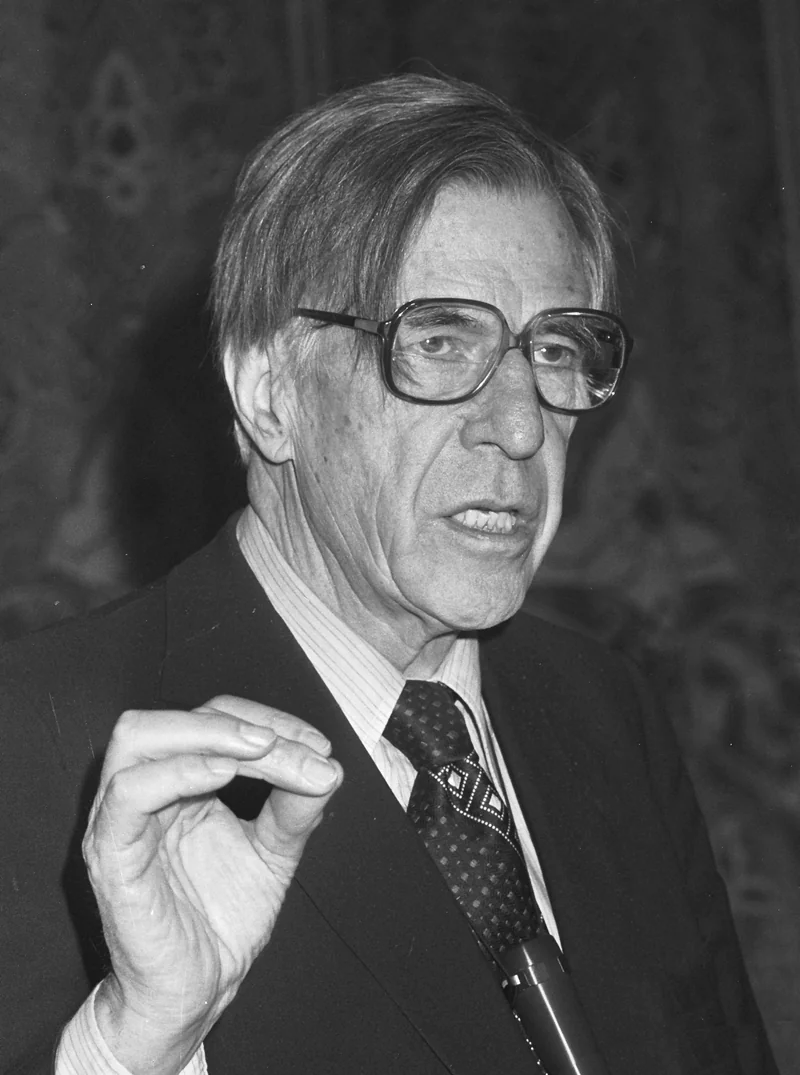
| 48 Quotes | |
| Occup. | Economist |
| From | USA |
| Born | October 15, 1908 Iona Station, Ontario, Canada |
| Died | April 29, 2006 Cambridge, Massachusetts, USA |
| Aged | 97 years |
| Cite | |
Citation Formats
APA Style (7th ed.)
John kenneth galbraith biography, facts and quotes. (2026, February 3). FixQuotes. https://fixquotes.com/authors/john-kenneth-galbraith/
Chicago Style
"John Kenneth Galbraith biography, facts and quotes." FixQuotes. February 3, 2026. https://fixquotes.com/authors/john-kenneth-galbraith/.
MLA Style (9th ed.)
"John Kenneth Galbraith biography, facts and quotes." FixQuotes, 3 Feb. 2026, https://fixquotes.com/authors/john-kenneth-galbraith/. Accessed 24 Mar. 2026.
Early Life and Background
John Kenneth Galbraith was born on October 15, 1908, on a farm near Iona Station in southwestern Ontario, Canada, to Scottish-descended parents, Sarah Catherine Kendall and Archibald "Archie" Galbraith. The household mixed hard rural work with a deep respect for education and public affairs, and the young Galbraith absorbed early lessons about scarcity, cooperation, and the social pecking order that governs who eats well and who does not. Tall, dryly funny, and observant, he grew into a temperament that distrusted cant and preferred the plain facts of power, price, and institution over moralized slogans.In 1931 he emigrated to the United States, a move that placed him inside the great drama of the Depression and the New Deal. The era mattered: mass unemployment and bank failure made it impossible to treat the economy as a self-correcting machine. Galbraith learned early that public policy was not an afterthought but a central actor - and that the confidence of elites could be as consequential as any mathematical model. Those convictions would later animate his willingness to pick fights with orthodoxy, whether in Washington, Harvard, or the corporate boardroom.
Education and Formative Influences
Galbraith studied agriculture at the Ontario Agricultural College (now part of the University of Guelph), earning a BSc in 1931, then moved to the University of California, Berkeley, for graduate work in agricultural economics, completing a PhD in 1934. Berkeley in the early 1930s was a crossroads where statistics, farm policy, and institutional economics met the political urgency of the Depression; he also encountered the emerging Keynesian revolution that re-framed unemployment as a systemic failure rather than personal defect. A Rockefeller fellowship later took him to Cambridge, where Keynesian ideas were in the air even when Keynes himself was not in the room, strengthening Galbraith's instinct that economies are governed by institutions, bargaining power, and administered prices as much as by abstract markets.Career, Major Works, and Turning Points
After teaching, Galbraith entered federal service during World War II, becoming a leading figure in the Office of Price Administration, where he confronted inflation, shortages, and the blunt necessity of controls - practical experience that shaped his lifelong suspicion of purely theoretical claims about "free" markets. In 1943 he was dismissed after political attacks, a formative bruise that hardened his view that economics is inseparable from politics. He later served at Fortune magazine, then returned to Harvard University as a prominent professor and public intellectual. His breakthrough books made him a household name: American Capitalism (1952) argued that modern markets were dominated by "countervailing power" among large firms, unions, and government; The Affluent Society (1958) criticized private abundance alongside public squalor; The New Industrial State (1967) described the rise of the managerial "technostructure"; and Economics and the Public Purpose (1973) pressed for stronger public authority over corporate planning. A trusted adviser to Democrats, he helped shape the intellectual climate around John F. Kennedy and served as US ambassador to India (1961-1963), where decolonization and development policy tested his belief that state capacity and dignity mattered as much as capital flows.Philosophy, Style, and Themes
Galbraith's economics began with a refusal to flatter the powerful. He treated capitalism not as an idealized market but as a system of organizations with advertising budgets, political leverage, and the ability to set as well as take prices. His prose - elegant, aphoristic, and amused - was a weapon: it deflated pretension and made institutional analysis readable to citizens, not only specialists. He aimed, as a matter of ethics and method, to puncture self-satisfaction: “In all life one should comfort the afflicted, but verily, also, one should afflict the comfortable, and especially when they are comfortably, contentedly, even happily wrong”. This was not mere attitude; it described his recurring psychological target - the way prosperity breeds complacency, and complacency breeds bad policy.He also distrusted the priestly aura of the discipline, especially when it became a shield for privilege. “In economics, hope and faith coexist with great scientific pretension and also a deep desire for respectability”. Behind the wit was a serious claim about motivation: economists, like other professionals, seek status, and status can bias what questions get asked. He reserved particular scorn for mystification in finance, insisting that the monetary system's power lies in its banality and in the public's reluctance to look closely: “The process by which banks create money is so simple that the mind is repelled”. In Galbraith's hands, these observations became a unified theme - that modern economies are managed by institutions whose legitimacy depends on stories, and that citizens must learn to read the stories as carefully as the statistics.
Legacy and Influence
Galbraith died on April 29, 2006, in Cambridge, Massachusetts, after a life spent arguing that democracy requires economic literacy and that economic literacy requires realism about power. He remains one of the 20th century's most influential popularizers of economic thinking and one of its most durable critics of market romanticism, widely read well beyond academia even as the profession often dismissed his lack of formal modeling. Concepts like "countervailing power", the critique of consumerism and public underinvestment, and the analysis of corporate planning anticipated later work in political economy, behavioral economics, and the study of inequality and regulatory capture. His enduring imprint is less a single theorem than a civic posture: economics as a moral and institutional inquiry, written in a style sharp enough to keep complacency from feeling safe.Our collection contains 48 quotes written by John, under the main topics: Witty One-Liners - Ethics & Morality - Truth - Wisdom - Art.