
John Le Carre Biography Quotes 39 Report mistakes
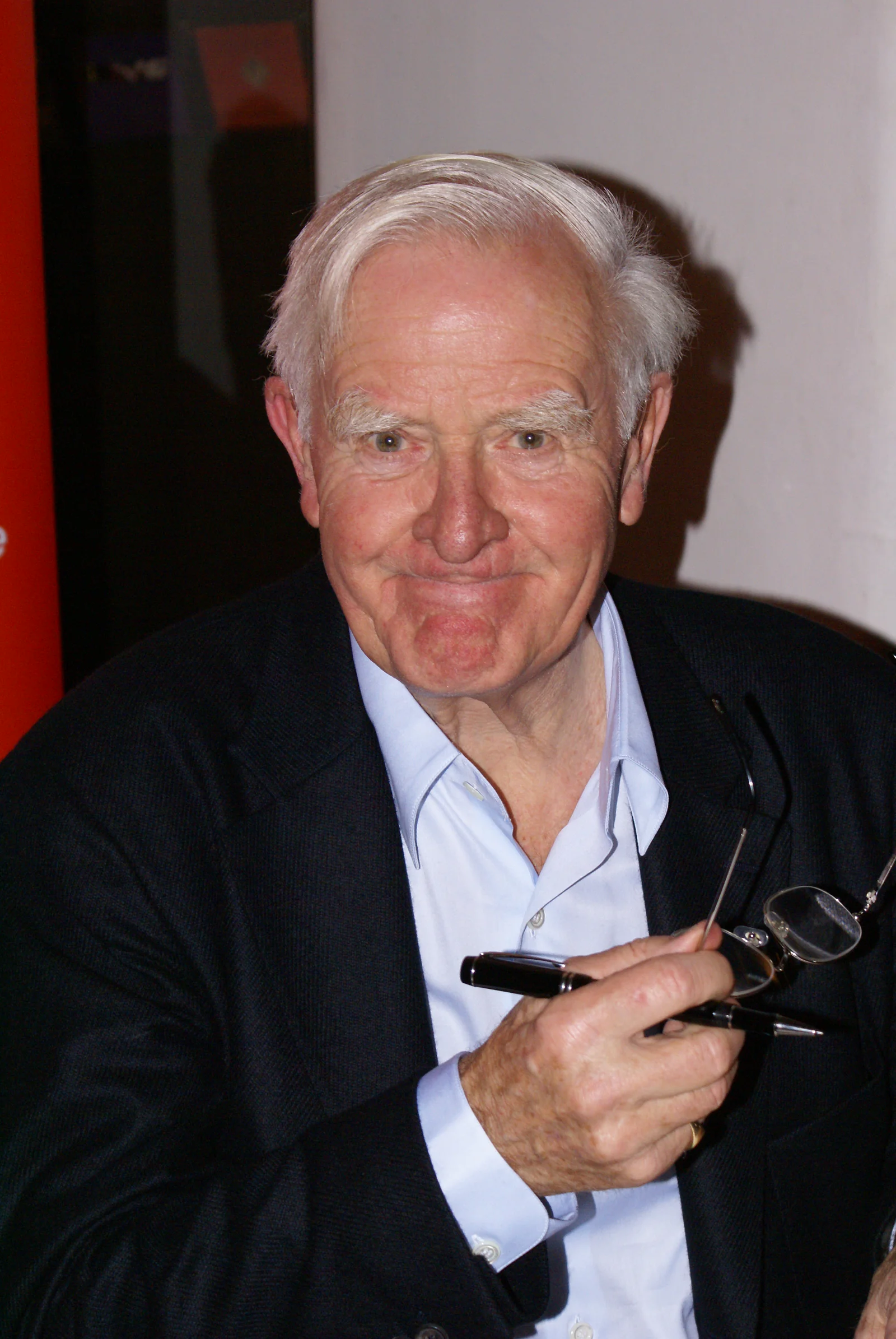
Attr: Krimidoedel, CC BY 3.0
| 39 Quotes | |
| Occup. | Author |
| From | England |
| Born | October 19, 1931 |
| Died | December 12, 2020 |
| Aged | 89 years |
| Cite | |
Citation Formats
APA Style (7th ed.)
John le carre biography, facts and quotes. (2026, February 11). FixQuotes. https://fixquotes.com/authors/john-le-carre/
Chicago Style
"John Le Carre biography, facts and quotes." FixQuotes. February 11, 2026. https://fixquotes.com/authors/john-le-carre/.
MLA Style (9th ed.)
"John Le Carre biography, facts and quotes." FixQuotes, 11 Feb. 2026, https://fixquotes.com/authors/john-le-carre/. Accessed 5 Mar. 2026.
Early Life and Background
John le Carre was born David John Moore Cornwell on October 19, 1931, in Poole, Dorset, and grew up in the long shadow of interwar England and the coming of World War II. His childhood was shaped less by steady domestic ritual than by rupture and performance. His father, Ronald Cornwell, was a charismatic con man who moved between apparent affluence and collapse, and whose schemes repeatedly upended the household. His mother, Olive, left when David was young, an absence that hardened into a lifelong emotional fact.Those early contradictions - status and shame, charm and threat, public front and private anxiety - became le Carre's first education in doubles. He learned to read rooms, to anticipate shifts in mood, and to protect an inner self behind a practiced exterior. England itself offered a matching backdrop: the faded certainties of empire, the moral seriousness of wartime, then the austere rebuilding years, all of which made questions of loyalty and belonging feel both urgent and slippery.
Education and Formative Influences
After unsettled schooling and time in Switzerland, Cornwell attended the University of Bern and later Lincoln College, Oxford. He also taught briefly at Eton, then moved into intelligence work: first with MI5 in the late 1950s, interrogating and running informants amid Cold War fear, and then with MI6 in the early 1960s, including a posting in West Germany at the edge of the divided continent. The work refined his ear for institutional language and his skepticism toward official narratives, while the era's headline betrayals - above all the Cambridge spy ring and, later, the exposure of Kim Philby - gave personal drama to national disillusion.Career, Major Works, and Turning Points
He published his early novels under the pen name "John le Carre" to protect his service: Call for the Dead (1961) introduced the weary, principled George Smiley; A Murder of Quality (1962) followed; then The Spy Who Came in from the Cold (1963) detonated expectations of the genre with its bleak moral arithmetic and made him internationally famous. Philby's revelations compromised Cornwell's cover and pushed him fully into writing, leading to The Looking Glass War (1965) and the great Karla trilogy - Tinker Tailor Soldier Spy (1974), The Honourable Schoolboy (1977), Smiley's People (1979) - anatomies of British decline and bureaucratic self-deception. After the Cold War he pivoted without losing bite: The Russia House (1989) and The Night Manager (1993) tracked new forms of power, while The Constant Gardener (2001), A Most Wanted Man (2008), Our Kind of Traitor (2010), and Agent Running in the Field (2019) confronted corporate impunity, the securitized state, and the corrosion of public trust. He died on December 12, 2020, in Cornwall, England.Philosophy, Style, and Themes
Le Carre's fiction is built on the conviction that institutions manufacture reality, and that the moral cost of serving them is paid in private. He distrusted armchair certainty, warning that “A desk is a dangerous place from which to view the world”. His realism was not documentary but psychological: the texture of tradecraft mattered because it revealed how fear and vanity shape decisions, and how secrecy turns ordinary people into actors in their own lives. The sentences are exacting, often rueful, tuned to the music of civil-service euphemism and the sudden jolt of human confession. Even his jokes carried menace, as in his view that “A committee is an animal with four back legs”. , a quip that doubles as a theory of bureaucratic evasion.At the center sits betrayal - not as a plot twist but as a condition of intimacy. Le Carre insists that “Love is whatever you can still betray. Betrayal can only happen if you love”. Smiley's marriage, agents' divided allegiances, and le Carre's own early lessons in parental unreliability all orbit this idea: devotion creates the leverage that treachery exploits. The novels return obsessively to compromised fathers, surrogate families, and the yearning for a clean moral line that never arrives. His characters cling to decency not because decency wins, but because without it the self becomes another false identity, as disposable as a legend in a passport.
Legacy and Influence
Le Carre remade the spy novel into a serious literature of modern governance, replacing glamour with paperwork, guilt, and the slow violence of compromise. His influence runs through contemporary espionage fiction, political thrillers, and prestige television, while his skepticism toward official truth helped give narrative shape to late-20th- and early-21st-century distrust in power. Yet the endurance of his work is not merely topical: he offered an ethics of attention, a way of seeing how nations rationalize harm and how individuals negotiate shame. In an era of spin and surveillance, le Carre left a body of work that reads like a moral history of the West's secret life - intimate, unsparing, and painfully plausible.Our collection contains 39 quotes written by John, under the main topics: Witty One-Liners - Ethics & Morality - Wisdom - Truth - Justice.
John Le Carre Famous Works
- 1989 The Russia House (Novel)
- 1986 A Perfect Spy (Novel)
- 1983 The Little Drummer Girl (Novel)
- 1979 Smiley's People (Novel)
- 1977 The Honourable Schoolboy (Novel)
- 1974 Tinker Tailor Soldier Spy (Novel)
- 1965 The Looking Glass War (Novel)
- 1963 The Spy Who Came in from the Cold (Novel)
- 1962 A Murder of Quality (Novel)
- 1961 Call for the Dead (Novel)
Source / external links