
John Quincy Adams Biography Quotes 10 Report mistakes
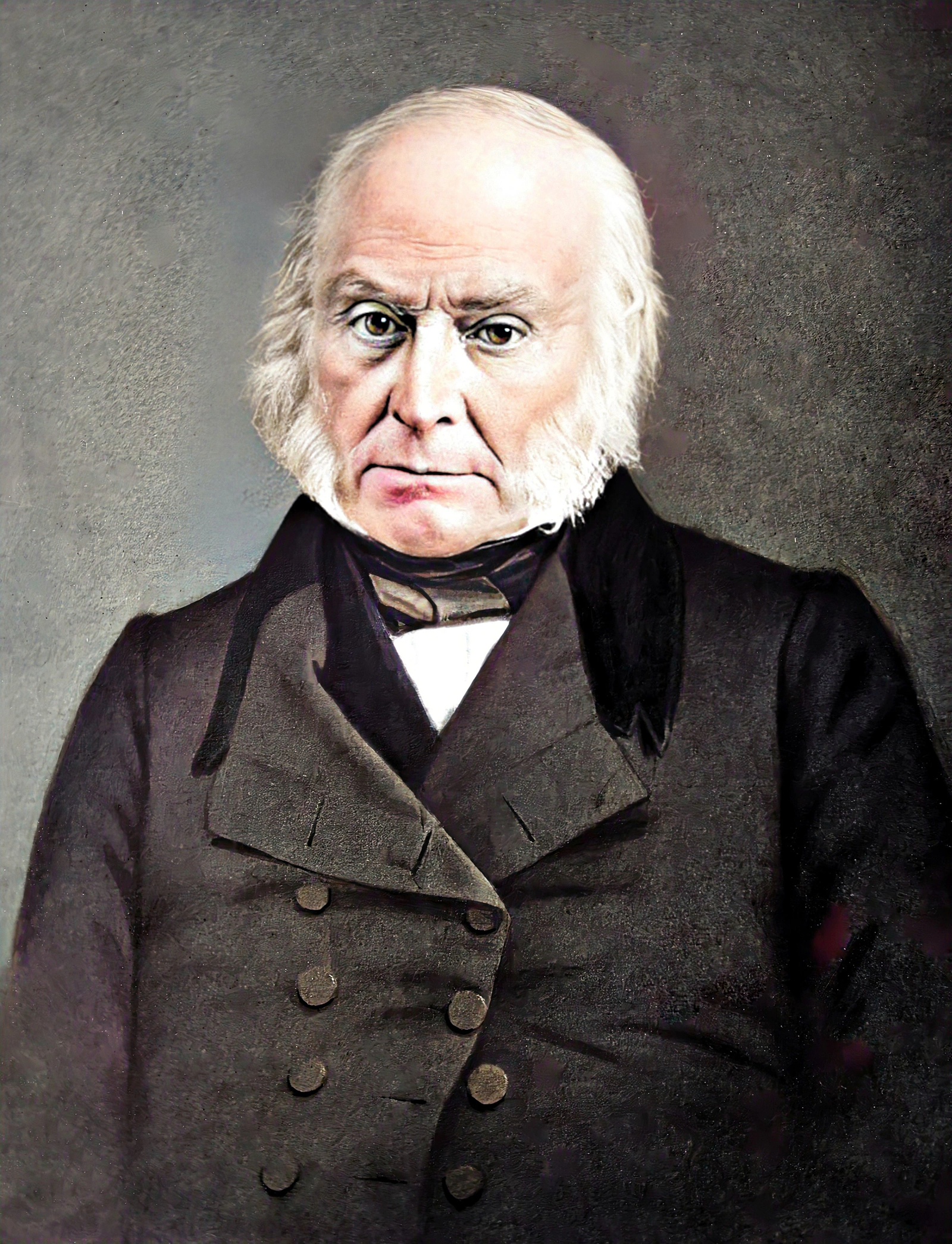
Attr: Attr.: Mathew Brady
| 10 Quotes | |
| Occup. | President |
| From | USA |
| Born | July 11, 1767 |
| Died | 1848 |
| Cite | |
Citation Formats
APA Style (7th ed.)
John quincy adams biography, facts and quotes. (2026, February 11). FixQuotes. https://fixquotes.com/authors/john-quincy-adams/
Chicago Style
"John Quincy Adams biography, facts and quotes." FixQuotes. February 11, 2026. https://fixquotes.com/authors/john-quincy-adams/.
MLA Style (9th ed.)
"John Quincy Adams biography, facts and quotes." FixQuotes, 11 Feb. 2026, https://fixquotes.com/authors/john-quincy-adams/. Accessed 26 Mar. 2026.
Early Life and Background
John Quincy Adams was born on July 11, 1767, in Braintree (now Quincy), Massachusetts, into a household where public duty was daily practice rather than abstract ideal. His father, John Adams, would become a leading revolutionary statesman and the second US president; his mother, Abigail Smith Adams, supplied the moral steel and intellectual rigor that anchored the family during war, separations, and political storms. The Revolution was not a distant event to the boy - he watched it from the edge of battle lines and through the correspondence, anxieties, and sacrifices that made independence feel both costly and unfinished.From early adolescence he lived inside diplomacy as much as domestic life. He crossed the Atlantic multiple times while still a teenager, accompanying his father on missions and learning that the new republics survival depended on discipline, credit, and alliances as much as on rhetoric. This early exposure produced a temperament both ambitious and self-scrutinizing: he carried a sense of being groomed for history, yet he also developed the lonelier habit of measuring himself against an exacting standard, recorded relentlessly in diaries that would become among the richest self-portraits of any American statesman.
Education and Formative Influences
Adams studied at Leiden in the Netherlands and later at Harvard College, graduating in 1787, then read law under Theophilus Parsons and was admitted to the Massachusetts bar in 1790. His formative influences were unusually international for an early American: European courts, republican experiments, and the realities of power politics pressed against the moral vocabulary he absorbed from New England Protestant culture and from Abigail Adams insistence on conscience. The result was a mind trained to think in systems - constitutions, treaties, balance-of-power - yet constantly pulled back toward personal rectitude and a fear of corruption in public life.Career, Major Works, and Turning Points
After early diplomatic posts in the Netherlands and Prussia, Adams became one of the nations most capable foreign-policy craftsmen: US senator from Massachusetts, minister to Russia, and a chief negotiator of the Treaty of Ghent (1814) ending the War of 1812, then minister to Britain. As secretary of state under James Monroe, he helped shape the Adams-Onis Treaty (1819), acquiring Florida and defining boundaries to the Pacific, and he authored the core ideas associated with the Monroe Doctrine. Elected president in 1824 in a bitter contest resolved by the House of Representatives, his administration (1825-1829) advanced national infrastructure and scientific projects but was politically strangled by a hostile coalition led by Andrew Jackson. The most dramatic turning point came after defeat: he returned not to private ease but to Congress, serving in the House (1831-1848) as an uncompromising opponent of slavery and of the gag rule, arguing the Amistad case before the Supreme Court in 1841 and collapsing at his desk in the Capitol before dying on February 23, 1848.Philosophy, Style, and Themes
Adams inner life was defined by a stern ethic of duty and an almost forensic attention to motive. He distrusted easy cynicism but refused sentimental faith in human nature, insisting that politics required disciplined judgment about character and temptation: “All men profess honesty as long as they can. To believe all men honest would be folly. To believe none so is something worse”. That sentence captures his psychological center - a conscience that demanded charity without naivete, and a self-awareness that treated moral failure as both personal and structural. His prose, whether in state papers or diary entries, is precise, argumentative, and often severe; he preferred the cold light of principle to the warmth of popularity.The themes that recur across his career are independence, restraint, and the long view of republican survival. In foreign policy he warned against crusading nationalism, crystallizing a doctrine of republican modesty: “America does not go abroad in search of monsters to destroy”. In domestic life he believed that citizenship was an act of conscience even when isolated, and he respected the solitary dissenter more than the convenient partisan: “Always vote for principle, though you may vote alone, and you may cherish the sweetest reflection that your vote is never lost”. His antislavery fight in the House, waged through petitions, procedural warfare, and constitutional argument, shows how he translated that ethic into practice - not as a romantic abolitionist alone, but as a constitutional moralist convinced that slavery was a corrosive power threatening the very mechanisms of free government.
Legacy and Influence
Adams endures as a paradox that clarifies the American experiment: a patrician who became a tribune, a president more admired in retrospect than in office, and a diplomat whose realism served a moral purpose. His treaties and statecraft helped secure the nations territorial and strategic footing, but his deeper legacy lies in the model of post-presidential public service and in the idea that the republic needs inconvenient consciences as much as charismatic leaders. By turning his later years into a sustained confrontation with slavery and with legislative suppression of dissent, he widened the meaning of political courage - not as spectacle, but as persistence under isolation - and left a record, in his speeches and diaries, of a mind determined to keep the nations power answerable to its principles.Our collection contains 10 quotes written by John, under the main topics: Leadership - Freedom - Honesty & Integrity - Faith - Peace.
Other people related to John: Henry Brooks Adams (Historian), William Wirt (Statesman), Andrew J. Bacevich (Educator)
John Quincy Adams Famous Works
- 1874 Memoirs of John Quincy Adams (Memoir)
- 1850 Poems of Religion and Society (Poetry)
- 1850 The Lives of James Madison and James Monroe (Biography)
- 1822 The Duplicate Letters, the Fisheries and the Mississippi (Book)
- 1821 Report upon Weights and Measures (Book)
- 1810 Lectures on Rhetoric and Oratory (Book)
Source / external links