
John Tyler Biography Quotes 5 Report mistakes
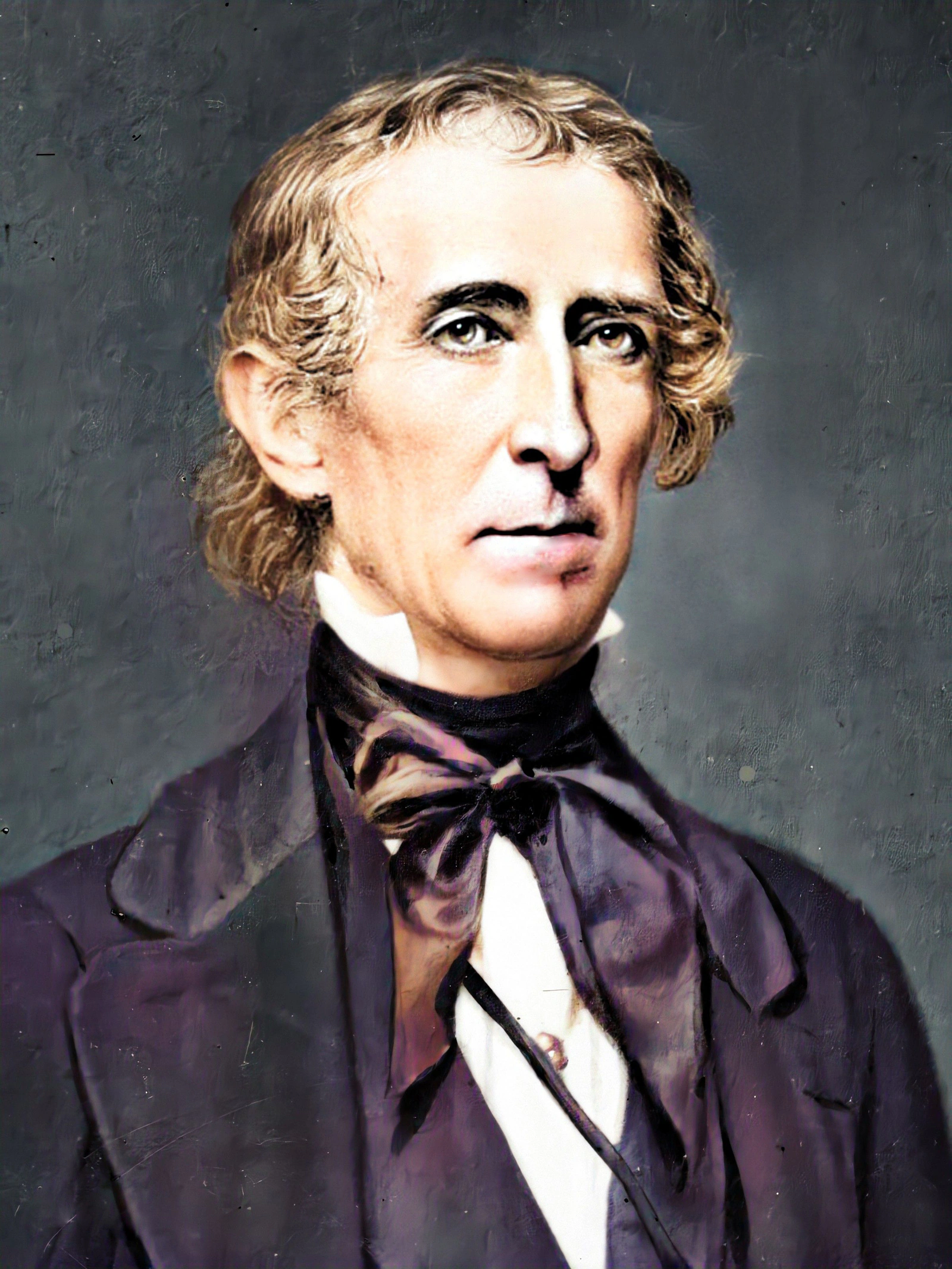
Attr: Mathew Brady
| 5 Quotes | |
| Occup. | President |
| From | USA |
| Born | March 29, 1790 Charles City County, Virginia, USA |
| Died | January 18, 1862 Richmond, Virginia, USA |
| Cause | Stroke |
| Aged | 71 years |
| Cite | |
Citation Formats
APA Style (7th ed.)
John tyler biography, facts and quotes. (2026, March 10). FixQuotes. https://fixquotes.com/authors/john-tyler/
Chicago Style
"John Tyler biography, facts and quotes." FixQuotes. March 10, 2026. https://fixquotes.com/authors/john-tyler/.
MLA Style (9th ed.)
"John Tyler biography, facts and quotes." FixQuotes, 10 Mar. 2026, https://fixquotes.com/authors/john-tyler/. Accessed 27 Mar. 2026.
Early Life and Background
John Tyler was born on March 29, 1790, at Greenway plantation in Charles City County, Virginia, into the ruling tidewater world of the early republic. His father, John Tyler Sr., was a prominent planter, judge, and governor of Virginia; his mother, Mary Armistead Tyler, died when he was young. He grew up in a household shaped by Revolutionary memory, Anglican inheritance, slave labor, and the assumptions of the Virginia gentry. That setting gave him both confidence and a lifelong political grammar: suspicion of concentrated federal power, reverence for state sovereignty, and a paternalist belief that social order rested on hierarchy. Physically slight and often in delicate health as a child, he nevertheless developed an early seriousness and a capacity for stubbornness that would define his public life.
The Virginia into which Tyler was born was losing national dominance even as it still supplied presidents and principles. He absorbed the language of Jeffersonian republicanism, but also the planter's instinct to defend local autonomy against distant authority. He married Letitia Christian in 1813, beginning a large family life that mixed affection, grief, and political strain; after her death in the White House, he later married Julia Gardiner in 1844, becoming the first sitting president to wed while in office. His domestic world was inseparable from slavery and landholding, and that fact shaped both his prosperity and his moral blind spots. Tyler's temperament was courtly but combative - personally gracious, politically unbending - a combination that repeatedly elevated him and then isolated him.
Education and Formative Influences
Tyler entered the College of William and Mary at an unusually young age and graduated in 1807. There he studied classics, rhetoric, history, and moral philosophy under the lingering intellectual influence of Bishop James Madison, whose teaching linked republican liberty with disciplined civic character. He then read law under his father and under Edmund Randolph, the former governor and U.S. attorney general, gaining a lawyer's taste for constitutional argument and a practitioner's sensitivity to jurisdiction and precedent. The crisis politics of the early nineteenth century - the embargo, the War of 1812, and the expanding conflict over federal economic policy - pushed him toward public office. Service in the Virginia House of Delegates, the U.S. House, and later the governorship and Senate hardened his identity as an Old Republican: pro-union in sentiment, anti-consolidation in doctrine, wary of banks, tariffs, and executive overreach when exercised by others, yet intensely jealous of the dignity of any office he himself occupied.
Career, Major Works, and Turning Points
Tyler's national career unfolded through paradox. In Congress he opposed much of the nationalist program associated with Henry Clay; in the Senate he even resigned rather than obey instructions from the Virginia legislature that violated his judgment, dramatizing his devotion to conscience and state-based constitutionalism. Chosen in 1840 as William Henry Harrison's running mate to balance the Whig ticket, he was expected to be politically useful and institutionally minor. Harrison's death after one month in office transformed him into the first vice president to succeed to the presidency, forcing a constitutional test: was he merely acting president, or fully president? Tyler insisted on full succession, took the oath, and established the precedent that governed until the Twenty-Fifth Amendment. That achievement was lasting; his administration was not easy. He vetoed Whig bank bills, shattered relations with Clay, and was expelled from his own party's inner circle, with most of his cabinet resigning. Yet he secured the Webster-Ashburton Treaty settling parts of the U.S.-Canada boundary, pressed a low-tariff, anti-bank constitutional vision, and, in his final major triumph, achieved the annexation of Texas by joint resolution in 1845 - a step that accelerated sectional conflict and the expansion of slavery. After the presidency he drifted toward southern particularism, chaired the failed Peace Conference of 1861, then sided with Virginia after secession and won election to the Confederate House. He died on January 18, 1862, politically exiled from the Union he had once led.
Philosophy, Style, and Themes
Tyler's inner life was organized around dignity, resistance, and a legalistic sense of honor. He did not think of politics primarily as persuasion or mass enthusiasm; he thought of it as the defense of rightful boundaries. “I can never consent to being dictated to”. That sentence captures not just his quarrel with Clay but a central psychological fact: Tyler experienced pressure as humiliation, and opposition often stiffened rather than moderated him. He was equally skeptical of applause as a guide to statesmanship: “Popularity, I have always thought, may aptly be compared to a coquette - the more you woo her, the more apt is she to elude your embrace”. This was not mere pose. He lacked the theatrical genius of Jackson and the party discipline of Polk; instead he cultivated the self-image of a man standing alone on constitutional ground, even when that solitude became politically ruinous.
That self-conception had principled and darker sides. On questions of religious liberty and conscience, Tyler could sound expansive and genuinely liberal: “Let it be henceforth proclaimed to the world that man's conscience was created free; that he is no longer accountable to his fellow man for his religious opinions, being responsible therefore only to his God”. The language reflects a real commitment to liberty of belief and suspicion of coercive orthodoxy. Yet his philosophy stopped at the color line. He defended a republic of local rights while living from enslaved labor and ultimately embracing the Confederate cause. His style in office mirrored that contradiction - ceremonious, controlled, and heavy with constitutional scruple, but narrow in sympathy. He believed government should be limited, diplomacy calm, and executive legitimacy firmly guarded; what he never fully grasped was that a constitutional order devoted to liberty could not endure while protecting human bondage as a local institution beyond moral challenge.
Legacy and Influence
Tyler's reputation has long been divided between institutional importance and political failure. He is indispensable in the history of the presidency because he settled the succession question by action, creating the "Tyler precedent" that preserved executive continuity in moments of crisis. He also helped complete the continental ambitions of the 1840s through Texas annexation, though at immense sectional cost. Historians generally rank him low because he had little party base, few durable domestic achievements, and ended by supporting disunion. Yet he remains revealing precisely because he embodied the strengths and limits of the early republic's Virginia constitutionalism: disciplined in legal argument, tenacious in defense of office, eloquent about liberty of conscience, and unable to see that states' rights, when fused to slavery, could become a doctrine of national destruction.
Our collection contains 5 quotes written by John, under the main topics: Wisdom - Freedom - Peace - Wealth.
Other people related to John: John C. Calhoun (Statesman), Caleb Cushing (Diplomat), Duff Green (Politician), Henry A. Wise (Statesman)
Source / external links