
John Updike Biography Quotes 46 Report mistakes
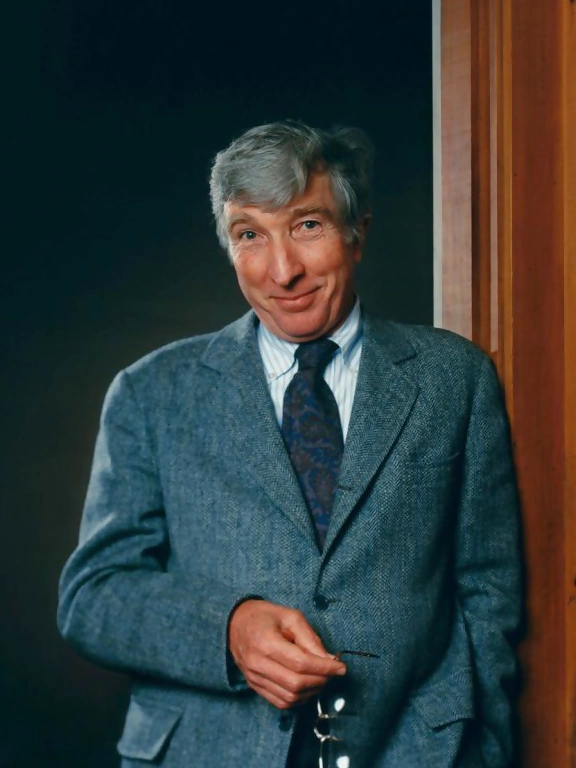
Attr: Yousuf Karsh
| 46 Quotes | |
| Born as | John Hoyer Updike |
| Occup. | Novelist |
| From | USA |
| Born | March 18, 1932 Shillington, Pennsylvania, USA |
| Died | January 27, 2009 Danvers, Massachusetts, USA |
| Cause | lung cancer |
| Aged | 76 years |
| Cite | |
Citation Formats
APA Style (7th ed.)
John updike biography, facts and quotes. (2026, February 11). FixQuotes. https://fixquotes.com/authors/john-updike/
Chicago Style
"John Updike biography, facts and quotes." FixQuotes. February 11, 2026. https://fixquotes.com/authors/john-updike/.
MLA Style (9th ed.)
"John Updike biography, facts and quotes." FixQuotes, 11 Feb. 2026, https://fixquotes.com/authors/john-updike/. Accessed 1 Apr. 2026.
Early Life and Background
John Hoyer Updike was born on March 18, 1932, in Shillington, Pennsylvania, a small-town grid of Protestant churches, post office rituals, and respectable anxieties that would become his lifelong imaginative home. His father, Wesley Russell Updike, taught high school; his mother, Linda Grace Hoyer Updike, wrote and nursed literary ambitions that her son would later recognize as both a gift and a burden. The family lived for a time on a nearby farm owned by his maternal grandparents, an experience that sharpened his eye for weather, seasons, and the tactile facts of rural labor, even as the Great Depression and then World War II framed his childhood with scarcity, rationing, and a national turn toward mass culture.Updike grew up with psoriasis and a stammer, private afflictions that encouraged inwardness and observation. He learned early how a polished surface can conceal discomfort, and how comedy can mask dread; those habits fed the cool, exacting sentences he later used to anatomize middle-class American life. By adolescence he was drawing cartoons and writing for school publications, already practicing the double vocation that never left him: to render the world precisely and to make it lightly, almost playfully, habitable.
Education and Formative Influences
He attended Harvard University (graduating in 1954), becoming president of the Harvard Lampoon and absorbing the discipline of weekly production and the social theater of elite institutions. A year at Oxford in 1954-1955 on a Knox Fellowship exposed him to English letters at close range, but his decisive apprenticeship was practical: he moved with his first wife, Mary Pennington, to Manhattan and worked for The New Yorker, where the magazine's standards of observation, elegance, and compression shaped his prose even after he left staff work in 1957 to write full time.Career, Major Works, and Turning Points
Settling in Ipswich, Massachusetts, Updike built one of the most prolific American careers of the postwar era: novels, stories, poems, essays, and criticism arriving with metronomic regularity. His early breakthrough, "Rabbit, Run" (1960), introduced Harry "Rabbit" Angstrom, whose subsequent appearances in "Rabbit Redux" (1971), "Rabbit Is Rich" (1981), "Rabbit At Rest" (1990), and the coda "Rabbit Remembered" (2001) created a rare longitudinal portrait of a man and a nation moving from Eisenhower complacency through Vietnam, sexual revolution, oil shocks, and late-century consumerism; the third and fourth novels won Pulitzer Prizes. In parallel he wrote the lyrical suburban tragedy "Couples" (1968), the scarred marital reckoning "Marry Me" (1976), the exuberant, rueful "The Witches of Eastwick" (1984), and the late-career masterpiece "The Widows of Eastwick" (2008). A turning point in his personal life came with his 1977 divorce and subsequent marriage to Martha Ruggles Bernhard (1977-1993), experiences that deepened his fiction's attention to betrayal, reinvention, and the moral lag between desire and consequence. He died on January 27, 2009, in Danvers, Massachusetts, of lung cancer.Philosophy, Style, and Themes
Updike's inner life was marked by the tension between religious metaphysics and bodily appetite. Raised Protestant and long attentive to Christian language, he wrote as if the visible world were a veil thin enough to tremble. His style is sensuous and hyper-perceptive - brand names, light on siding, the geometry of parking lots - yet always angled toward the spiritual question of what such surfaces mean. He distrusted abstraction, preferring the moral intelligence of specifics: the way a marriage sours in small humiliations, the way prosperity changes speech, posture, and politics. Even when he satirized the era's self-liberation, he refused to write as a scold; he wrote as a witness of appetite and its aftermath.Love and eros, for Updike, are both revelation and trap - a brief clearing where the self feels intensified, then endangered by time. “We are most alive when we're in love”. That line captures the voltage he assigned to infatuation: it is the moment when the ordinary American life he chronicled - commuting, cocktails, car payments - briefly flares into transcendence. Yet his characters survive by compromise more than by epiphany, clinging to continuity even as they decay: “We do survive every moment, after all, except the last one”. His art repeatedly tests whether the sacred can be found not beyond the world but inside it - in weather, skin, grief, and the stubborn continuation of days. “What art offers is space - a certain breathing room for the spirit”. In that breathing room, Updike placed his own anxiety, then translated it into sentences whose clarity can feel like courage.
Legacy and Influence
Updike endures as a defining anatomist of late-20th-century American middle-class life, especially the uneasy overlap of faith, consumer comfort, and sexual freedom. His Rabbit sequence remains a benchmark for the social novel, and his short stories - many first published in The New Yorker - shaped the modern expectation that domestic life can bear epic scrutiny. Critics have debated his blind spots, particularly his frequent centering of male desire, but even that debate testifies to the force of his example: he made the private life of ordinary Americans matter at the highest literary pitch, and he left a model of craftsmanship in which minute attention becomes moral inquiry.Our collection contains 46 quotes written by John, under the main topics: Witty One-Liners - Motivational - Ethics & Morality - Truth - Wisdom.
Other people related to John: Vladimir Nabokov (Novelist), Alfred A. Knopf (Publisher), Edward Hoagland (Author)
John Updike Famous Works
- 2002 Seek My Face (Novel)
- 2001 Rabbit Remembered (Novella)
- 1996 In the Beauty of the Lilies (Novel)
- 1990 Rabbit At Rest (Novel)
- 1986 Roger's Version (Novel)
- 1981 Rabbit Is Rich (Novel)
- 1979 Too Far to Go (Collection)
- 1971 Rabbit Redux (Novel)
- 1968 Couples (Novel)
- 1965 Of the Farm (Novel)
- 1963 The Centaur (Novel)
- 1962 Pigeon Feathers and Other Stories (Collection)
- 1961 A&P (Short Story)
- 1960 Rabbit, Run (Novel)
- 1959 The Poorhouse Fair (Novel)