
John Wesley Powell Biography Quotes 2 Report mistakes
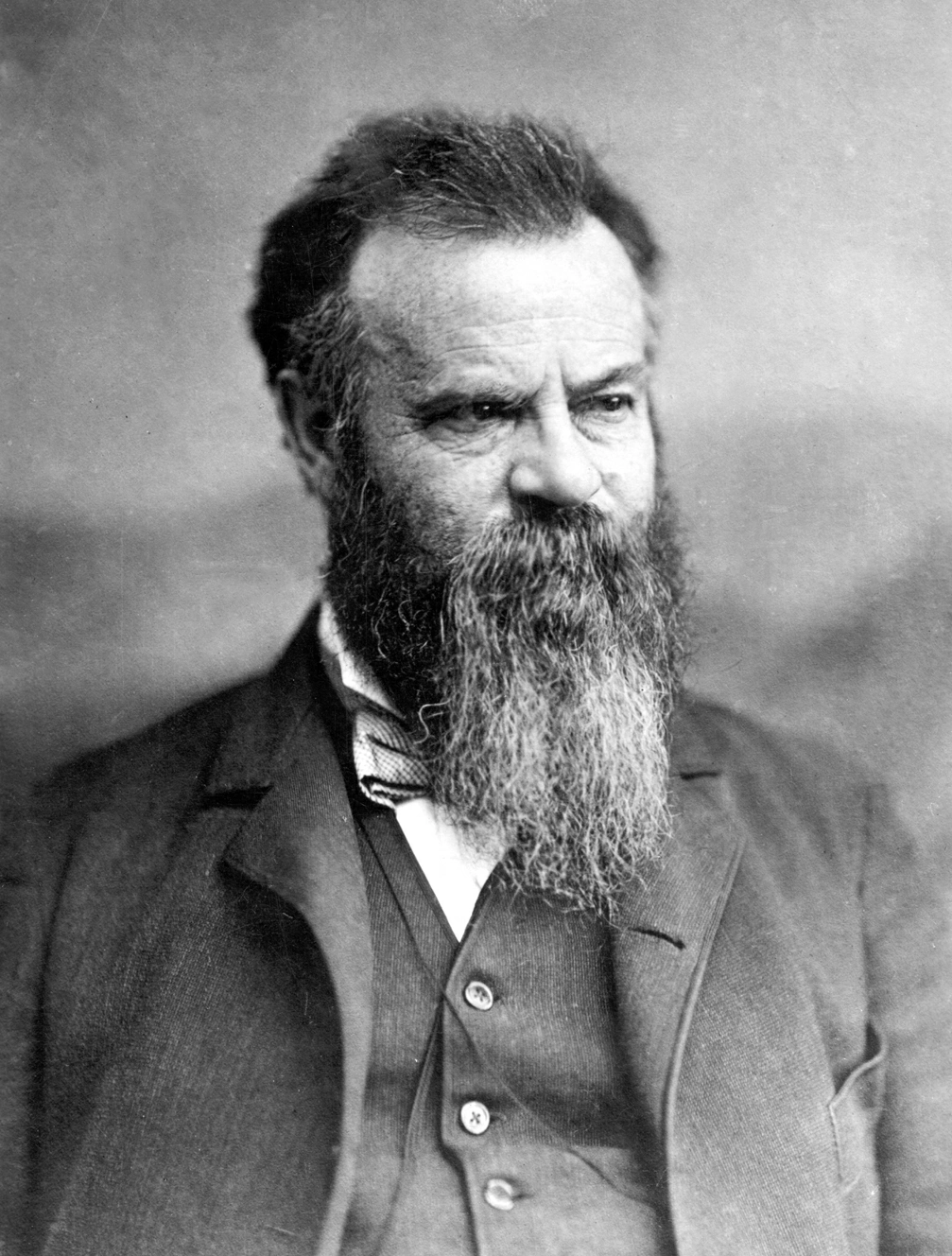
| 2 Quotes | |
| Occup. | Explorer |
| From | USA |
| Born | March 24, 1834 Mount Morris, New York |
| Died | September 23, 1902 |
| Aged | 68 years |
| Cite | |
Citation Formats
APA Style (7th ed.)
John wesley powell biography, facts and quotes. (2026, February 11). FixQuotes. https://fixquotes.com/authors/john-wesley-powell/
Chicago Style
"John Wesley Powell biography, facts and quotes." FixQuotes. February 11, 2026. https://fixquotes.com/authors/john-wesley-powell/.
MLA Style (9th ed.)
"John Wesley Powell biography, facts and quotes." FixQuotes, 11 Feb. 2026, https://fixquotes.com/authors/john-wesley-powell/. Accessed 26 Mar. 2026.
Early Life and Background
John Wesley Powell was born on March 24, 1834, in Mount Morris, New York, to Joseph Powell, an itinerant Methodist preacher, and Mary Dean Powell. The family moved repeatedly through the old Northwest - Ohio, Wisconsin, and Illinois - following the circuits and prospects of the antebellum frontier. In that mobile household, piety, self-discipline, and a belief in improvement traveled with them, as did a readiness to live close to land and water. Powell grew up amid rivers and woodlots where curiosity could be practiced as a daily habit, not an abstraction.A childhood accident cost him most of his right arm, a physical fact that hardened into an inner posture: patience under strain, and a preference for planning over bravado. By the 1850s he was a young man of the Midwest, shaped by the era's mingling of revival religion, popular science, and westward ambition. The United States was stretching toward the Rockies, yet much of the arid interior remained poorly understood by eastern institutions. Powell's early life primed him to become a translator between those worlds.
Education and Formative Influences
Powell never followed a conventional academic track, but he educated himself intensely, studying natural history and geology while attending - without taking a degree - several Midwestern colleges, including Illinois Institute and Oberlin. He learned by walking, collecting, and measuring: long field trips on the Mississippi and into the upper Midwest trained him to observe strata, plants, and waterways as connected systems. The influence of nineteenth-century geology and the Smithsonian-centered culture of American science pushed him toward careful description, while his father's moral earnestness pushed him toward public purpose - knowledge not as ornament, but as a tool for settlement and governance.Career, Major Works, and Turning Points
The Civil War made Powell an officer and veteran; he served in the Union Army, rose to brevet lieutenant colonel, and lost his arm's full function did not prevent him from command. After the war he turned fully to western science, leading expeditions in the Rocky Mountains and then the landmark 1869 and 1871-1872 descents of the Green and Colorado Rivers through the Grand Canyon region. Those voyages, executed with small boats, improvised maps, and a constant risk of wreck, established him as the era's signature river explorer. He later became a central architect of federal science: second director of the U.S. Geological Survey (1881-1894) and long-serving head of the Bureau of Ethnology at the Smithsonian (1879-1902). His major books - Report on the Lands of the Arid Region of the United States (1878) and Canyons of the Colorado (1895) - translated field experience into policy arguments about water, land, and the limits of humid-world assumptions in the West.Philosophy, Style, and Themes
Powell wrote like a man who trusted measurement but never forgot awe. His descriptions of canyon country are notable for refusing easy mastery, insisting that the landscape exceeds the usual instruments of capture: “The wonders of the Grand Canyon cannot be adequately represented in symbols of speech, nor by speech itself. The resources of the graphic art are taxed beyond their powers in attempting to portray its features. Language and illustration combined must fail”. Psychologically, this is not surrender but discipline - a check on ego, and a reminder that even authoritative report-writing has boundaries. The explorer in him wanted to name and classify; the witness in him kept an admission of the sublime on the page.That tension also shaped his leadership style. Before entering the canyon, he framed the journey as a wager with uncertainty rather than a parade of certainty: “We have an unknown distance yet to run, an unknown river to explore. What falls there are, we know not; what rocks beset the channel, we know not; what walls ride over the river, we know not. Ah, well! we may conjecture many things”. The sentence reads like self-talk for fear management - cataloging dangers, then converting them into a problem that method can face. Across his writings, the theme is adaptation: societies must adjust their institutions to ecology. In the arid West, he argued, rainfall would not support the Jeffersonian grid of small farms by default; irrigation, watershed-scale planning, and cooperative water law were necessities, not options. Even in his ethnological work with Indigenous languages and societies, his best moments tried to record complexity rather than flatten it, though his position within federal systems always carried the era's paternalism.
Legacy and Influence
Powell died on September 23, 1902, in Maine, having helped professionalize American geology and ethnology and having turned a perilous river journey into a national story. His maps and reports fixed the Colorado Plateau in the scientific imagination, while his arid-lands warnings became more relevant with every drought cycle and water-rights conflict in the Colorado River Basin. Later conservationists and water planners drew on his watershed logic, and historians read him as a figure who saw - earlier than most - that the West's central fact was scarcity managed through institutions. He endures as both symbol and warning: the explorer who proved the canyon could be run, and the administrator who insisted the nation could not run from hydrology.Our collection contains 2 quotes written by John, under the main topics: Nature - Adventure.
Other people related to John: David Lavender (Historian), James Mooney (Scientist)
John Wesley Powell Famous Works
- 2001 Seeing Things Whole: The Essential John Wesley Powell (Book)
- 1895 Canyons of the Colorado (Book)
- 1875 Exploration of the Colorado River of the West and its Tributaries (Book)
- 1869 Introduction to the Study of Indian Languages (Book)
Source / external links