
John Wycliffe Biography Quotes 4 Report mistakes
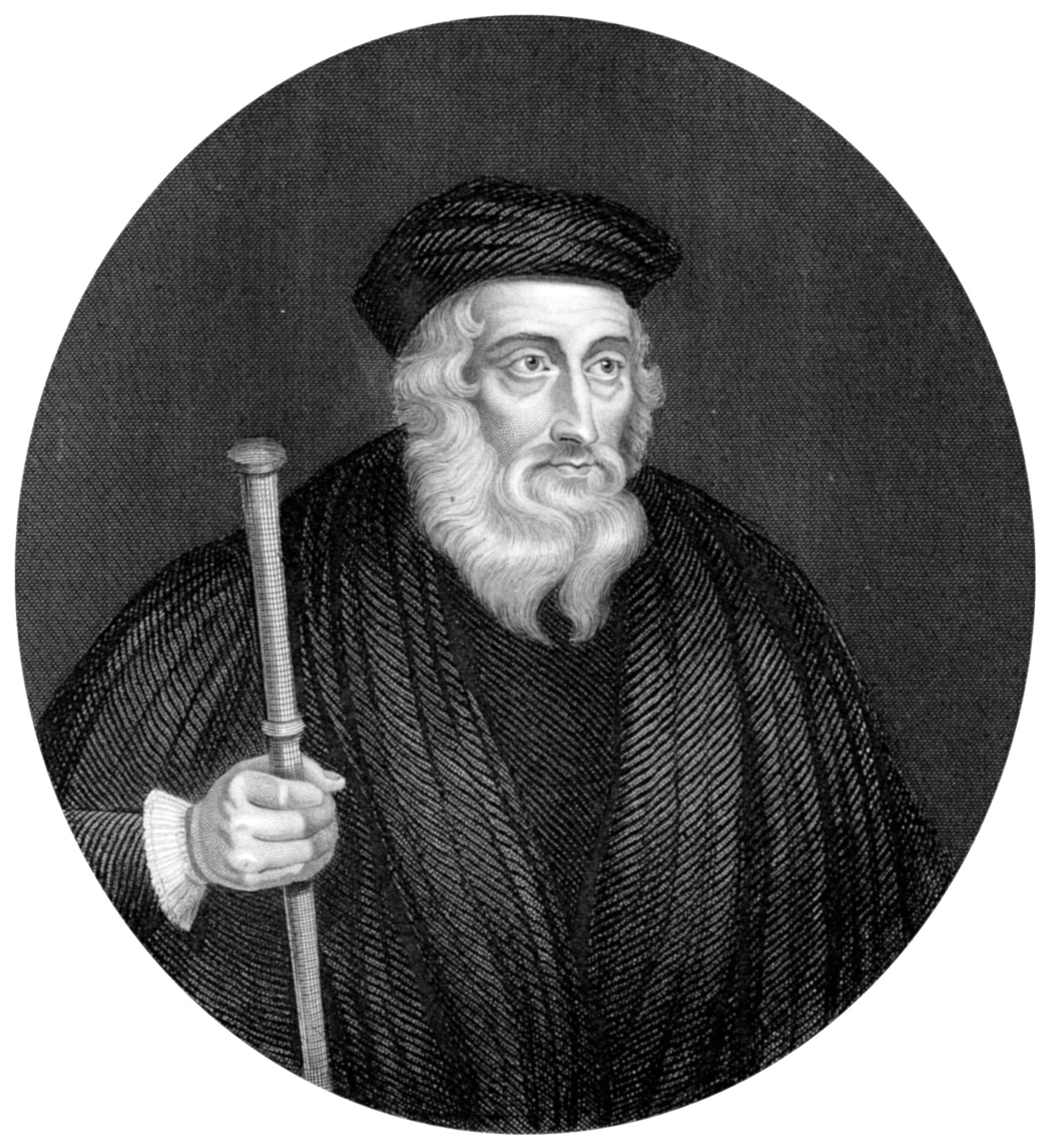
| 4 Quotes | |
| Known as | Wyclif, Wycliff, Wiclef, Wicliffe, or Wickliffe |
| Occup. | Theologian |
| From | England |
| Born | 1328 AC Ipreswell, England |
| Died | December 31, 1384 Lutterworth, England |
| Cite | |
Citation Formats
APA Style (7th ed.)
John wycliffe biography, facts and quotes. (2026, February 11). FixQuotes. https://fixquotes.com/authors/john-wycliffe/
Chicago Style
"John Wycliffe biography, facts and quotes." FixQuotes. February 11, 2026. https://fixquotes.com/authors/john-wycliffe/.
MLA Style (9th ed.)
"John Wycliffe biography, facts and quotes." FixQuotes, 11 Feb. 2026, https://fixquotes.com/authors/john-wycliffe/. Accessed 31 Mar. 2026.
Early Life and Background
John Wycliffe was born around 1328 in Yorkshire, England, near the village of Hipswell by Richmond, during the long shadow of the Hundred Years' War and the dislocations of the Black Death. His early world was one where plague thinned parishes, land changed hands abruptly, and resentment toward clerical privilege hardened into political argument. Out of that turbulence emerged a mind unusually attuned to authority - who possessed it, on what grounds, and what happened when it failed.England in Wycliffe's youth was ruled by Edward III and then shaped by the minority and early reign of Richard II, an era of ambitious taxation, papal financial demands, and a church that could look, to lay eyes, more like a great landlord than a shepherd. Wycliffe's later ferocity was not that of an outsider: it was the alarm of an insider convinced that the spiritual credibility of Christian society depended on reform that reached into property, preaching, and the machinery of power.
Education and Formative Influences
He rose through Oxford, probably at Balliol College, becoming one of the university's most formidable scholastic theologians and philosophers. Oxford trained him in logic and the contested metaphysics of the day, including debates about universals and the nature of dominion - questions that could be made explosively practical in a world where bishops held castles and kings claimed sacred sanction. By the early 1360s he was a master of arts; he later earned the doctorate in theology and held prominent posts, including as master of Balliol (traditionally dated to 1361). Intellectual formation and institutional proximity combined to give him a rare vantage point: he could speak as a learned churchman while diagnosing the church as a system.Career, Major Works, and Turning Points
Wycliffe's public career sharpened in the 1370s, when he became increasingly involved in disputes between the English crown and the papacy over appointments, taxation, and jurisdiction. He served as a royal diplomat in 1374 at Bruges in negotiations concerning papal provisions, and he developed a theory that linked spiritual legitimacy to moral standing, arguing that chronic sin voided claims to lordship and that the church should be poor in the apostolic sense. His controversial writings - including De Civili Dominio, De Ecclesia, and later De Veritate Sacrae Scripturae - attacked the accumulation of ecclesiastical wealth, the coercive use of excommunication, and what he saw as a drift from Scripture toward human tradition. In 1377 Pope Gregory XI issued bulls condemning propositions associated with him; he was examined in London and again at Oxford. After 1381, the year of the Peasants' Revolt (with which his followers were often associated, fairly or not), pressure intensified; in 1382 the Oxford "Earthquake Synod" condemned his teachings, and he withdrew to his parish living at Lutterworth. There he continued to write, to organize a preaching program later labeled "Lollard", and to press his most incendiary doctrinal claim: a rejection of transubstantiation, asserting instead a form of "remanence" that put him at odds with the central sacramental consensus of Latin Christianity. He died on 1384-12-31 at Lutterworth after a stroke.Philosophy, Style, and Themes
Wycliffe's inner life reads as a collision between scholastic precision and prophetic urgency. He believed institutions were accountable to realities deeper than themselves: truth, Scripture, and the moral demands of Christ. The engine of his reform was not mere anticlericalism but a theological psychology that treated corruption as a spiritual epistemology - sin did not only deform behavior, it darkened judgment and made officials cling to power as compensation. “The higher the hill, the stronger the wind: so the loftier the life, the stronger the enemy's temptations”. In that sentence Wycliffe revealed his own self-understanding: reformers would be tested not only by enemies outside but by the inner temptations of prominence, resentment, and fear.His style alternated between tightly argued Latin treatise and bracing vernacular plainness, with Scripture as court of appeal. He envisioned a church re-centered on preaching and pastoral care, and he treated ministry as a gift grounded in divine authorization rather than mere office: “In order to the existence of such a ministry in the Church, there is requisite an authority received from God, and consequently power and knowledge imparted from God for the exercise of such ministry; and where a man possesses these, although the bis”. The fragment captures his recurring theme - that sacramental and pastoral power was not magic in the hands of a morally indifferent hierarchy, but responsibility under God. His insistence that biblical truth could outlast coercion steadied him under censures and hearings: “I believe that in the end the truth will conquer”. That confidence fueled the movement for an English Bible associated with his circle - likely translated by colleagues such as Nicholas of Hereford and later revised by John Purvey - a project that implied not only linguistic access but a redistribution of interpretive authority toward the laity.
Legacy and Influence
Wycliffe became, long after his death, a symbol of pre-Reformation dissent: honored by later Protestants as a "morning star", feared by church authorities as a seedbed of heresy, and studied by historians as a case where university theology met social strain. The Council of Constance condemned him posthumously in 1415; in 1428 his remains were exhumed and burned, the ashes cast into the River Swift - a punitive ritual that inadvertently advertised the durability of his memory. Lollardy endured in England through the fifteenth century, and Wycliffe's arguments about Scripture, lordship, and clerical poverty echoed across Europe, influencing reform currents that reached Jan Hus and, eventually, the wider Reformation. His enduring impact lies less in a single doctrine than in a posture: the conviction that the church must submit its power to the judgment of Scripture and moral truth, even when that demand unsettles an entire society.Our collection contains 4 quotes written by John, under the main topics: Truth - Wisdom - Freedom - God.
Other people related to John: Jan Hus (Philosopher), Robert Vaughan (Author)
Source / external links