
Jorge Luis Borges Biography Quotes 31 Report mistakes
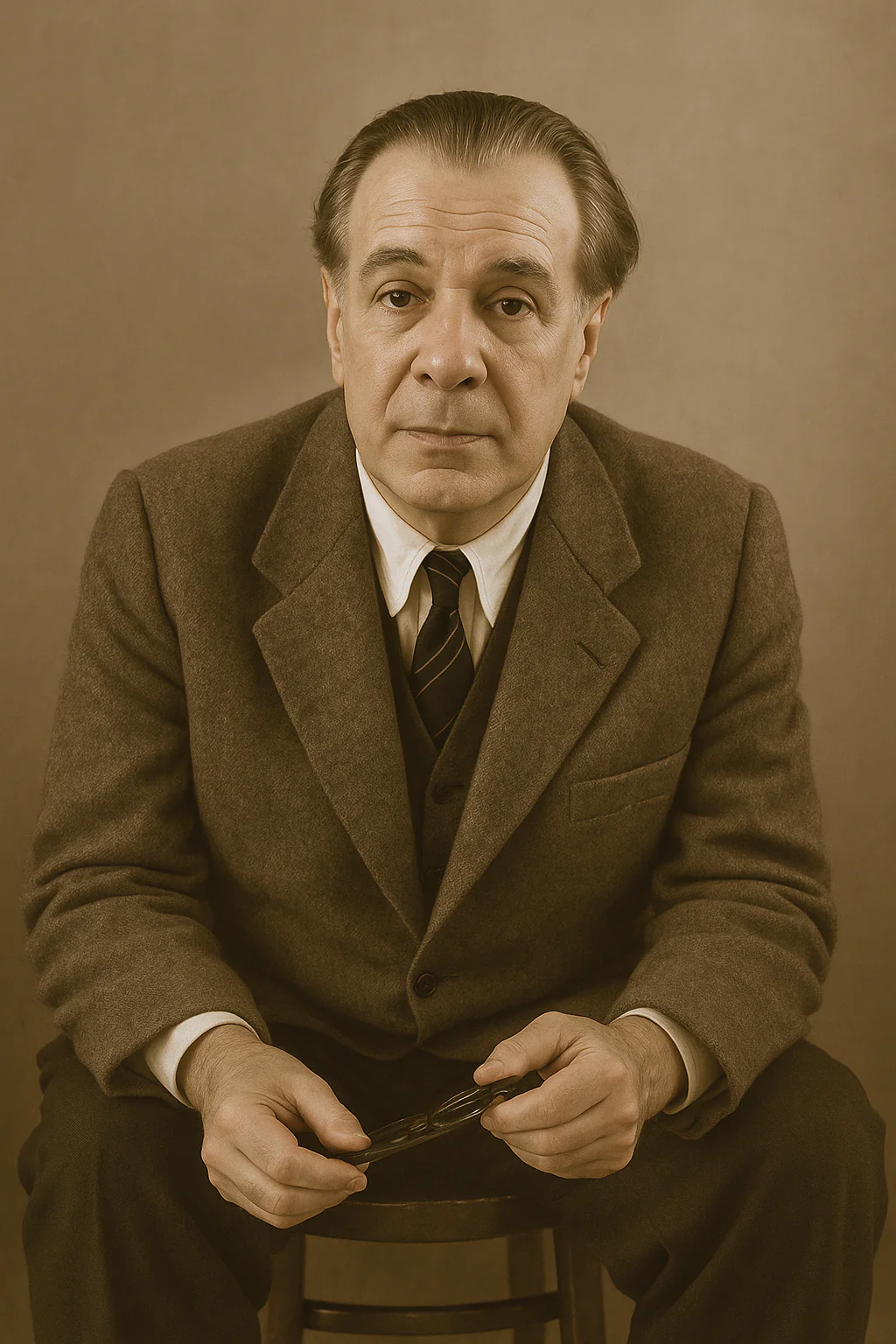
Attr: Grete Stern
| 31 Quotes | |
| Born as | Jorge Francisco Isidoro Luis Borges Acevedo |
| Occup. | Poet |
| From | Argentina |
| Born | August 24, 1899 Buenos Aires, Autonomous City of Buenos Aires, Argentina |
| Died | June 14, 1986 Geneva, Canton of Geneva, Switzerland |
| Cause | Liver cancer |
| Aged | 86 years |
| Cite | |
Citation Formats
APA Style (7th ed.)
Jorge luis borges biography, facts and quotes. (2026, February 11). FixQuotes. https://fixquotes.com/authors/jorge-luis-borges/
Chicago Style
"Jorge Luis Borges biography, facts and quotes." FixQuotes. February 11, 2026. https://fixquotes.com/authors/jorge-luis-borges/.
MLA Style (9th ed.)
"Jorge Luis Borges biography, facts and quotes." FixQuotes, 11 Feb. 2026, https://fixquotes.com/authors/jorge-luis-borges/. Accessed 5 Mar. 2026.
Early Life and Background
Jorge Francisco Isidoro Luis Borges Acevedo was born on 1899-08-24 in Buenos Aires, Argentina, into a family that turned private life into a workshop of words. His father, Jorge Guillermo Borges, a lawyer and psychology teacher with literary ambitions, filled the house with English books; his mother, Leonor Acevedo, became his lifelong amanuensis. From early childhood Borges moved between Spanish and English, absorbing the cadence of Stevenson and Kipling alongside the legends, knife-fights, and patios of the Rio de la Plata.The Buenos Aires of his youth was modernizing fast, but it still had edges - the arrabales, the railway lots, the half-rural outskirts where compadritos and criollo mythologies lingered. Those borders became his inner geography: honor and bravado, labyrinthine streets, the melancholy of places about to vanish. Even before he wrote about them, he experienced them as a tension between inherited European books and the local violence and nostalgia that haunted Argentine identity.
Education and Formative Influences
Borges was educated largely at home, then at the Colegio Nacional de Buenos Aires, but his decisive schooling came from travel and language. In 1914 his family went to Europe and was stranded by World War I; in Geneva he studied at the College de Geneve, learned French and German, and read Schopenhauer, Berkeley, and the symbolists. After the war he lived in Spain, joining the ultraista avant-garde and publishing manifestos and poems, before returning to Buenos Aires in 1921 with a program: renew Argentine literature without abandoning its streets, and make metaphysics speak in the accent of the suburbs.Career, Major Works, and Turning Points
Back in Argentina he published the poetry collection Fervor de Buenos Aires (1923), followed by Luna de enfrente (1925) and Cuaderno San Martin (1929), then the essays of Inquisiciones and El tamano de mi esperanza, building a reputation for fierce intelligence and local devotion. A near-fatal accident in 1938 - a head wound that led to septicemia - became a turning point; during recovery he began writing the fictions that made him singular: the stories later gathered in Ficciones (1944) and El Aleph (1949). As a librarian at the Miguel Cane branch he lived among catalogues and shadows, while Argentina lurched through coups and Peronism; his anti-Peronist stance cost him his library job and he was mockingly appointed a poultry inspector, pushing him toward lecturing and international visibility. Progressive hereditary blindness deepened through the 1950s; in 1955, after Peron fell, he was named director of the National Library, a cruelly apt honor for a man who could no longer read. With Adolfo Bioy Casares he wrote brilliant parodies and detective fictions; later works such as El hacedor (1960), El informe de Brodie (1970), and El libro de arena (1975) show a late style that is sparer but no less metaphysical. He traveled widely, declined the Nobel despite repeated candidacy, and in 1986 moved to Geneva, where he died on 1986-06-14.Philosophy, Style, and Themes
Borges wrote like a skeptic who loved enchantment: a mind trained by idealism and philology, yet moved by knives, tango, and the ethics of courage. His signature method was the short form that behaves like an infinite machine - a story that reads like an essay, an essay that turns into a fable. He treated libraries, mirrors, and encyclopedias as psychological spaces where identity dissolves into reading, and where authorship becomes a collaboration with tradition. “Writing is nothing more than a guided dream”. The line reveals his inner discipline: imagination, yes, but shepherded by form, quotation, and the pleasure of constraint, as if the unconscious needed a map to become art.Time, for Borges, was not a backdrop but a pressure on the self, producing both terror and freedom. “Time is the substance from which I am made. Time is a river which carries me along, but I am the river; it is a tiger that devours me, but I am the tiger; it is a fire that consumes me, but I am the fire”. In that paradox lies his psychology - the desire to outwit mortality by turning the self into pattern, into language that can be reread. Translation and re-writing were not secondary acts but proofs that originality is unstable; his famous reimagining of authorship, from "Pierre Menard, Author of the Quixote" to his constant self-revisions, culminates in the aphorism “The original is unfaithful to the translation”. Borges used such reversals to dramatize how memory edits reality, how nations invent epics, and how a man with failing sight can still build worlds from the murmured echoes of books.
Legacy and Influence
Borges changed the trajectory of world literature by proving that metaphysics could be narrated with the velocity of a detective story and the elegance of a lyric. He became a foundational figure for Latin American modernism and a key precursor to postmodern fiction, influencing writers from Julio Cortazar and Gabriel Garcia Marquez to Umberto Eco, Italo Calvino, and countless anglophone short-story stylists. His concepts - the labyrinth as structure, the infinite library, the counterfeit scholar, the double, the book that contains all books - migrated into philosophy, film, and contemporary theories of intertextuality. In Argentina he remains both beloved and contested: a cosmopolitan who made the suburbs eternal, a political conservative whose artistic radicalism expanded what a poem and a story could be.Our collection contains 31 quotes written by Jorge, under the main topics: Witty One-Liners - Ethics & Morality - Wisdom - Truth - Art.
Other people related to Jorge: Alex Cox (Director), James Laughlin (Poet)
Frequently Asked Questions
- Jorge Luis Borges Labyrinths: A 1962 English-language collection of stories and essays, published by New Directions.
- Jorge Luis Borges awards: Formentor Prize (1961); Jerusalem Prize (1971); Cervantes Prize (1979).
- Short stories by Jorge Luis Borges: The Library of Babel; The Garden of Forking Paths; The Aleph; Death and the Compass; The South.
- Jorge Luis Borges born: August 24, 1899, Buenos Aires, Argentina.
- Jorge Luis Borges famous works: Ficciones; The Aleph; The Library of Babel; The Garden of Forking Paths; Tlön, Uqbar, Orbis Tertius.
- Jorge Luis Borges death: June 14, 1986, in Geneva, Switzerland.
- Jorge Luis Borges - poemas: Fervor de Buenos Aires; Luna de enfrente; El otro, el mismo; El hacedor; El oro de los tigres.
- Jorge Luis Borges books: Ficciones; El Aleph; The Book of Sand (El libro de arena); Historia universal de la infamia; Labyrinths (English anthology).
- How old was Jorge Luis Borges? He became 86 years old
Jorge Luis Borges Famous Works
- 1980 Siete noches (Essay)
- 1975 El libro de arena (Collection)
- 1972 El oro de los tigres (Poetry)
- 1970 El informe de Brodie (Collection)
- 1967 El libro de los seres imaginarios (Non-fiction)
- 1964 El otro, el mismo (Poetry)
- 1960 El hacedor (Collection)
- 1952 Otras inquisiciones (Essay)
- 1949 El Aleph (Collection)
- 1944 Ficciones (Collection)
- 1935 Historia universal de la infamia (Collection)
- 1932 Discusión (Essay)
- 1930 Evaristo Carriego (Biography)
- 1929 Cuaderno San Martín (Poetry)
- 1925 Luna de enfrente (Poetry)
- 1925 Inquisiciones (Essay)
- 1923 Fervor de Buenos Aires (Poetry)
Source / external links