
Joseph Conrad Biography Quotes 48 Report mistakes
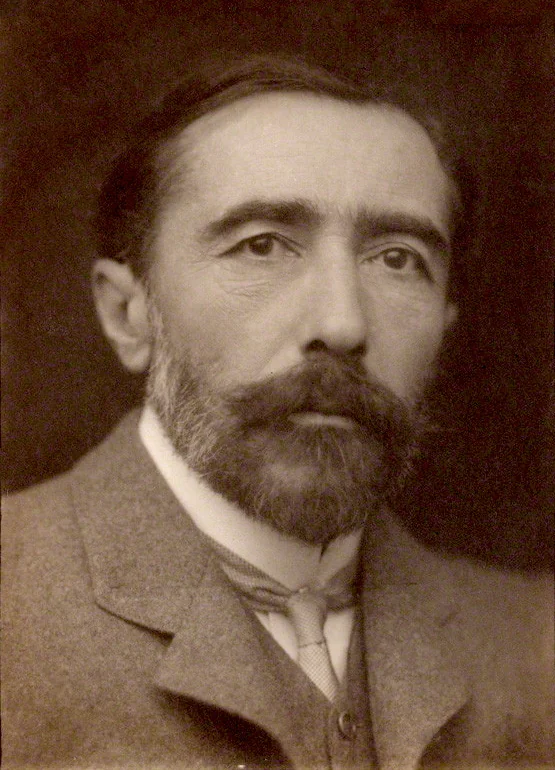
| 48 Quotes | |
| Born as | Jozef Teodor Konrad Korzeniowski |
| Occup. | Novelist |
| From | Poland |
| Born | December 3, 1857 |
| Died | August 3, 1924 |
| Aged | 66 years |
| Cite | |
Citation Formats
APA Style (7th ed.)
Joseph conrad biography, facts and quotes. (2026, February 11). FixQuotes. https://fixquotes.com/authors/joseph-conrad/
Chicago Style
"Joseph Conrad biography, facts and quotes." FixQuotes. February 11, 2026. https://fixquotes.com/authors/joseph-conrad/.
MLA Style (9th ed.)
"Joseph Conrad biography, facts and quotes." FixQuotes, 11 Feb. 2026, https://fixquotes.com/authors/joseph-conrad/. Accessed 5 Mar. 2026.
Early Life and Background
Jozef Teodor Konrad Korzeniowski was born on December 3, 1857, in Berdychiv in the Russian Empire (now Ukraine), to a Polish gentry family living under imperial rule after Poland's partitions. His parents, Apollo Korzeniowski and Ewa (nee Bobrowska), were ardent Polish patriots; Apollo wrote and translated and was involved in clandestine politics. When Conrad was still a child, the family was punished for nationalist activity and exiled to northern Russia, an early lesson in the costs of loyalty and the blunt machinery of power that would later animate his fiction.Orphaned young - Ewa died in 1865 and Apollo in 1869 - he was raised largely by his maternal uncle Tadeusz Bobrowski, a cautious landowner and meticulous letter-writer who urged discipline and solvency. The contrast between Apollo's romantic martyrdom and Bobrowski's pragmatic stewardship formed a lifelong internal argument: honor versus survival, aspiration versus duty. That tension, sharpened by living as a Pole without a state, became the psychological undertow of his later portraits of men tested at sea and in the imperial margins.
Education and Formative Influences
Conrad was educated in partitioned Poland and in Krakow, absorbing French and Polish literature more readily than the utilitarian curricula of the day; he read widely, including adventure narratives and the French novelists, and cultivated a sensibility attuned to moral pressure and atmospheric detail. In 1874 he left for Marseille, beginning a maritime life that doubled as self-invention: a young exile choosing a cosmopolitan profession, learning languages by necessity, and converting displacement into a vocation. Debt, illness, and a suicide attempt in 1878 marked the cost of that reinvention, but also fixed in him the idea that character is forged under duress, not discovered in comfort.Career, Major Works, and Turning Points
He joined the British merchant marine in 1878, became a British subject in 1886, and rose to master mariner, experiences that gave him the professional exactitude underpinning his prose. The decisive ordeal was his 1890 Congo journey as captain of a river steamer for a Belgian company, where he witnessed the brutalities of Leopold II's regime; the shock of that encounter fed the imaginative core of "Heart of Darkness" (1899). He began writing seriously in the early 1890s, publishing "Almayer's Folly" (1895) and "An Outcast of the Islands" (1896), then consolidating his reputation with "Lord Jim" (1900), "Nostromo" (1904), "The Secret Agent" (1907), and "Under Western Eyes" (1911). Illness, chronic financial anxiety, and the strain of composing in his third language shaped his career as much as reviews did; he wrote to support a household, yet pursued an artistic standard that made each book feel like a moral trial.Philosophy, Style, and Themes
Conrad's fiction is built on the pressure between what men tell themselves and what their actions reveal. He distrusted abstract ideals when they floated free of conduct, yet he was equally skeptical of material success that lacked inner coherence. “Action is consolatory. It is the enemy of thought and the friend of flattering illusions”. The line captures a recurring psychology in his characters - the tendency to flee into decisive motion to avoid unbearable self-knowledge - and it also hints at Conrad's own suspicion that busy competence can mask moral evasion, whether in imperial bureaucracy or in a ship's efficient routine.Stylistically, he fused maritime concreteness with layered narration: framed storytellers, delayed disclosures, and moral chiaroscuro. He pursued an almost tactile fidelity of sentence and scene, aligning craft with conscience: “Any work that aspires, however humbly, to the condition of art should carry its justification in every line”. Yet his metaphysics remained unsettled - less a system than a set of weather conditions. The sea, his lifelong element, becomes both stage and philosophy: “The sea has never been friendly to man. At most it has been the accomplice of human restlessness”. In that restlessness he located modernity itself - uprooted labor, imperial appetite, and the private hunger to outrun one's past - while insisting that the ultimate test is not belief but endurance under ambiguity.
Legacy and Influence
Conrad died on August 3, 1924, in Bishopsbourne, near Canterbury, leaving a body of work that helped define literary modernism without surrendering to its coldness. His innovations in narrative perspective influenced writers from Ford Madox Ford (his collaborator and friend) to later figures such as T.S. Eliot and Graham Greene, while his critique of imperial hypocrisy made him central to debates about colonialism and its psychic damage. A Polish-born exile who made English his instrument, he expanded what the English novel could sound like and what it could confront: the thin membrane between civilization and coercion, the romance of far places and the violence that pays for it, and the lonely, often unheroic struggle to keep faith with one's own conscience.Our collection contains 48 quotes written by Joseph, under the main topics: Witty One-Liners - Motivational - Ethics & Morality - Wisdom - Truth.
Other people related to Joseph: Ivan Turgenev (Novelist), Italo Calvino (Journalist), Edward Said (Writer)
Joseph Conrad Famous Works
- 1923 The Rover (Novel)
- 1920 The Rescue (Novel)
- 1919 The Arrow of Gold (Novel)
- 1917 The Shadow Line (Novella)
- 1915 Victory (Novel)
- 1913 Chance (Novel)
- 1912 A Personal Record (Autobiography)
- 1911 Under Western Eyes (Novel)
- 1910 The Secret Sharer (Novella)
- 1907 The Secret Agent (Novel)
- 1906 The Mirror of the Sea (Non-fiction)
- 1904 Nostromo (Novel)
- 1903 Typhoon and Other Stories (Collection)
- 1900 Lord Jim (Novel)
- 1899 Heart of Darkness (Novella)
- 1898 Tales of Unrest (Collection)
- 1897 The Nigger of the 'Narcissus' (Novel)
- 1896 An Outcast of the Islands (Novel)
- 1895 Almayer's Folly (Novel)