
Joyce Brothers Biography Quotes 18 Report mistakes
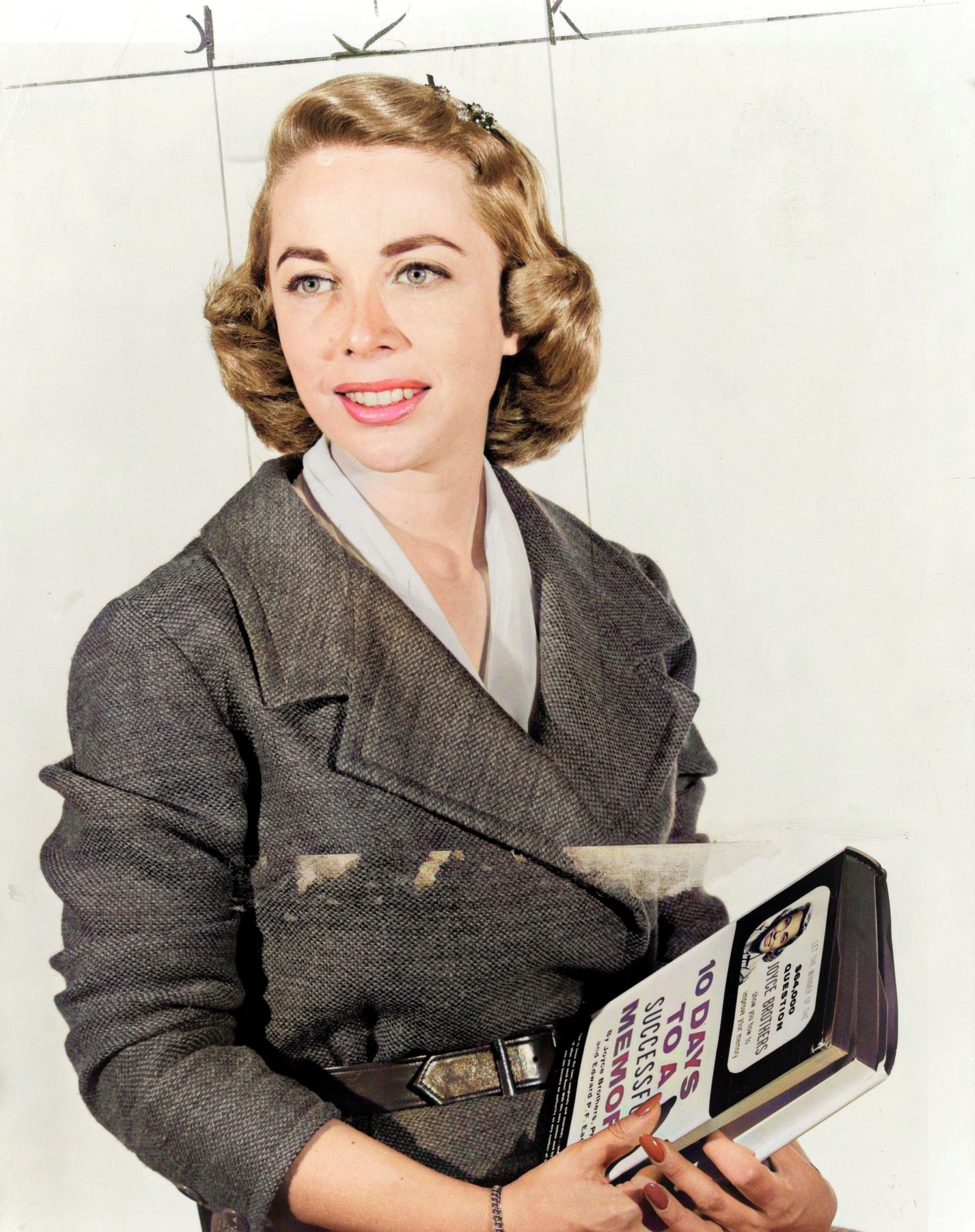
| 18 Quotes | |
| Born as | Joyce Diane Bauer |
| Known as | Dr. Joyce Brothers |
| Occup. | Psychologist |
| From | USA |
| Born | September 20, 1927 New York City, New York, U.S. |
| Died | May 14, 2013 Fort Lee, New Jersey |
| Aged | 85 years |
| Cite | |
Citation Formats
APA Style (7th ed.)
Joyce brothers biography, facts and quotes. (2026, February 11). FixQuotes. https://fixquotes.com/authors/joyce-brothers/
Chicago Style
"Joyce Brothers biography, facts and quotes." FixQuotes. February 11, 2026. https://fixquotes.com/authors/joyce-brothers/.
MLA Style (9th ed.)
"Joyce Brothers biography, facts and quotes." FixQuotes, 11 Feb. 2026, https://fixquotes.com/authors/joyce-brothers/. Accessed 24 Mar. 2026.
Early Life and Background
Joyce Brothers was born Joyce Diane Bauer on September 20, 1927, into a Jewish family in Brooklyn, New York, a borough whose dense immigrant neighborhoods and hustle-and-scrape ambition shaped her early sense that identity was both inherited and made. She grew up during the Great Depression and came of age as World War II reshaped American ideas about women, work, and authority. In that era, psychological language was entering everyday life through radio, magazines, and the new prestige of medicine - a cultural opening Brothers would later turn into a public vocation.Family expectations and Brooklyn pragmatism gave her two enduring instincts: self-discipline and readability. She learned early how quickly people judged by appearance, status, and confidence, and how powerfully reassurance could steady a room. That sensitivity to social evaluation - and to the quiet fears people hid behind politeness - became the emotional engine of her later media work, where she translated private anxieties into plain speech without dissolving them into sentimentality.
Education and Formative Influences
She studied at Cornell University, receiving a BA in psychology in 1947, then continued at Columbia University, earning an MA and PhD in psychology. Columbia in the postwar years was a crossroads of clinical training, personality research, and the rising authority of scientific method; it rewarded clarity, evidence, and the careful separation of observation from moralizing. Those habits mattered: Brothers would spend her career working in a space where audiences wanted certainty, yet real psychological help required nuance, limits, and the humility to treat the individual life as more complicated than a headline.Career, Major Works, and Turning Points
Brothers became nationally known in 1955 when she won the top prize on the television quiz show The $64, 000 Question by answering questions in her field, making her an instant symbol of expertise and composure under pressure. She turned that visibility into a long, unusual career: a licensed psychologist who also functioned as a mass communicator, appearing on television and radio, writing widely read advice columns, and publishing books aimed at general readers. Over decades she became a familiar presence on talk shows and news programs, including frequent appearances on The Tonight Show, and she offered commentary on relationships, sex education, parenting, grief, and self-esteem as those topics moved from taboo to mainstream conversation in late-20th-century America. She died on May 14, 2013, after helping define what the public expected a media psychologist to be: reassuring, direct, and broadly literate in everyday pain.Philosophy, Style, and Themes
Brothers practiced a kind of democratic psychology - less about the couch than about the kitchen table, where couples argued, teenagers tested boundaries, and exhausted parents searched for language. Her advice emphasized competence, habit, and self-perception over melodrama. She returned repeatedly to confidence as a learnable skill, not a gift, aligning with her conviction that “A strong, positive self-image is the best possible preparation for success”. The line reads like a slogan, but its psychological subtext is deeper: she had seen how shame narrows choice, how a battered self-concept makes even good options look undeserved, and how people often need permission to act before they can feel worthy.Her style also blended common sense with a clinician's attention to ambivalence. She treated intuition not as mysticism but as pattern-recognition, advising audiences to respect tacit knowledge: “Trust your hunches. They're usually based on facts filed away just below the conscious level”. That was her bridge between science and everyday living - validating inner experience while still anchoring it in information. And she insisted that love had maintenance costs as well as poetry, puncturing romantic idealization with domestic realism: “Marriage is not just spiritual communion, it is also remembering to take out the trash”. In that compact sentence is her recurring theme - durable intimacy depends on follow-through, not grand declarations; the psyche is shaped as much by small, repeated actions as by sudden revelations.
Legacy and Influence
Brothers helped normalize psychological talk in American popular culture at a time when therapy still carried stigma, especially for men and for conservative families. By presenting herself as both credentialed and accessible, she widened the audience for mental-health ideas long before social media made such discourse ubiquitous, and she modeled how an expert could speak to millions without surrendering entirely to spectacle. Her influence persists in the expectation that public-facing clinicians translate research into humane, practical guidance - and in the lasting cultural shift she advanced: that private distress can be discussed in public without losing dignity.Our collection contains 18 quotes written by Joyce, under the main topics: Witty One-Liners - Love - Equality - Success - Marriage.
Source / external links