
Judith Butler Biography Quotes 8 Report mistakes
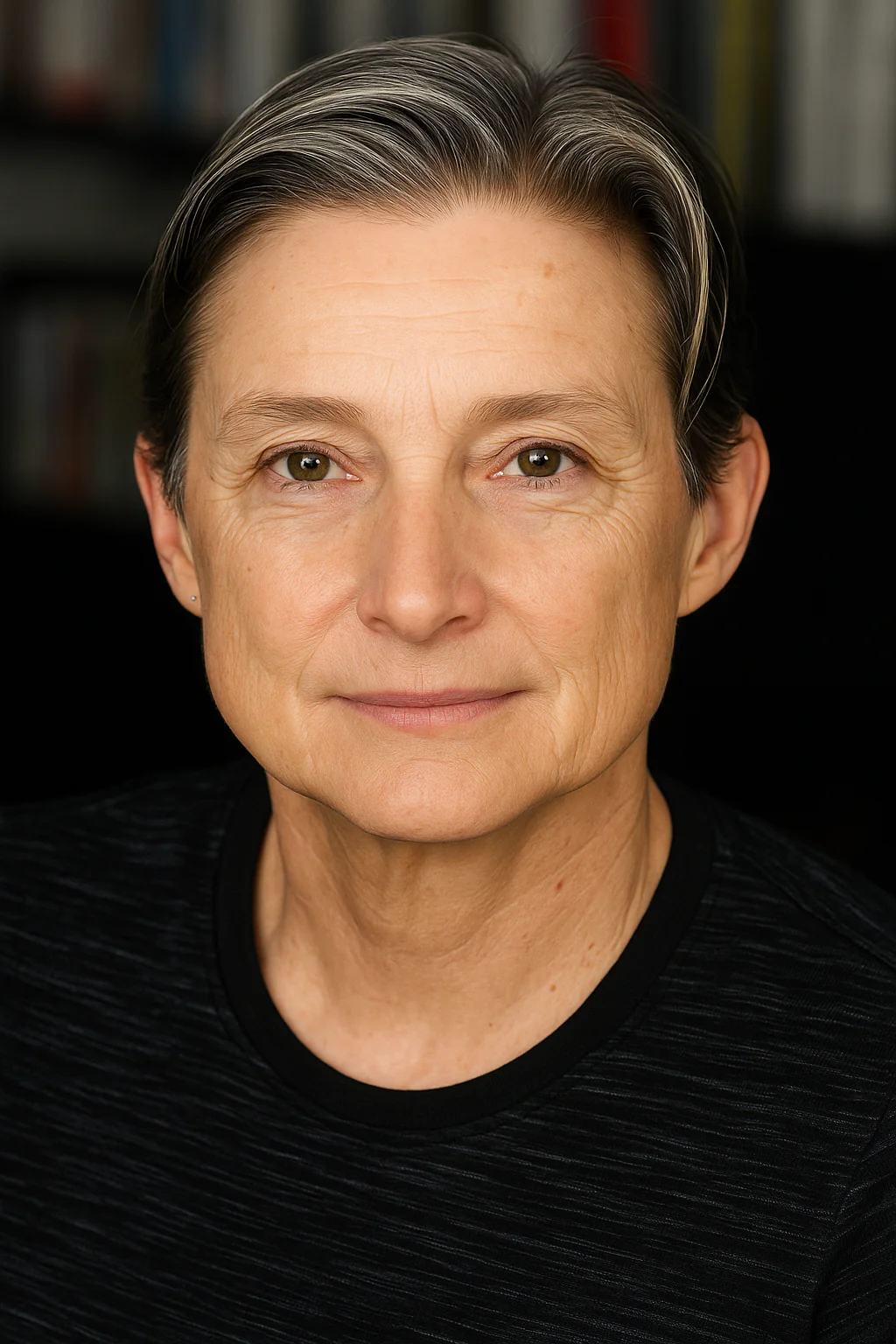
| 8 Quotes | |
| Born as | Judith Pamela Butler |
| Occup. | Philosopher |
| From | USA |
| Born | February 24, 1956 Cleveland, Ohio, United States |
| Age | 70 years |
| Cite | |
Citation Formats
APA Style (7th ed.)
Judith butler biography, facts and quotes. (2026, February 8). FixQuotes. https://fixquotes.com/authors/judith-butler/
Chicago Style
"Judith Butler biography, facts and quotes." FixQuotes. February 8, 2026. https://fixquotes.com/authors/judith-butler/.
MLA Style (9th ed.)
"Judith Butler biography, facts and quotes." FixQuotes, 8 Feb. 2026, https://fixquotes.com/authors/judith-butler/. Accessed 25 Mar. 2026.
Early Life and Background
Judith Pamela Butler was born on February 24, 1956, in Cleveland, Ohio, into an American Jewish family shaped by postwar mobility and the lingering pressures of Cold War conformity. Cleveland in the 1960s was also a city of labor politics and racial contestation, and Butler grew up alert to how public life polices bodies and speech - not only through law and religion, but through the quieter coercions of family expectation and school discipline.A defining early influence was Jewish ethical and intellectual culture, including synagogue life and communal debate, where interpretation is not merely academic but moral. Butler has recalled being sent to study philosophy as a kind of punishment for talking too much - a formative irony that foreshadowed a career devoted to taking the supposedly private acts of language, confession, and self-description and showing how they are never purely personal. That early mixture of constraint and argument seeded a temperament drawn to difficult questions: how norms form, how they injure, and how they can be resisted without pretending one can step outside them.
Education and Formative Influences
Butler studied at Bennington College before moving into philosophy proper at Yale University, earning a PhD in 1984. At Yale, continental thought and critical theory provided the scaffolding for Butler's future method: Hegelian accounts of recognition and social formation, the deconstructive rigor of Jacques Derrida, and Michel Foucault's genealogy of power and sexuality, alongside feminist debates that refused to treat "woman" as a settled category. The result was an intellectual formation that treated identity as an event in history rather than a natural fact, and ethics as inseparable from politics.Career, Major Works, and Turning Points
After early teaching posts, Butler became a central figure in late-20th-century humanities and social theory, notably at the University of California, Berkeley, where Butler has long been associated with rhetoric and comparative literature. The turning point was Gender Trouble (1990), a book that traveled far beyond academic philosophy and helped inaugurate what came to be called queer theory; it was followed by Bodies That Matter (1993), which refined the account of materiality and normativity. Butler later widened the lens: Excitable Speech (1997) on injurious language and censorship; Antigone's Claim (2000) on kinship and intelligibility; Precarious Life (2004) and Frames of War (2009) on mourning, violence, and whose lives count as grievable; and Notes Toward a Performative Theory of Assembly (2015) on public protest and collective embodiment. Across these phases, Butler's public profile grew alongside controversy - from misreadings that reduced the work to slogan, to political disputes around Israel-Palestine, Zionism, and Jewish identity - yet the through-line remained an insistence that thinking is a form of responsibility.Philosophy, Style, and Themes
Butler's signature intervention is the concept of gender performativity, often misunderstood as mere "performance" in the theatrical sense, when it is closer to a theory of how norms become real through repetition, citation, and social enforcement. Butler argues, “There is no gender identity behind the expressions of gender... identity is performatively constituted by the very 'expressions' that are said to be its results”. Psychologically, this is less a debunking of interior life than a sober account of how the inner becomes livable only through available scripts - and how those scripts can both shelter and suffocate. The famous attention to drag is not a celebration of imitation for its own sake, but a way of revealing the fragility of what passes as natural: “There is no original or primary gender a drag imitates, but gender is a kind of imitation for which there is no original”. The joke, for Butler, is also a diagnosis - comedy as a crack in authority, where certainty falters and the self briefly sees its own construction.Stylistically, Butler writes with philosophical density and an almost juridical attention to consequences, often circling a problem until its hidden premises show themselves. The themes that recur - vulnerability, recognition, normativity, grievability - reflect an inner life preoccupied with dependency and exposure: the body as what cannot be fully authored, and the social world as what both sustains and threatens. Butler refuses a politics of purity, preferring coalition and friction over a single center, and insists on feminist lineage even while transforming it, writing, “I would say that I'm a feminist theorist before I'm a queer theorist or a gay and lesbian theorist”. That ordering is revealing: feminism names for Butler not an identity badge but an ethical demand to rethink power, desire, and survival together.
Legacy and Influence
Butler's influence is simultaneously conceptual and practical: the vocabulary of performativity reshaped gender studies, literary theory, anthropology, and political theory, while also filtering into activist debates about trans life, speech, sexual violence, and state power. Few late-20th-century thinkers have been so frequently cited and so frequently simplified; yet the durability of Butler's work lies in its hard lesson that freedom is not the absence of norms but the struggle over which norms will govern recognition, intimacy, and public space. In an era marked by culture-war caricature and renewed authoritarianism, Butler's central claim remains unsettling and useful: identities are made in history, and because they are made, they can be remade - but only through collective work, not private will alone.Our collection contains 8 quotes written by Judith, under the main topics: Witty One-Liners - Deep - Equality - Human Rights.
Frequently Asked Questions
- Judith Butler young: Raised in Cleveland; studied philosophy at Yale.
- Judith Butler partner: Wendy Brown.
- Judith Butler influenced by: Michel Foucault, Jacques Derrida, Simone de Beauvoir, Jacques Lacan.
- Judith Butler son: Has one son, Isaac.
- Judith Butler gender theory: Gender performativity, gender as a repeated social performance shaped by norms.
- Judith Butler books: Gender Trouble; Bodies That Matter; Undoing Gender; Excitable Speech; The Force of Nonviolence
- How old is Judith Butler? She is 70 years old
Judith Butler Famous Works
- 2020 The Force of Nonviolence: An Ethico-Political Bind (Book)
- 2015 Senses of the Subject (Book)
- 2015 Notes Toward a Performative Theory of Assembly (Book)
- 2012 Parting Ways: Jewishness and the Critique of Zionism (Book)
- 2009 Frames of War: When Is Life Grievable? (Book)
- 2005 Giving an Account of Oneself (Book)
- 2004 Undoing Gender (Book)
- 2004 Precarious Life: The Powers of Mourning and Violence (Book)
- 2000 Antigone's Claim: Kinship Between Life and Death (Book)
- 1997 Excitable Speech: A Politics of the Performative (Book)
- 1997 The Psychic Life of Power: Theories in Subjection (Book)
- 1993 Bodies That Matter: On the Discursive Limits of Sex (Book)
- 1990 Gender Trouble: Feminism and the Subversion of Identity (Book)
- 1988 Performative Acts and Gender Constitution: An Essay in Phenomenology and Feminist Theory (Essay)
- 1987 Subjects of Desire: Hegelian Reflections in Twentieth-Century France (Book)
Source / external links