
Judy Chicago Biography Quotes 12 Report mistakes
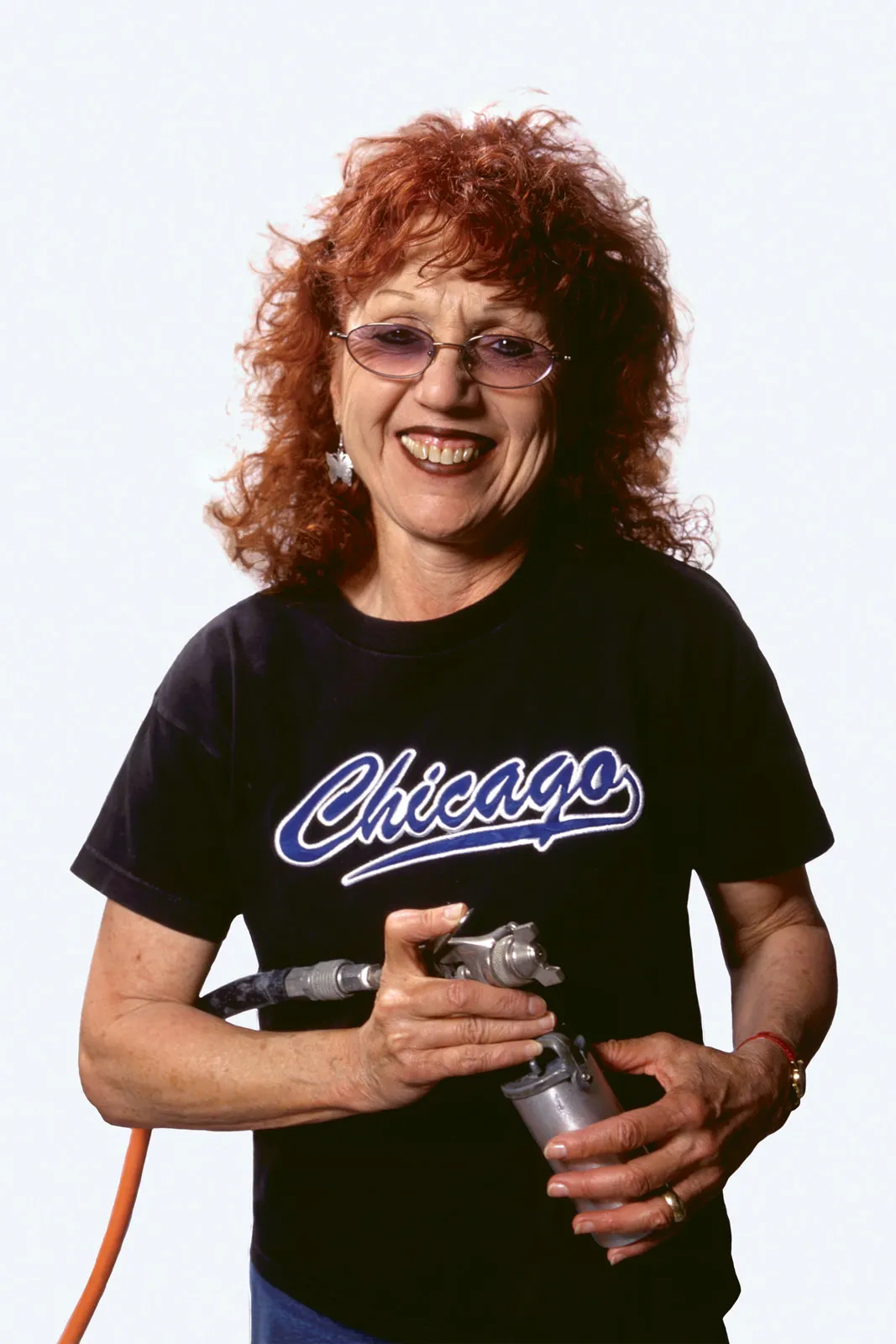
| 12 Quotes | |
| Born as | Judith Sylvia Cohen |
| Occup. | Artist |
| From | USA |
| Born | July 20, 1939 Chicago, Illinois, United States |
| Age | 86 years |
| Cite | |
Citation Formats
APA Style (7th ed.)
Judy chicago biography, facts and quotes. (2026, February 11). FixQuotes. https://fixquotes.com/authors/judy-chicago/
Chicago Style
"Judy Chicago biography, facts and quotes." FixQuotes. February 11, 2026. https://fixquotes.com/authors/judy-chicago/.
MLA Style (9th ed.)
"Judy Chicago biography, facts and quotes." FixQuotes, 11 Feb. 2026, https://fixquotes.com/authors/judy-chicago/. Accessed 26 Mar. 2026.
Early Life and Background
Judy Chicago was born Judith Sylvia Cohen on July 20, 1939, in Chicago, Illinois, into a Jewish, working-class household shaped by Depression-era politics and the aftershocks of war. Her father, Arthur Cohen, was a labor organizer with leftist commitments; her mother, May Cohen, sought stability through practical work and encouraged her daughter's ambitions even as the culture around them trained girls toward modesty and containment. Chicago grew up alert to the ways public life could be structured against ordinary people - and against women in particular - and that early awareness hardened into a lifelong insistence that the personal and the political belong on the same canvas.Loss and pressure arrived early. Her father died when she was still a child, leaving the family with financial strain and a sharpened sense that survival required will and strategy. In the postwar years, Chicago watched American modernity sell itself as progress while domestic norms narrowed women's possibilities; the friction between those promises and her own hunger for scale and seriousness became a formative inner engine. She would later treat that friction not as a private wound to be hidden, but as evidence - material to be named, researched, and remade as cultural knowledge.
Education and Formative Influences
After early art study in Chicago, she earned her BFA (1962) and MFA (1964) at UCLA, training amid the muscular confidence of postwar American art - Minimalism, hard-edge painting, and the myth of the solitary (male) genius. She absorbed formal rigor and industrial process, but also the disciplinary habits of the studio critique. As she later recalled, “With my early work I got eviscerated by my male professors, and so you learned to disguise your impulses, as many women have done. And that's definitely changed”. That lesson - that women were expected to edit themselves to be legible - helped push her toward a counter-education: creating spaces where women could make work without translating their experience into a male-approved dialect.Career, Major Works, and Turning Points
In the mid-1960s, she emerged in California with sleek, process-driven work (including the sprayed surfaces of her early "Pasadena Lifesavers" and the vehicle-based interventions of "Car Hood", 1964) while also remaking her public identity: she adopted the name "Chicago" in 1970, a pointed rejection of patronymic inheritance and a declaration of authorship. That same year she founded the Feminist Art Program at Fresno State College; she soon moved it to CalArts with Miriam Schapiro, where "Womanhouse" (1972) turned an abandoned home into a total environment of feminist critique and invention. Her most famous achievement, "The Dinner Party" (1974-79), mobilized hundreds of collaborators to stage a symbolic banquet of women's history, and it fixed her reputation as an artist willing to use research, craft, spectacle, and collective labor to challenge what museums had taught viewers to forget. Later projects extended that method: the "Birth Project" (1980-85) recruited needleworkers to reclaim childbirth as monumental subject; "Powerplay" (1982-87) anatomized masculinist violence; and the long-running "Holocaust Project: From Darkness Into Light" (1985-93), shaped with her husband Donald Woodman, confronted inherited trauma and moral repair.Philosophy, Style, and Themes
Chicago's art begins with an unapologetic ambition to enter - and revise - the canon. “I set my sights upon becoming the kind of artist who would make a contribution to art history”. Yet her route was to treat "art history" not as a neutral timeline but as a structure of exclusions, sustained by taste, schooling, and institutional gatekeeping. The psychological drama in her career is the move from self-censorship to self-authorship: the young artist trained to mask her "impulses" becomes the mature artist who builds new pedagogies and production models so those impulses can be developed rather than disciplined away. Collaboration in her practice is not a soft alternative to mastery; it is a hard, logistical argument that women's labor - often invisible, often domestic, often coded as "craft" - can operate at the scale of public memory.Formally, she moves between clean, industrial surfaces and sensuous color, between diagram and icon, between text, image, and material process. Her most controversial motifs - the vulvar "central core" imagery associated with 1970s feminism, the embroidered and ceramic strategies of "The Dinner Party", the pageantry of installation - are best read as tools for building a new visual grammar. “So women are at the beginning of building a language, and not all women are conscious of it”. That claim explains both her didactic streak (naming, listing, teaching) and her insistence on pleasure, ornament, and bodily specificity as legitimate carriers of meaning. At the same time, she framed feminism as an expansive ethic rather than a niche doctrine: “I am trying to make art that relates to the deepest and most mythic concerns of human kind and I believe that, at this moment of history, feminism is humanism”. The inner life underneath the polemics is a desire for wholeness - for histories of gender, sexuality, labor, and trauma to be held in view without being reduced to either confession or propaganda.
Legacy and Influence
Chicago's influence is measurable in institutions and in habits of mind: feminist art education, the legitimacy of installation as historical argument, the revival of textile and ceramic traditions as high cultural forms, and a widened sense of who counts as a subject of monumentality. "The Dinner Party" eventually found a permanent home at the Elizabeth A. Sackler Center for Feminist Art at the Brooklyn Museum, where it continues to attract both devotion and debate - a sign of its enduring power as a lightning rod for questions about representation, essentialism, and public pedagogy. Across generations, artists have borrowed her strategies of research-based spectacle, collaborative production, and the refusal to separate beauty from critique. She helped normalize the idea that a woman artist can be both formally rigorous and historically revisionist, and that building a language is itself a form of cultural repair.Our collection contains 12 quotes written by Judy, under the main topics: Art - Life - Equality - Legacy & Remembrance - Husband & Wife.
Frequently Asked Questions
- Judy Chicago husband: Photographer Donald Woodman (married 1985).
- Judy Chicago print: She produced notable prints and editions, e.g., Red Flag, available through museums, galleries, and print publishers.
- Judy Chicago Feminist Art: She helped found the Feminist Art Program and created works like Womanhouse and The Dinner Party centering women’s experiences.
- Judy Chicago Art: Pioneering feminist artist known for large-scale installations like The Dinner Party, exploring women’s history and bodily experience.
- Judy Chicago tampon: Refers to her work Red Flag (1971), an image of tampon removal and menstrual blood.
- Judy Chicago Red Flag: A 1971 photolithograph depicting a woman removing a bloody tampon, confronting menstrual taboos.
- Judy Chicago Womanhouse: 1972 collaborative feminist art project in Los Angeles organized by Judy Chicago and Miriam Schapiro with CalArts students.
- Judy Chicago Dinner Party: Iconic 1974–79 installation honoring women in history; 39 place settings and 999 names; permanently at the Brooklyn Museum.
- How old is Judy Chicago? She is 86 years old
Source / external links