
Karl Marx Biography Quotes 55 Report mistakes
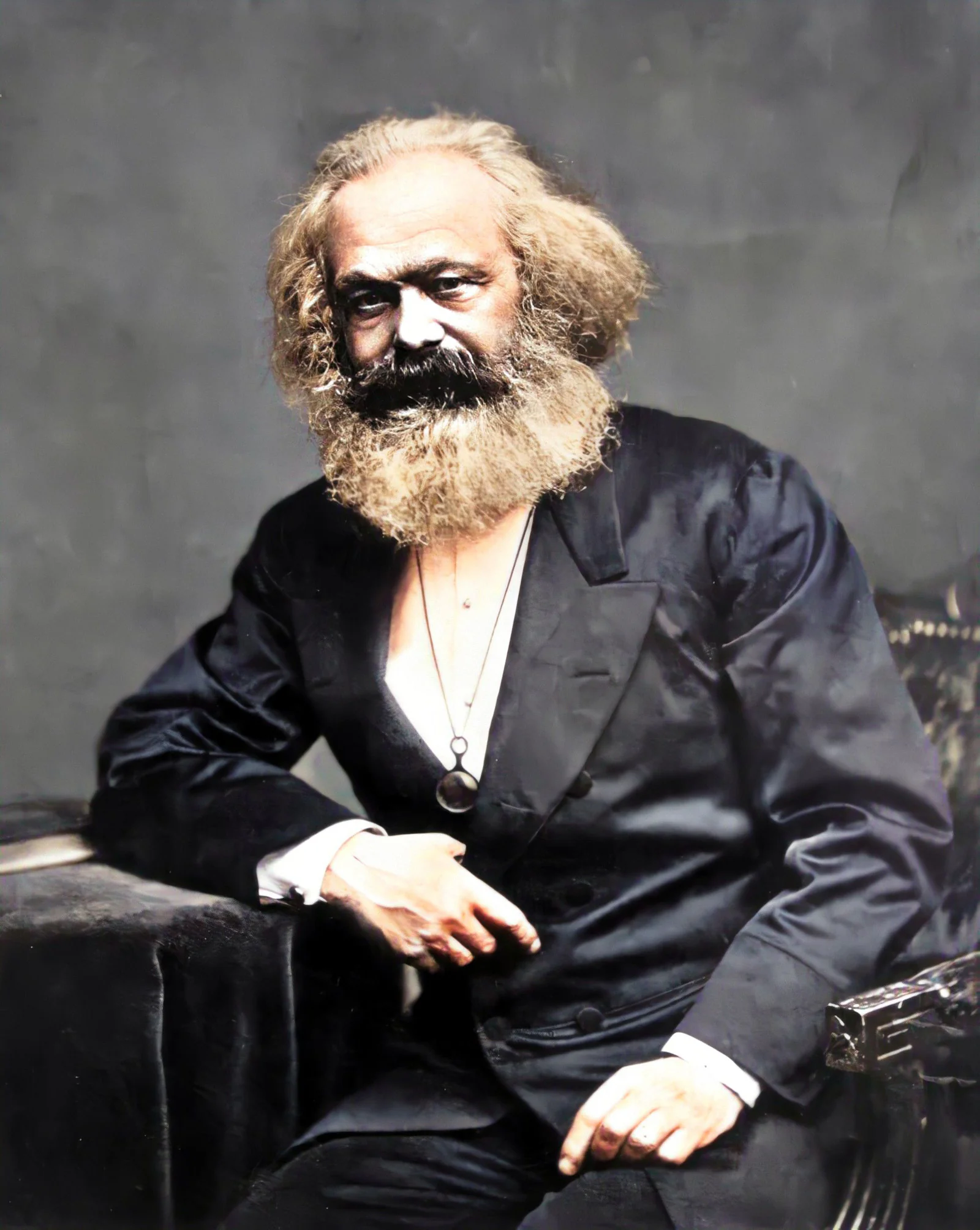
| 55 Quotes | |
| Born as | Karl Heinrich Marx |
| Occup. | Philosopher |
| From | Germany |
| Spouse | Jenny von Westphalen |
| Born | May 5, 1818 Trier, Rhineland-Palatinate, Germany |
| Died | March 14, 1883 London, England, United Kingdom |
| Cause | Bronchitis |
| Aged | 64 years |
| Cite | |
Citation Formats
APA Style (7th ed.)
Karl marx biography, facts and quotes. (2026, February 2). FixQuotes. https://fixquotes.com/authors/karl-marx/
Chicago Style
"Karl Marx biography, facts and quotes." FixQuotes. February 2, 2026. https://fixquotes.com/authors/karl-marx/.
MLA Style (9th ed.)
"Karl Marx biography, facts and quotes." FixQuotes, 2 Feb. 2026, https://fixquotes.com/authors/karl-marx/. Accessed 20 Mar. 2026.
Early Life and Background
Karl Heinrich Marx was born on 1818-05-05 in Trier, in the Prussian Rhineland, a borderland shaped by the aftershocks of the French Revolution and the reimposition of conservative Prussian rule. He grew up amid a culture where Roman law, French administrative habits, and German nationalism overlapped, and where censorship and police supervision pressed heavily on public life. That early experience of a state that claimed order while restricting speech helped form his lifelong suspicion that official politics often masked deeper social forces.His family embodied the compromises demanded by the era. His father, Heinrich Marx, a lawyer from a line of rabbis, converted from Judaism to Lutheranism to keep his career under Prussian restrictions. Marx absorbed both Enlightenment rationalism and the quiet stress of social stigma and adaptation. The young Marx developed a temperament that mixed combative certainty with a capacity for intimate loyalty - especially later to Jenny von Westphalen, his aristocratic childhood friend and eventual wife - and a sense that personal fates were entangled with structures larger than any single will.
Education and Formative Influences
Marx studied first at the University of Bonn (1835) and then at Berlin (1836), moving from youthful romanticism toward philosophical militancy. At Berlin he entered the orbit of G.W.F. Hegel's posthumous influence and the circle later called the Young Hegelians, whose radical critiques of religion and monarchy taught him to treat ideas as historically situated rather than timeless. He completed a doctorate at the University of Jena in 1841 on ancient materialism, contrasting Democritus and Epicurus, already searching for an account of freedom that did not rely on metaphysical consolation. His early journalism and polemics were sharpened by censorship, which forced him to think about power not as an abstraction but as an administrative machine with courts, police, and compliant editors.Career, Major Works, and Turning Points
Marx's public career began in Cologne as editor of the Rheinische Zeitung (1842-1843), where clashes with Prussian censors pushed him from liberal reform toward a more structural critique. Exile followed: Paris (1843-1845), where he met Friedrich Engels and discovered political economy as a weapon; Brussels (1845-1848), where he drafted the "Theses on Feuerbach" and "The German Ideology"; then the revolutionary year 1848, when he and Engels issued "The Communist Manifesto" and Marx returned briefly to Germany to edit the Neue Rheinische Zeitung. After the revolutions failed, he settled in London (1849), living through grinding poverty, family illness, and the death of several children while he researched in the British Museum Reading Room. His mature synthesis emerged in "Capital" volume 1 (1867), with later volumes edited from his manuscripts by Engels after Marx died on 1883-03-14. Alongside this work he helped lead the International Working Men's Association (First International), navigating splits between trade unionists, Proudhonists, and Bakuninists, and writing decisive interventions on events like the 1851 coup of Louis-Napoleon ("The Eighteenth Brumaire") and the Paris Commune ("The Civil War in France").Philosophy, Style, and Themes
Marx's inner life was marked by a paradox: a fierce confidence in analysis coupled with a recurring dread that time, debt, or illness would prevent completion. Chronic liver problems, boils, and exhaustion accompanied a work ethic that treated research as a moral duty. His style fused German philosophical architecture with the brutal specificity of factory reports, parliamentary blue books, and price tables - not to decorate theory, but to force the reader to see how suffering is produced. In his view, capitalism was not mainly a tale of wicked individuals but a system that compels behavior through competition, property, and the wage relation; the drama lies in how ordinary needs become instruments of domination.Three linked themes organize his thought: relations, contradictions, and emancipation. He insisted that human beings are formed within webs of dependence: “Society does not consist of individuals but expresses the sum of interrelations, the relations within which these individuals stand”. That claim explains his harshness toward moralistic reform that ignores structure and his attention to class as a real, lived relationship. He also anatomized capitalism's tendency to generate abundance alongside exclusion, a psychological wound that turns laborers into surplus: “The production of too many useful things results in too many useless people”. Finally, he treated freedom not as escape from necessity but as mastery through understanding and collective action: “Necessity is blind until it becomes conscious. Freedom is the consciousness of necessity”. Even his rhetoric of inevitability was therefore also a demand for education, organization, and the self-clarification of movements.
Legacy and Influence
Marx left a body of work that reshaped modern political vocabulary - class, ideology, alienation, exploitation, commodity fetishism - and changed how history is written by placing production, property, and conflict at the center of explanation. His influence ran in two diverging streams: revolutionary states and parties that claimed him as an oracle, and critical traditions in sociology, economics, history, and cultural theory that used his methods against new forms of domination, including those carried out in his name. Few thinkers have been so persistently contested: praised for exposing the hidden discipline of markets, condemned for inspiring coercive regimes, yet continually returned to whenever crises reveal how wealth can expand while security collapses.Our collection contains 55 quotes written by Karl, under the main topics: Witty One-Liners - Ethics & Morality - Truth - Wisdom - Art.
Other people related to Karl: Erich Fromm (Psychologist), Pierre-Joseph Proudhon (Economist), Bruno Bauer (Theologian), Mark Poster (Writer), George Jackson (Activist), Raymond Aron (Philosopher), Robert Heilbroner (Economist), Louis Blanc (Politician), Mark Skousen (Economist)
Karl Marx Famous Works
- 1867 Das Kapital (Economic and Philosophical Book)
- 1857 Grundrisse (Economic and Philosophical Manuscripts)
- 1852 The Eighteenth Brumaire of Louis Bonaparte (Essay)
- 1848 The Communist Manifesto (Political Book)
- 1845 The German Ideology (Philosophical Book)
- 1844 Economic and Philosophic Manuscripts of 1844 (Philosophical and Economic Manuscripts)
Source / external links