
Karl Popper Biography Quotes 13 Report mistakes
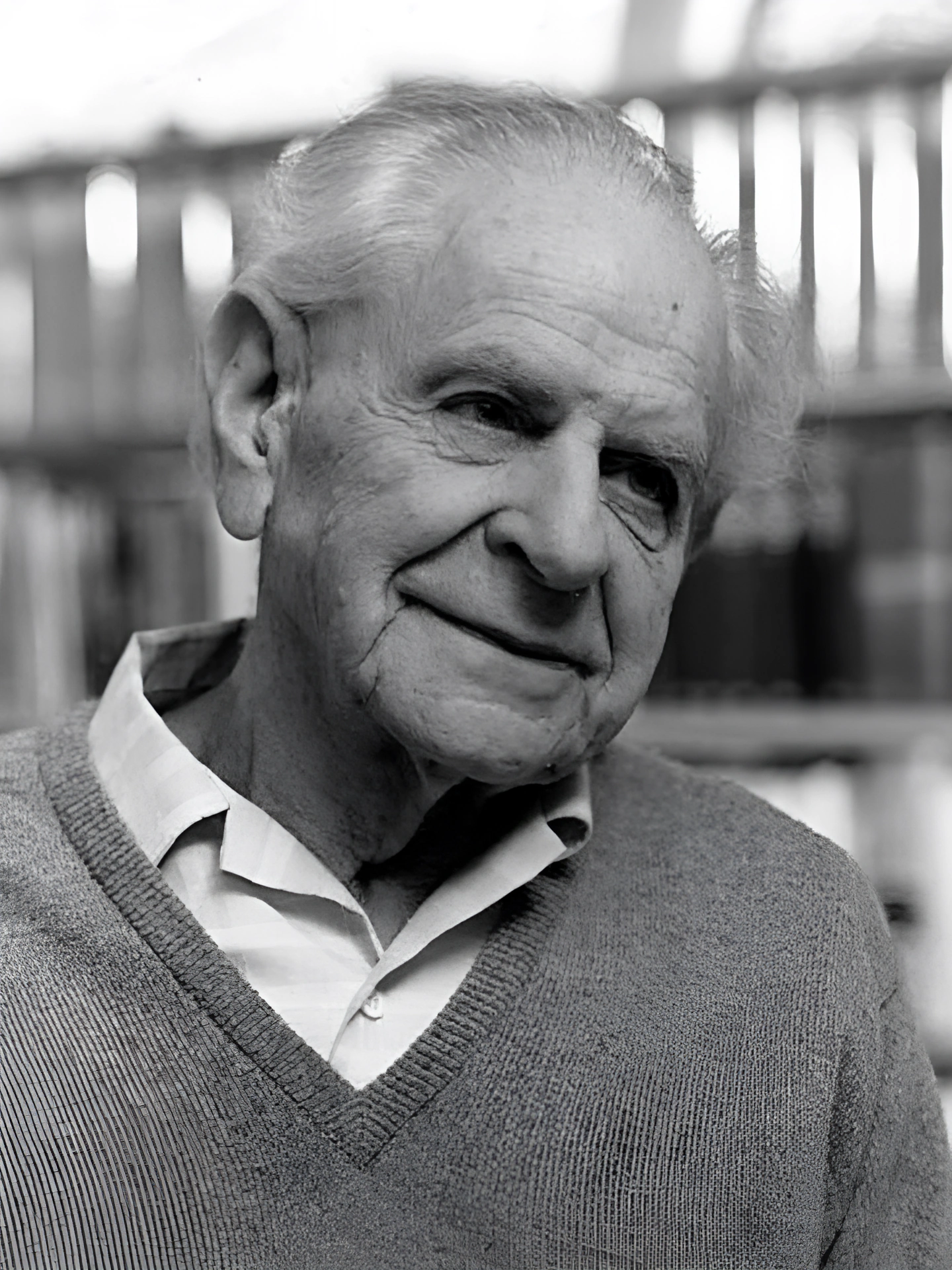
Attr: Karl Popper - LSE
| 13 Quotes | |
| Born as | Karl Raimund Popper |
| Occup. | Philosopher |
| From | Austria |
| Born | July 28, 1902 Vienna, Austria-Hungary |
| Died | September 17, 1994 London, United Kingdom |
| Aged | 92 years |
| Cite | |
Citation Formats
APA Style (7th ed.)
Karl popper biography, facts and quotes. (2026, February 11). FixQuotes. https://fixquotes.com/authors/karl-popper/
Chicago Style
"Karl Popper biography, facts and quotes." FixQuotes. February 11, 2026. https://fixquotes.com/authors/karl-popper/.
MLA Style (9th ed.)
"Karl Popper biography, facts and quotes." FixQuotes, 11 Feb. 2026, https://fixquotes.com/authors/karl-popper/. Accessed 19 Mar. 2026.
Early Life and Background
Karl Raimund Popper was born on July 28, 1902, in Vienna, then the confident capital of the Habsburg Empire and, by his adolescence, a city shadowed by war, inflation, and ideological street fighting. He grew up in an assimilated Jewish family that had converted to Lutheranism; the conversion did not insulate the household from the era's racial politics, but it did frame Popper's later insistence that identity and destiny should never be fused into tribal fate. His father, Simon Siegmund Popper, was a lawyer and bibliophile whose library formed the young Popper's first serious schooling in history, philosophy, and the sciences.Vienna offered Popper a double education: the high culture of music and scholarship, and the brutal pedagogy of political extremes. As a teenager in the years after World War I, he moved through socialist youth circles and briefly joined the Austrian Social Democratic milieu, then recoiled from what he experienced as doctrinal certainty and the willingness to excuse violence for an alleged future good. A formative shock came in 1919, when he later recalled that deaths during political unrest convinced him that any worldview that made martyrdom a policy had forfeited the right to call itself humane. The "Vienna Circle" of logical positivists also formed part of his landscape, but Popper's temperament ran against closed systems - whether metaphysical or hyper-empirical.
Education and Formative Influences
Popper studied at the University of Vienna, taking courses in mathematics, physics, and philosophy while supporting himself with varied work, including as an apprentice cabinetmaker and a schoolteacher. He earned a doctorate in 1928 and trained as a secondary-school teacher in mathematics and physics. Early engagement with Einstein's relativity helped crystallize his defining question: why do some theories invite risk and correction while others immunize themselves against failure? Encounters with Marxism and Freudian psychoanalysis sharpened the contrast in his mind between bold conjecture and interpretive systems that seemed able to "explain" anything after the fact.Career, Major Works, and Turning Points
In 1934 he published The Logic of Scientific Discovery (German: Logik der Forschung), arguing that the demarcation of science lies not in verification but in falsifiability - the readiness of a claim to be tested in ways that could refute it. With Nazism rising, Popper left Austria in 1937 for New Zealand, teaching at Canterbury University College in Christchurch; exile turned his philosophy outward, toward politics and the moral stakes of error. During World War II he wrote The Open Society and Its Enemies (1945), a sweeping critique of totalitarian thought he traced through Plato, Hegel, and Marx, and The Poverty of Historicism (published in essays in the 1940s; book 1957), attacking the dream of discovering historical laws that permit prophecy. In 1946 he moved to England to join the London School of Economics, where he became a central voice in postwar Anglophone philosophy of science, later developing ideas such as "piecemeal social engineering", "situational logic", and "World 3" (the objective realm of theories, arguments, and problems) while influencing students and rivals alike.Philosophy, Style, and Themes
Popper's inner life was shaped by a moral allergy to intellectual coercion. He distrusted the comfort of inevitability - in science, the wish for final proofs; in politics, the promise of historical destiny. His epistemology begins with human fallibility: “Our knowledge can only be finite, while our ignorance must necessarily be infinite”. From that recognition he built a disciplined optimism: we can progress, not by securing certainty, but by exposing our beliefs to criticism and learning from what survives.His prose is argumentative, urgent, and often autobiographical in its stakes, because for Popper error was never merely academic. In science, he insisted that claims about the world must court refutation: “In so far as a scientific statement speaks about reality, it must be falsifiable; and in so far as it is not falsifiable, it does not speak about reality”. In politics, he extended the same ethic to institutions: design systems that can correct mistakes without bloodshed, and prefer reforms that can be reversed over revolutions that demand submission. His anti-utopian warning was not rhetorical but historically earned: “Those who promise us paradise on earth never produced anything but a hell”. Across both domains runs a single psychological thread - a determination to replace the romance of purity with the humility of revisability.
Legacy and Influence
Popper died on September 17, 1994, in London, having become a symbol of liberal anti-totalitarian reason in the Cold War and beyond, and he was knighted in 1965. His falsificationism reshaped debates in philosophy of science, even where it was revised or rejected, and his vocabulary of conjectures, refutations, and critical rationalism became a lingua franca for scientists, economists, and public intellectuals. The Open Society continues to animate arguments about democracy, pluralism, and the limits of historical prophecy, while later thinkers - from Thomas Kuhn to Imre Lakatos and Paul Feyerabend - defined themselves in dialogue with him. Popper's enduring influence lies less in a finished system than in a civic temperament: the insistence that the best societies, like the best theories, are those that build error-correction into their very structure.Our collection contains 13 quotes written by Karl, under the main topics: Ethics & Morality - Wisdom - Freedom - Deep - Reason & Logic.
Other people related to Karl: Imre Lakatos (Philosopher), David Deutsch (Scientist), Rudolf Carnap (Philosopher), Ernest Gellner (Philosopher), Bryan Magee (Author)
Karl Popper Famous Works
- 1994 All Life Is Problem Solving (Book)
- 1982 The Open Universe: An Argument for Indeterminism (Book)
- 1977 The Self and Its Brain (Book)
- 1976 Unended Quest: An Intellectual Autobiography (Autobiography)
- 1972 Objective Knowledge: An Evolutionary Approach (Book)
- 1963 Conjectures and Refutations: The Growth of Scientific Knowledge (Collection)
- 1959 The Propensity Interpretation of Probability (Essay)
- 1957 The Poverty of Historicism (Book)
- 1945 The Open Society and Its Enemies (Book)
- 1934 The Logic of Scientific Discovery (Book)