
Kassym-Jomart Tokayev Biography Quotes 16 Report mistakes
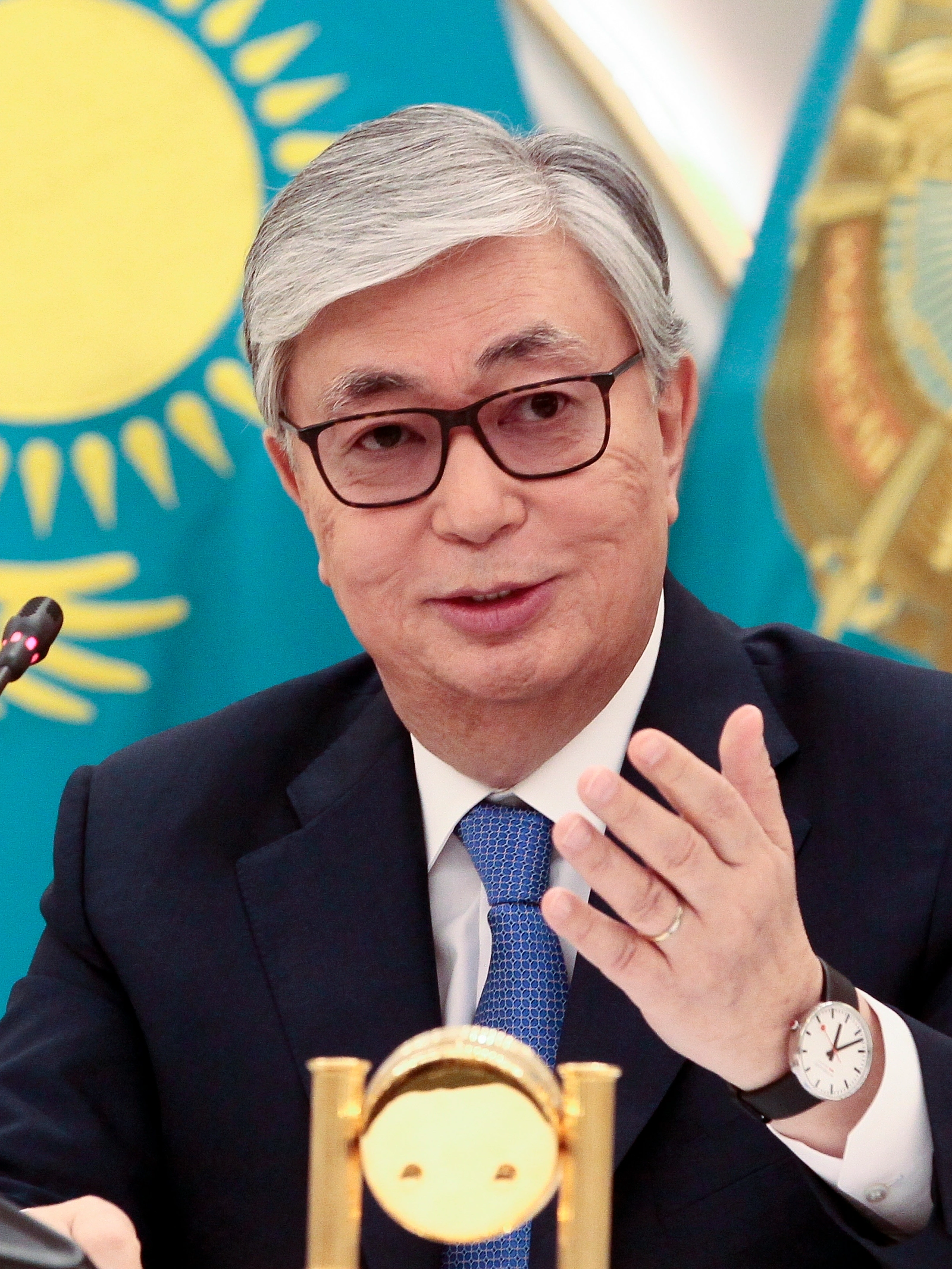
Attr: Washington Times
| 16 Quotes | |
| Born as | Kassym-Zhomart Kemelevich Tokayev |
| Native name | Қасым-Жомарт Тоқаев |
| Occup. | President |
| From | Kazakhstan |
| Spouse | Nadezhda Tokayeva |
| Born | May 17, 1953 Alma-Ata (now Almaty), Kazakh SSR, Soviet Union (now Kazakhstan) |
| Age | 72 years |
| Cite | |
Citation Formats
APA Style (7th ed.)
Kassym-jomart tokayev biography, facts and quotes. (2026, February 16). FixQuotes. https://fixquotes.com/authors/kassym-jomart-tokayev/
Chicago Style
"Kassym-Jomart Tokayev biography, facts and quotes." FixQuotes. February 16, 2026. https://fixquotes.com/authors/kassym-jomart-tokayev/.
MLA Style (9th ed.)
"Kassym-Jomart Tokayev biography, facts and quotes." FixQuotes, 16 Feb. 2026, https://fixquotes.com/authors/kassym-jomart-tokayev/. Accessed 31 Mar. 2026.
Early Life and Background
Kassym-Jomart Kemelevich Tokayev was born in 1953 in the Kazakh SSR, into the postwar Soviet world that trained ambitious provincials to serve an empire of committees, plans, and protocols. His family carried both the burdens and the cultural capital of that era. His father, Kemel Tokayev, was known in Kazakhstan as a writer of detective fiction and war-themed prose, a public figure whose craft revolved around motive, evidence, and the hidden logic of events. From this household the younger Tokayev absorbed a respect for language and narrative, but also an instinct for discipline and restraint - traits that later became hallmarks of his political persona.The Kazakhstan of Tokayev's youth was a society of managed stability: a multiethnic republic tied to Moscow, shaped by rapid urbanization, Russified administrative culture, and the lingering trauma of collectivization and war. Coming of age under late-Soviet stagnation, he learned that advancement depended on competence and conformity, yet that real influence lay in mastering institutions from within. That early environment helps explain the central tension in his later career - a technocratic belief in order and gradual reform set against periodic eruptions of social anger that the Soviet inheritance never fully processed.
Education and Formative Influences
Tokayev studied at the Moscow State Institute of International Relations (MGIMO), the elite training ground for Soviet diplomacy, and then entered the Ministry of Foreign Affairs of the USSR. MGIMO's curriculum - languages, international law, and the psychology of negotiation - formed him into a professional mediator more than a tribune. Early postings included work in Singapore and, crucially, assignments connected to China, giving him long exposure to Asian statecraft and to the reality that Kazakhstan's security would always hinge on balancing stronger neighbors.Career, Major Works, and Turning Points
After Kazakhstan's independence in 1991, Tokayev became one of the architects of the new state's diplomacy, serving as deputy foreign minister and then foreign minister, helping institutionalize a "multi-vector" policy that sought workable ties with Russia, China, the United States, and Europe without formal alignment. He served as prime minister (1999-2002), then returned to the foreign ministry, later chairing the Senate and acting as a key institutional partner to President Nursultan Nazarbayev. Internationally, his pinnacle was as director-general of the UN Office at Geneva (2011-2013), reinforcing his identity as a consensus administrator. In 2019 Nazarbayev resigned and Tokayev became president, winning an election that signaled continuity but also unleashed demands for deeper change. His defining test came in January 2022, when protests and violence shook the country; Tokayev moved decisively to restore control, sidelined Nazarbayev's remaining formal influence, and advanced a reform agenda branded as a "New Kazakhstan", alongside constitutional changes and a recalibration of elite power.Philosophy, Style, and Themes
Tokayev's public philosophy is built on cohesion, incremental modernization, and the belief that a diverse society must be governed through a language of common purpose. His diplomatic temperament appears in the way he frames conflict as a failure of political imagination rather than an opportunity for domination: “Threats, sanctions, and the use of force do not solve problems”. Psychologically, this is less a pacifist slogan than an autobiographical credo of the negotiator - a man trained to regard escalation as expensive, unpredictable, and usually reversible only through painstaking compromise. It also fits Kazakhstan's strategic vulnerability: a landlocked state whose survival depends on keeping channels open even when great powers collide.A second theme is intergenerational duty, which he uses to moralize governance and to ask citizens for patience while legitimizing state authority. “Never in history have we had such a need for responsible leadership for the next generations”. The phrasing casts leadership as stewardship, implying that the leader's discipline must be mirrored by society's self-control. His nation-building vocabulary similarly insists that identity is not nostalgia but adaptation: “New Kazakhstan is the way to strengthen our national identity in a dynamically changing world”. Taken together, these lines reveal an inner preference for managed transformation - reform as a controlled narrative in which unity is not a byproduct but a precondition.
Legacy and Influence
Tokayev's legacy is still being written, but its contours are clear: he embodies the post-Soviet technocrat who rose through diplomacy, translated international legitimacy into domestic authority, and then confronted the limits of inherited stability. He is likely to be judged on whether "New Kazakhstan" becomes more than a slogan - whether constitutional tweaks, anti-elite signaling, and administrative modernization produce accountable institutions rather than merely a reshuffled hierarchy. Internationally, his influence rests on keeping Kazakhstan's multi-vector posture viable during an era of intensifying rivalry, while domestically his defining imprint will be how he reconciled state order with social demands after 2022, and whether his rhetoric of unity and responsibility matured into durable political culture.Our collection contains 16 quotes written by Kassym-Jomart, under the main topics: Justice - Leadership - Hope - Resilience - Equality.
Source / external links