
King Hussein Biography Quotes 3 Report mistakes
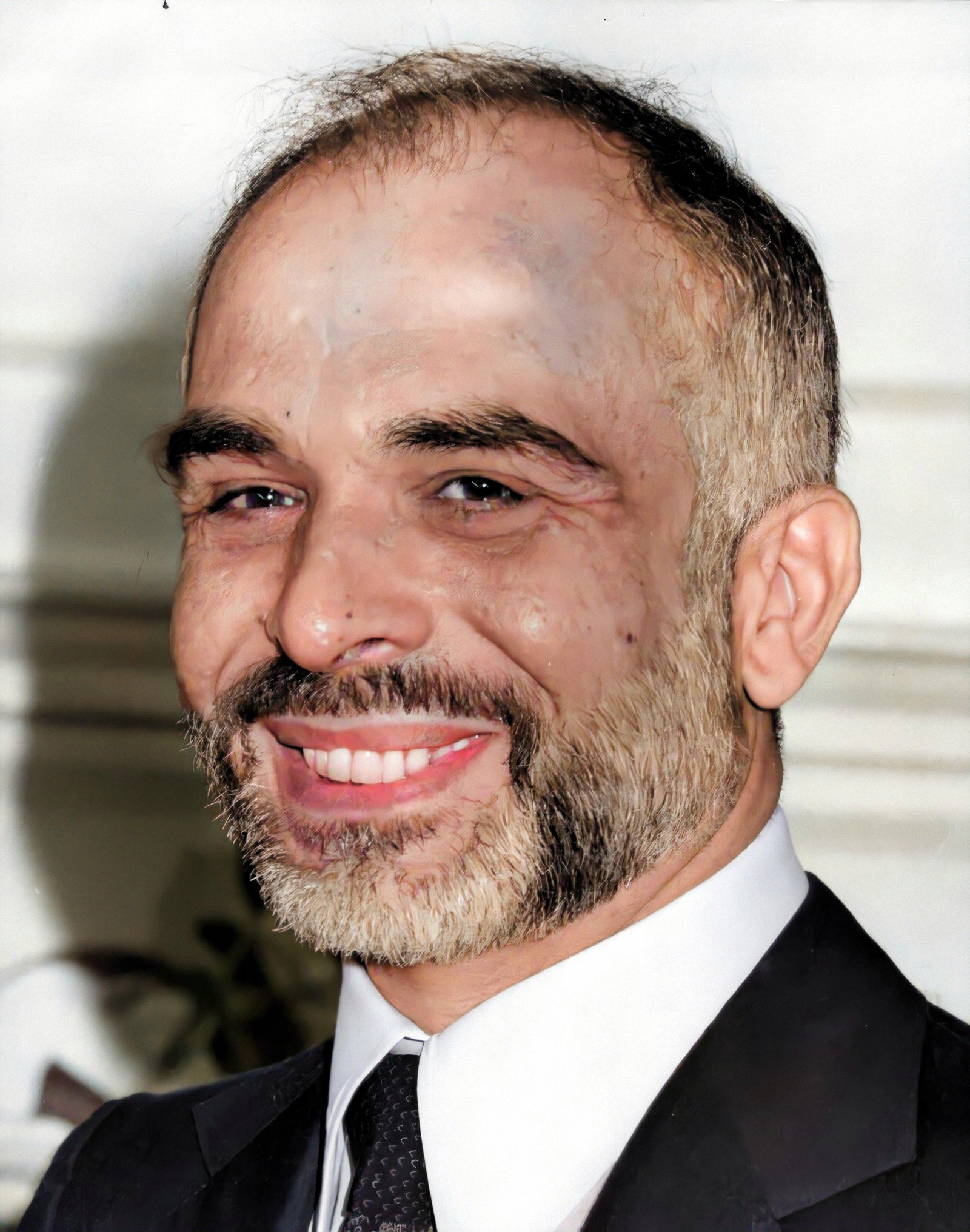
| 3 Quotes | |
| Born as | Hussein bin Talal |
| Occup. | Royalty |
| From | Jordan |
| Spouse | Antoinette Avril Gardiner |
| Born | November 14, 1935 Amman, Jordan |
| Died | February 7, 1999 Amman, Jordan |
| Cause | Cancer |
| Aged | 63 years |
| Cite | |
Citation Formats
APA Style (7th ed.)
King hussein biography, facts and quotes. (2026, February 11). FixQuotes. https://fixquotes.com/authors/king-hussein/
Chicago Style
"King Hussein biography, facts and quotes." FixQuotes. February 11, 2026. https://fixquotes.com/authors/king-hussein/.
MLA Style (9th ed.)
"King Hussein biography, facts and quotes." FixQuotes, 11 Feb. 2026, https://fixquotes.com/authors/king-hussein/. Accessed 5 Mar. 2026.
Early Life and Education
Hussein bin Talal was born on 14 November 1935 in Amman into the Hashemite dynasty, the son of King Talal ibn Abdullah and Queen Zein al-Sharaf. His grandfather, King Abdullah I, had established the modern Hashemite Kingdom of Jordan. Hussein spent parts of his childhood in Jordan and in Egypt, and later attended Harrow School in England and the Royal Military Academy Sandhurst, training for the military responsibilities he expected to inherit. A formative event came in July 1951, when Abdullah I was assassinated at the Al-Aqsa Mosque in Jerusalem; the teenage Hussein, standing beside his grandfather, survived when a medal on his chest deflected a bullet. The episode created a lifelong sense of vulnerability and duty that shaped his approach to rule.Accession and Consolidation of Power
In August 1952, after King Talal abdicated due to ill health, Hussein was proclaimed king at the age of 16. He assumed full constitutional powers in May 1953. The young monarch confronted a volatile region and a fragile state apparatus. One of his earliest and most consequential decisions came in 1956, when he dismissed British commander John Bagot Glubb, known as Glubb Pasha, and Arabized the officer corps of the Arab Legion, reconstituting it as the Jordanian Arab Army. That move asserted sovereignty and bolstered his legitimacy among Jordanians. The following year brought a domestic political crisis involving Prime Minister Suleiman Nabulsi and tensions with pro-Nasser elements; Hussein navigated the challenge by dissolving the government and reasserting the monarchy's authority. In 1958, after the Hashemite Kingdom of Iraq fell and King Faisal II, Hussein's cousin, was killed, Jordan faced acute external pressure. British forces were airlifted in to help stabilize the kingdom, underscoring the delicate balance Hussein maintained between Arab nationalism and Western support.War, Loss, and Recalibration in the 1960s
The 1960s saw deepening Arab-Israeli tensions. Despite periodic covert contacts with Israeli leaders, Hussein aligned publicly with neighboring Arab states. Days before the June 1967 war, he concluded a defense pact with Egypt's Gamal Abdel Nasser. When war erupted, Jordan entered the conflict and suffered devastating losses, including East Jerusalem and the West Bank. The defeat was a personal and national trauma. Hussein openly shouldered responsibility while embarking on a program to strengthen the armed forces and preserve Jordan's stability. He maintained links with Arab leaders, including Nasser and Syria's Hafez al-Assad, and engaged with Palestinian representatives as the Palestine Liberation Organization rose in prominence.Black September and State Survival
By 1970, armed Palestinian fedayeen operated with growing autonomy on Jordanian soil, creating a state-within-a-state and clashing with Jordanian authorities. After a series of escalations and hijackings that drew global attention, Hussein ordered the army, under commanders such as Habis al-Majali, to restore state authority. The civil war known as Black September pitted the army against the PLO, led by Yasser Arafat. A brief Syrian armored incursion was repelled, and by 1971 the fedayeen were expelled to Lebanon. The military victory prevented the fragmentation of the kingdom but left lasting scars. Prime Minister Wasfi al-Tal, a close confidant, was assassinated in Cairo in 1971 by militants, a reminder of the risks Hussein faced in asserting control.Measured Engagement in the 1970s
Hussein sought to rebuild the economy and stabilize politics while remaining engaged in the Arab-Israeli arena. During the 1973 war, Jordan deployed a limited force to the Syrian front, calibrating involvement to avoid catastrophic escalation. He maintained dialogue with a range of interlocutors, including Israel's leaders Golda Meir, Yitzhak Rabin, and Shimon Peres, sometimes in secret, while publicly coordinating with Arab partners such as Egypt's Anwar Sadat and Syria's leadership. In 1974, the Arab League recognized the PLO as the sole legitimate representative of the Palestinian people, a decision that constrained Jordan's role in negotiations over the West Bank. Hussein adjusted by advocating a comprehensive settlement that would protect Jordan's security and Palestinian rights.Strains and Openings in the 1980s
The 1980s were marked by shifting alliances and economic strain. Hussein explored diplomatic openings, including an initiative with Shimon Peres in London in 1987 to advance an international conference, but Israeli domestic politics and regional divisions stalled progress. In 1988, recognizing geopolitical realities and the primacy the Arab world had accorded the PLO, he severed Jordan's administrative and legal ties to the West Bank and affirmed Palestinian self-determination. A severe economic downturn sparked unrest in 1989, especially in southern towns; Hussein responded with political liberalization, reintroducing parliamentary elections, commissioning the National Charter, and legalizing political parties, while relying on pragmatic prime ministers such as Zaid al-Rifai to manage reforms.Gulf War, Rebalancing, and the Road to Peace
When Iraq under Saddam Hussein invaded Kuwait in 1990, Hussein tried to mediate but refused to join the coalition against Baghdad, a stance that aligned with much of Jordanian public opinion yet strained ties with the United States and Gulf states. The costs in trade and aid were severe. With the Cold War ending, he reoriented Jordan's diplomacy, joining the Madrid Peace Conference in 1991 alongside Palestinian representatives. Jordan's negotiating team, led at key junctures by Abdelsalam al-Majali, pursued a bilateral track with Israel that culminated in the 1994 Israel-Jordan peace treaty, signed in the Wadi Araba with Israeli Prime Minister Yitzhak Rabin and witnessed by U.S. President Bill Clinton. The agreement secured borders, water allocations, and security coordination. Hussein developed a close rapport with Rabin and delivered a widely praised tribute at Rabin's funeral in 1995. Relations with Israel suffered in 1997 after a botched Mossad attempt to kill Hamas leader Khaled Mashal in Amman; Hussein compelled Israel to supply an antidote and release prisoners, including Sheikh Ahmed Yassin, to resolve the crisis, demonstrating both leverage and insistence on Jordanian sovereignty.Family and Personal Life
Hussein's personal life unfolded in tandem with statecraft. He married four times. His first marriage, to Sharifa Dina bint Abdul-Hamid, produced Princess Alia. In 1961 he married Antoinette Gardiner, who became Princess Muna al-Hussein; their children included Abdullah, later King Abdullah II, Prince Faisal, and the twins Princess Aisha and Princess Zein. His third wife, Alia Toukan, became Queen Alia; they had Princess Haya and Prince Ali, and also adopted a daughter. After Queen Alia's death in a helicopter crash in 1977, Hussein married Lisa Halaby, who became Queen Noor; their children are Prince Hamzah, Prince Hashim, Princess Iman, and Princess Raiyah. Within the royal court, his mother Queen Zein remained an influential moral and social force, and his brother Prince Hassan served for decades as crown prince and chief adviser. Hussein cultivated close ties with tribal leaders and urban notables, balancing the interests of East Bank communities and citizens of Palestinian origin, and he frequently visited towns and army units, projecting a hands-on style.Character, Governance, and Reforms
Hussein sought to maintain Jordan's cohesion in a turbulent region by blending firmness with conciliation. He modernized the armed forces, nurtured a professional officer corps, and invested in education and infrastructure. His style was personal and direct; he often piloted aircraft to visit distant areas, signaling accessibility. While the monarchy retained broad powers, he permitted contested elections beginning in 1989 and oversaw the gradual institutionalization of party politics in the early 1990s, all under the umbrella of national unity and security. His circle included seasoned military commanders like Habis al-Majali, technocratic prime ministers including Zaid al-Rifai and Abdelsalam al-Majali, and an array of advisers who helped steer economic adjustment and diplomacy. He managed relations with U.S. leaders across decades, culminating in a close partnership with President Bill Clinton during the 1990s peace process.Illness, Succession, and Legacy
Hussein was diagnosed with non-Hodgkin lymphoma in 1992 and received treatment in the United States that placed the illness in remission for several years. When the cancer returned in 1998, he underwent further treatment while continuing to arbitrate political disputes at home. In January 1999, shortly before his death, he named his eldest son Abdullah as crown prince, replacing Prince Hassan, reflecting his judgment about the continuity of the monarchy. Hussein died on 7 February 1999 in Amman. His funeral drew an extraordinary assembly of world leaders and regional figures, testifying to his stature. He left a country that had survived wars, internal conflict, and economic crises, with institutions resilient enough to pass authority smoothly to King Abdullah II. His long reign, from 1952 to 1999, was defined by survival amid adversity, careful statecraft, and an enduring commitment to Jordan's independence and stability, informed by relationships with allies and adversaries alike, including Yasser Arafat, Yitzhak Rabin, Hafez al-Assad, Saddam Hussein, and a succession of Arab, Israeli, British, and American leaders.Our collection contains 3 quotes written by King, under the main topics: Never Give Up - Learning from Mistakes - Youth.
Other people related to King: Ehud Barak (Statesman), Amr Moussa (Diplomat), Dennis Ross (Diplomat), Levi Eshkol (Statesman)
Source / external links