
Kofi Annan Biography Quotes 30 Report mistakes
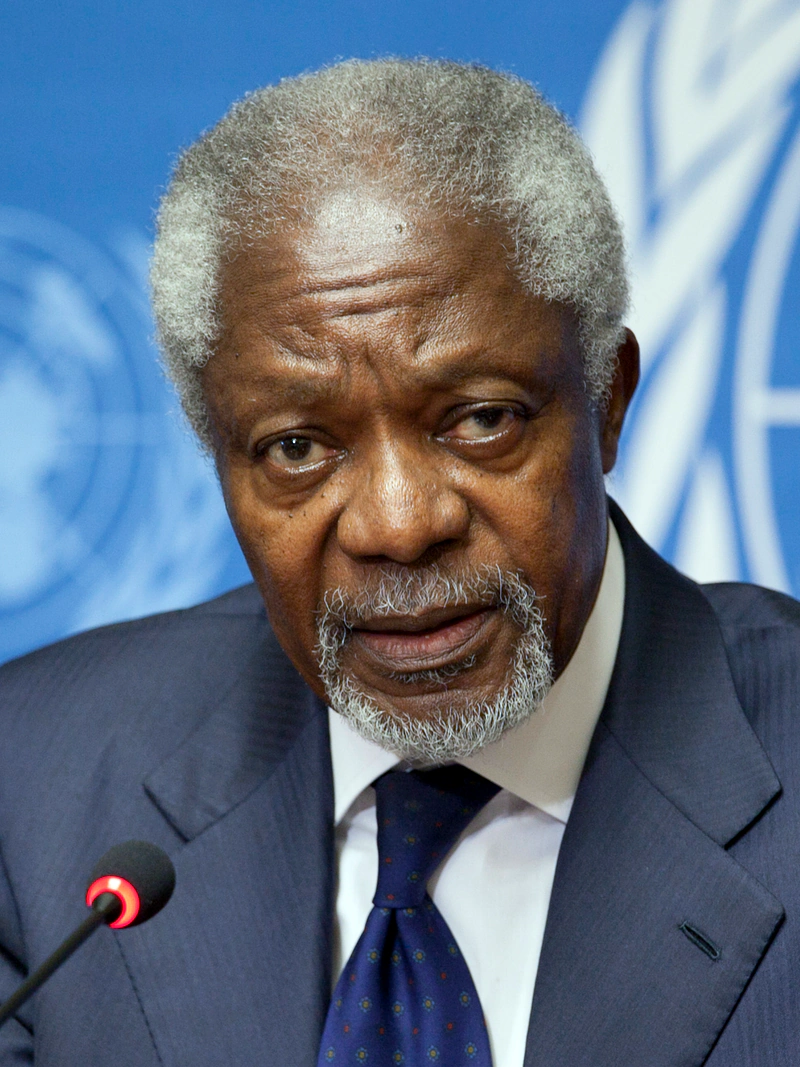
| 30 Quotes | |
| Born as | Kofi Atta Annan |
| Occup. | Statesman |
| From | Ghana |
| Born | April 8, 1938 Kumasi, Gold Coast |
| Died | August 18, 2018 Bern, Switzerland |
| Aged | 80 years |
| Cite | |
Citation Formats
APA Style (7th ed.)
Kofi annan biography, facts and quotes. (2026, February 11). FixQuotes. https://fixquotes.com/authors/kofi-annan/
Chicago Style
"Kofi Annan biography, facts and quotes." FixQuotes. February 11, 2026. https://fixquotes.com/authors/kofi-annan/.
MLA Style (9th ed.)
"Kofi Annan biography, facts and quotes." FixQuotes, 11 Feb. 2026, https://fixquotes.com/authors/kofi-annan/. Accessed 25 Mar. 2026.
Early Life and Background
Kofi Atta Annan was born on April 8, 1938, in Kumasi, in the Ashanti region of the then British-ruled Gold Coast, into a prominent Fante family with deep ties to commerce and public service. His father, Henry Reginald Annan, was an export manager and later a provincial governor; his mother, Victoria, came from a lineage of community leaders. The household was bilingual and outward-looking, a bridge between Akan tradition and the administrative modernity arriving with late colonial rule.Annan came of age as Ghana moved from colony to the first sub-Saharan African nation to win independence (1957). That national pivot formed his inner grammar: pride in sovereignty paired with suspicion of power unrestrained by law. Friends and colleagues later noted his quiet, deliberate manner - a temperament suited to an era when new states faced coups, Cold War courtship, and the daily problem of building institutions faster than grievances could multiply.
Education and Formative Influences
He attended the elite Mfantsipim School in Cape Coast, whose Methodist discipline and civic ethos emphasized service over display. After studying economics at Kumasi College of Science and Technology, he pursued a peripatetic education typical of postcolonial meritocrats: a degree in economics at Macalester College in Minnesota, graduate study in international relations at the Graduate Institute in Geneva, and mid-career training at MITs Sloan School of Management as a Sloan Fellow. The mix mattered - West African nationalism, American liberal education, Swiss multilateralism, and managerial pragmatism - producing a statesman who treated institutions as moral instruments rather than mere arenas.Career, Major Works, and Turning Points
Annan joined the United Nations system in 1962, beginning with the World Health Organization in Geneva and gradually moving into the UNs political core. His rise was patient rather than meteoric: director roles, then Assistant Secretary-General, then Under-Secretary-General for Peacekeeping Operations in the 1990s, when failures in Rwanda and Srebrenica forced the organization to confront the lethal cost of hesitancy and mandate ambiguity. In 1997 he became the first sub-Saharan African to serve as UN Secretary-General, holding the post through 2006 and steering the institution through the wars of the post-9/11 world, the Iraq crisis, and the long argument over humanitarian intervention. He championed the Millennium Development Goals, pressed for UN reform, and helped found the Global Compact to bind business to human-rights and labor standards. After leaving office, he remained a roving mediator - notably as UN-Arab League envoy for Syria in 2012 and as chair of The Elders - and he lent his credibility to election monitoring and governance initiatives in Africa while speaking bluntly about corruption and impunity.Philosophy, Style, and Themes
Annan practiced a moral diplomacy built on restraint: he rarely humiliated opponents, preferred incremental coalitions to grandstanding, and treated legitimacy as a resource that could be spent or squandered. The interior engine of that style was a belief that identity must precede policy - “To live is to choose. But to choose well, you must know who you are and what you stand for, where you want to go and why you want to get there”. For Annan, this was not self-help rhetoric but governance logic: states without a stable civic self drift toward factionalism, and international bodies without principled purpose become procedural shells.His economic internationalism was equally conditional. He accepted globalization as a structural fact - “It has been said that arguing against globalization is like arguing against the laws of gravity”. - yet refused to treat markets as moral arbiters. The psychological tension that animated his public life ran between realism and conscience: he understood the inertia of great powers and the seductions of short-term profit, but he insisted on standards that could shame as well as guide. That is why his speeches returned to education and dignity as the long lever of peace: “Knowledge is power. Information is liberating. Education is the premise of progress, in every society, in every family”. In crises, his language aimed to widen the time horizon, turning todays tactical victories into tomorrows legitimacy.
Legacy and Influence
Annan died on August 18, 2018, leaving a model of global statesmanship defined less by charisma than by ethical stamina. His tenure helped normalize the idea that sovereignty carries responsibilities - to protect citizens, to accept scrutiny, and to pursue development as security - even when the world repeatedly fell short. The UN he led remained imperfect and contested, but his imprint endured in the MDG-to-SDG development arc, in the expectation that business should answer to human-rights norms, and in the quiet craft of mediation that prizes listening over theatricality. For Ghana, he became a symbol of postcolonial possibility; for the wider world, a reminder that international order depends on people willing to translate ideals into institutions without losing their gentleness.Our collection contains 30 quotes written by Kofi, under the main topics: Ethics & Morality - Wisdom - Justice - Nature - Leadership.
Other people related to Kofi: James Wolfensohn (Businessman), Mwai Kibaki (Statesman), Mohammed Aldouri (Politician), Richard Goldstone (Judge), Adolfo Aguilar Zinser (Diplomat), Paul A. Volcker (Economist)