
Kurt Vonnegut Biography Quotes 29 Report mistakes
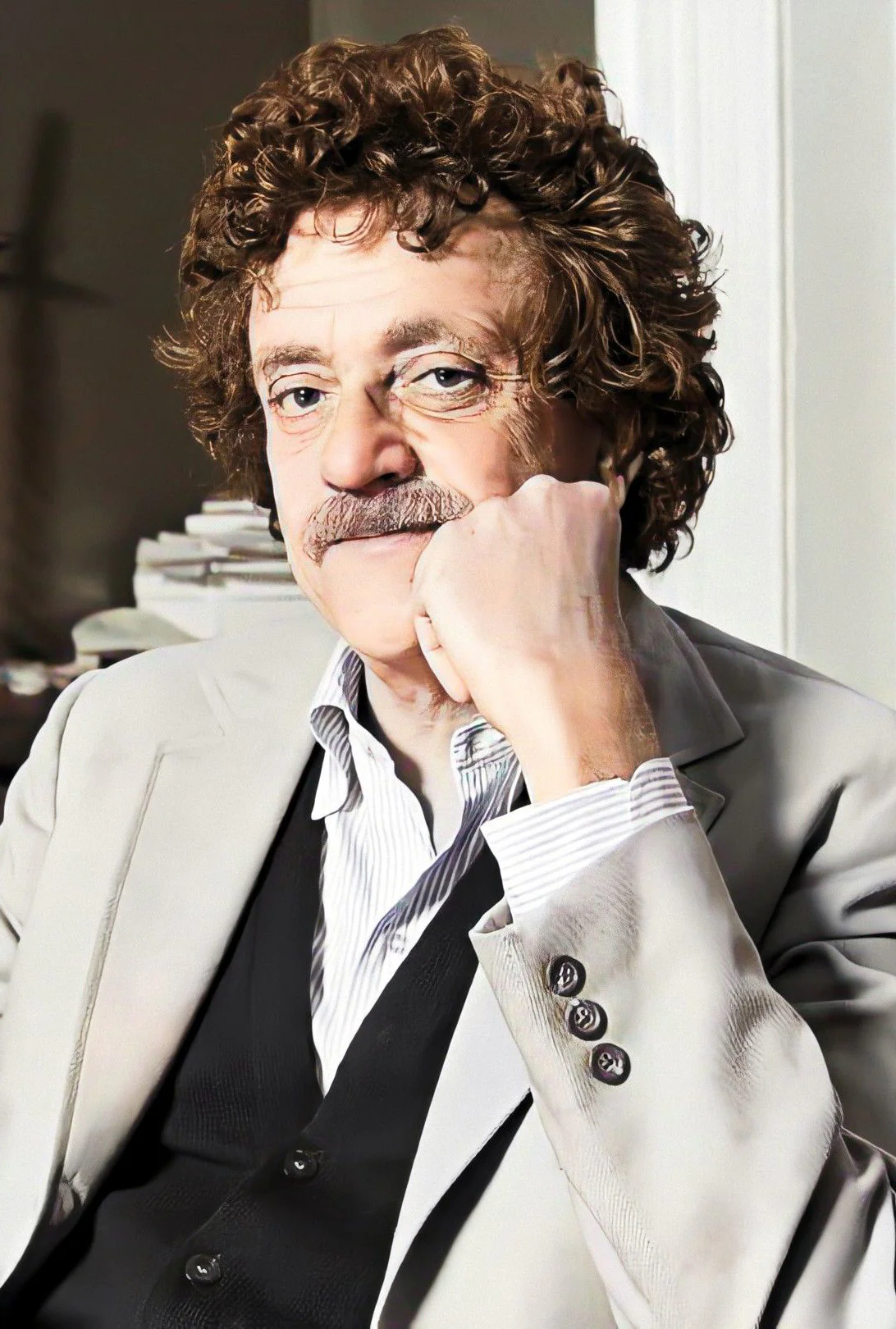
| 29 Quotes | |
| Occup. | Author |
| From | USA |
| Spouses | Jane Marie Cox (1945–1979) Jill Krementz (1979–2007) |
| Born | November 11, 1922 Indianapolis, Indiana, USA |
| Died | April 11, 2007 Manhattan, New York, USA |
| Cause | Natural causes |
| Aged | 84 years |
| Cite | |
Citation Formats
APA Style (7th ed.)
Kurt vonnegut biography, facts and quotes. (2026, February 2). FixQuotes. https://fixquotes.com/authors/kurt-vonnegut/
Chicago Style
"Kurt Vonnegut biography, facts and quotes." FixQuotes. February 2, 2026. https://fixquotes.com/authors/kurt-vonnegut/.
MLA Style (9th ed.)
"Kurt Vonnegut biography, facts and quotes." FixQuotes, 2 Feb. 2026, https://fixquotes.com/authors/kurt-vonnegut/. Accessed 26 Mar. 2026.
Early Life and Background
Kurt Vonnegut Jr. was born on November 11, 1922, in Indianapolis, Indiana, into a once-prominent German-American family whose fortunes and confidence were battered by the Great Depression. His father, Kurt Sr., was an architect whose commissions dried up; his mother, Edith (Lieber), who had been raised in wealth, struggled as the household constricted. The gap between old status and new scarcity left Vonnegut with an early education in American insecurity - how quickly comfort can become performance.He grew up amid Midwestern propriety, civic clubs, and the polite fictions of respectability, but the family carried unspoken grief. In 1944, while Vonnegut was away at war, his mother died by suicide on Mother's Day, a rupture that later surfaced in his work as a quiet, recurring question about what people owe one another when private despair collides with public cheerfulness. Indianapolis gave him his plainspoken voice and his ear for the moral comedy of ordinary talk; the Depression gave him his suspicion of institutions that promise stability but cannot deliver it.
Education and Formative Influences
Vonnegut studied at Shortridge High School, where he wrote for the student newspaper, then attended Cornell University starting in 1941, initially in biochemistry before drifting toward writing and editing The Cornell Daily Sun. He left to enlist in the U.S. Army during World War II, and the war became his decisive education: captured at the Battle of the Bulge, he was sent as a prisoner of war to Dresden and survived the February 1945 firebombing while sheltering in an underground slaughterhouse, an experience that fused technological modernity with ancient catastrophe and gave him a lifelong sense that history is both monstrous and absurdly bureaucratic.Career, Major Works, and Turning Points
After the war he studied anthropology at the University of Chicago (his thesis was rejected) and worked in public relations at General Electric in Schenectady, New York, learning the corporate idiom he would later parody with surgical accuracy. He began publishing short fiction in the 1950s, debuting as a novelist with Player Piano (1952), a satire of automation and managerial rule. The breakthrough came with Cat's Cradle (1963), then the cultural explosion of Slaughterhouse-Five (1969), which transformed personal trauma into a new American antiwar grammar. Subsequent novels - Breakfast of Champions (1973), Slapstick (1976), Jailbird (1979), Galapagos (1985), Hocus Pocus (1990), Timequake (1997) - deepened his portrait of a nation that confuses progress with profit. He lived for years on Cape Cod, later in New York City, surviving a 1984 suicide attempt and, in 2007, dying from complications after a fall on April 11.Philosophy, Style, and Themes
Vonnegut's inner life was a contest between tenderness and dread: he wanted decency to be possible in a system that seemed designed to grind it down. His narrators adopt the posture of the friendly pessimist, offering jokes as first aid for existential injury. The comedy is not evasion but triage - a way to stay awake to suffering without turning to stone. “Laughter and tears are both responses to frustration and exhaustion. I myself prefer to laugh, since there is less cleaning up to do afterward”. That preference is psychological self-defense, but also an ethical choice: laughter keeps the speaker human, connected, and capable of mercy.Formally, he wrote in shards - short chapters, slogans, cartoons of ideas - because the modern world, and his war memory, arrived in fragments. Time in Slaughterhouse-Five breaks into recurrence; fate in Cat's Cradle congeals into religious parody; technology in Player Piano becomes a spiritual demotion. His moral center is identity as role-play under pressure: “We are what we pretend to be, so we must be careful what we pretend to be”. The line is both warning and diagnosis, shaped by a century of mass persuasion, uniforms, advertising, and political theater. Yet he also refused grand cosmic explanations for pain, insisting on the stubborn fact of being alive in time: “Here we are, trapped in the amber of the moment. There is no why”. That hard sentence does not counsel nihilism so much as compassion - if there is no why, then blame is cheap and care is priceless.
Legacy and Influence
Vonnegut became one of the defining American writers of the postwar era, a bridge between high literary experiment and the plain language of the common room. He gave generations a vocabulary for surviving modernity's contradictions: the soldier who cannot unsee, the citizen numbed by spectacle, the worker replaced by a machine, the family patched together from strangers. His blend of satire, science fiction tools, and moral intimacy influenced writers across genres and helped normalize antiwar skepticism, technological critique, and an unpretentious humanism in U.S. letters. Long after his death in 2007, his work endures because it treats the reader as a co-survivor - someone who may not find a why, but can still choose kindness.Our collection contains 29 quotes written by Kurt, under the main topics: Witty One-Liners - Ethics & Morality - Wisdom - Mortality - Nature.
Other people related to Kurt: Mark Twain (Author), Mary Schmich (Journalist), Haruki Murakami (Writer), Bruce Jay Friedman (Novelist)
Kurt Vonnegut Famous Works
- 1973 Breakfast of Champions (Novel)
- 1969 Slaughterhouse-Five (Novel)
- 1963 Cat's Cradle (Novel)
- 1961 Mother Night (Novel)
- 1959 The Sirens of Titan (Novel)
- 1952 Player Piano (Novel)
Source / external links