
Lakhdar Brahimi Biography Quotes 32 Report mistakes
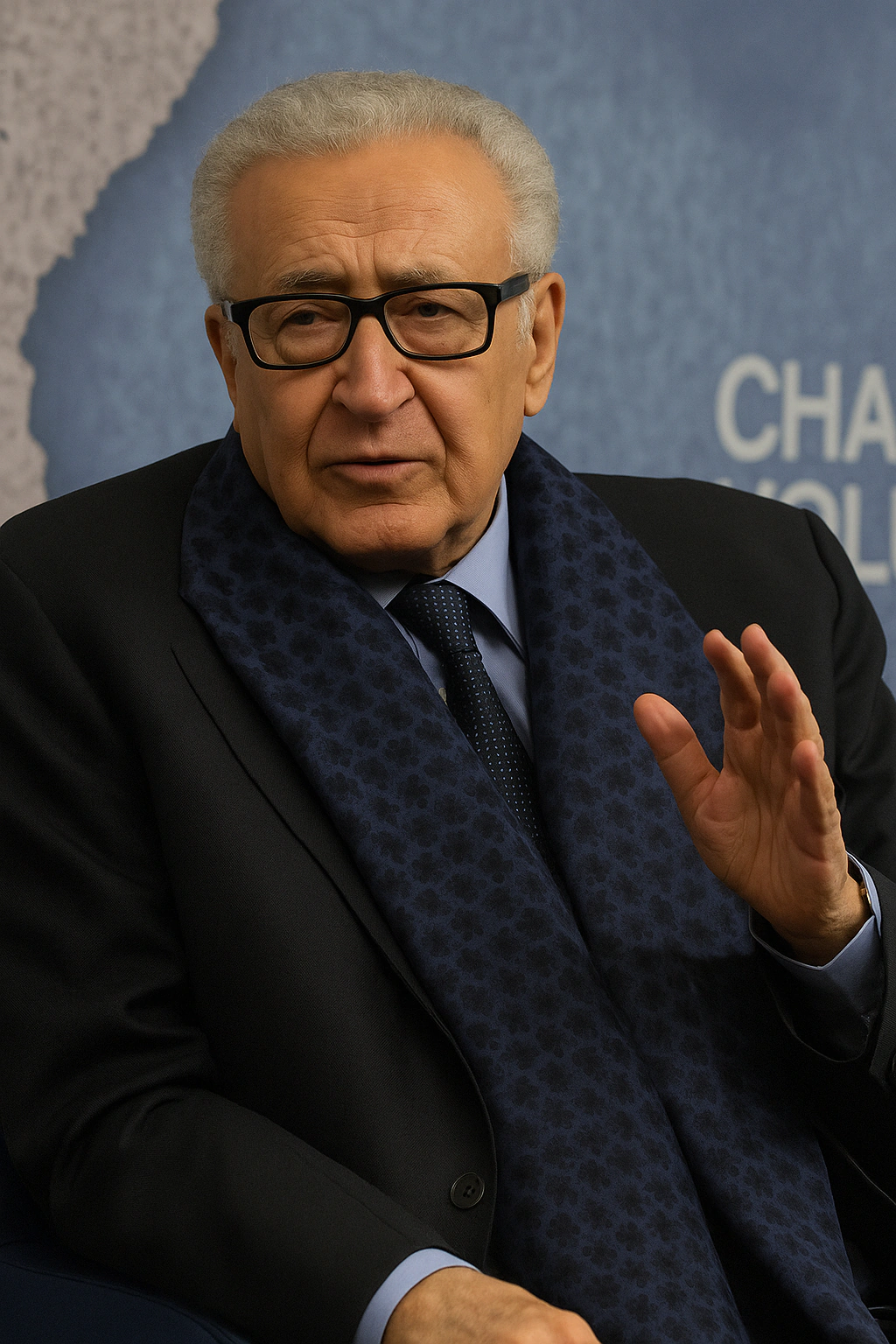
Attr: Chatham House, London
| 32 Quotes | |
| Occup. | Diplomat |
| From | Algeria |
| Born | January 1, 1934 El Azizia, French Algeria |
| Age | 92 years |
| Cite | |
Citation Formats
APA Style (7th ed.)
Lakhdar brahimi biography, facts and quotes. (2026, March 14). FixQuotes. https://fixquotes.com/authors/lakhdar-brahimi/
Chicago Style
"Lakhdar Brahimi biography, facts and quotes." FixQuotes. March 14, 2026. https://fixquotes.com/authors/lakhdar-brahimi/.
MLA Style (9th ed.)
"Lakhdar Brahimi biography, facts and quotes." FixQuotes, 14 Mar. 2026, https://fixquotes.com/authors/lakhdar-brahimi/. Accessed 25 Mar. 2026.
Early Life and Background
Lakhdar Brahimi was born in 1934 in El Azizia, near Sidi Okba in eastern Algeria, then under French colonial rule. He grew up in a society marked by legal inequality, cultural humiliation, and the daily evidence that sovereignty had been stripped from the Arab and Berber majority. That setting mattered. For Brahimi, politics was never an abstraction learned in a seminar room; it began as lived colonial experience, with power visibly organized between ruler and ruled. The generation to which he belonged came of age in the final decades of empire, when anticolonial nationalism in North Africa was hardening from aspiration into disciplined struggle.
His family background combined rural rootedness with an attachment to learning and public service, and he was formed by both Islamic-Arab traditions and the modern political language of national liberation. When the Algerian War began in 1954, he was among the young nationalists drawn into the orbit of the National Liberation Front, or FLN. Exile, clandestine work, and diplomacy became intertwined early in his life. Like many future Algerian state-builders, he was shaped by a paradox: he learned international politics while fighting for a nation that did not yet formally exist. That double consciousness - intimate knowledge of domination and practical familiarity with negotiation - would define his later career.
Education and Formative Influences
Brahimi studied in Algeria and later in France, where colonial education exposed him at once to exclusion and to the rhetoric of universal rights. He belonged to a cohort for whom formal schooling was less decisive than political apprenticeship. The real academy was the independence movement: its arguments over tactics, legitimacy, representation, and the uses of violence. During the war he served the FLN in diplomatic capacities, including work that helped present the Algerian cause abroad. Those years taught him how insurgencies seek recognition, how outside powers instrumentalize principle, and how fragile revolutionary unity can be. They also gave him an early education in the psychology of mediation - not as neutral distance, but as a disciplined attempt to move between irreconcilable narratives without becoming captive to any of them.
Career, Major Works, and Turning Points
After Algerian independence in 1962, Brahimi entered state service and became part of the new republic's diplomatic elite. He served as ambassador to Egypt and to the United Kingdom, then as foreign minister from 1991 to 1993 during one of the bleakest passages in Algerian history, when the country was sliding into the civil conflict that followed the canceled 1991 elections. His reputation, however, became global through the United Nations. He served as special envoy in South Africa, Haiti, Afghanistan, Iraq, and later Syria, repeatedly called in when peace processes were stalled by mistrust, factionalism, or external meddling. In 2000 he chaired the panel whose report on UN peace operations - usually called the Brahimi Report - became a landmark in rethinking peacekeeping after the failures of the 1990s. His central role in the Bonn Agreement of 2001, which created an interim Afghan political framework after the fall of the Taliban, cemented his image as the UN's most seasoned crisis diplomat. Yet his career was also marked by limits: Iraq after 2003, Lebanon, and especially Syria showed how even the most respected envoy could be overwhelmed when major powers used negotiation as cover for rivalry rather than resolution.
Philosophy, Style, and Themes
Brahimi's public manner was patient, grave, and deliberately untheatrical. He cultivated authority without grandiosity, preferring understatement to moral exhibition. At the core of his method was a realism sharpened by anticolonial memory. He understood that wounded societies do not respond to slogans about institution-building if humiliation, fear, and foreign intrusion remain unaddressed. His diplomacy began with ethical posture: “Be modest, be respectful of others, try to understand”. This was not mere civility. It reflected a hard-earned belief that mediators fail when they confuse access with insight. He paired that modesty with a visceral identification with the vulnerable: “There is also a natural and very, very strong empathy with the underdog, with people who have suffered, people who have been pushed around by foreigners in particular, but also by their own people”. In psychological terms, this empathy grew from Algeria's colonial wound, but he disciplined it so that sympathy did not become sentimentality.
Just as important was his distrust of diplomatic vanity. Brahimi repeatedly stressed that envoys arrive clothed in institutional legitimacy, but legitimacy alone does not move armed actors. “You are dealing with people who have taken the responsibility of killing their own because they think that they are right, they think that they are serving the interests of their people. They not going to give that up easily, just because you've shown up”. That sentence reveals his deepest theme: politics is tragic before it is procedural. He resisted both romantic revolutionary myths and technocratic illusions, insisting that peace requires not only formulas and mandates but an unsparing reading of pride, grief, fear, and memory. In this, his style joined Arab political intelligence, UN institutional experience, and the austere self-knowledge of a man who had seen how often good intentions are defeated by timing, ego, and force.
Legacy and Influence
Lakhdar Brahimi's legacy rests on two intertwined achievements: he professionalized a more self-critical form of international mediation, and he embodied a postcolonial statesmanship that could speak with credibility to both great powers and battered societies. The Brahimi Report reshaped debate on peace operations by insisting on clearer mandates, better resources, and strategic honesty. His field work in Afghanistan set a template - imperfect but consequential - for transitional bargaining under UN auspices. Even where he did not succeed, especially in Syria, his failure illuminated the structural weakness of diplomacy when external patrons prefer proxy war to compromise. He remains significant not simply as a troubleshooter of late twentieth- and early twenty-first-century conflicts, but as a moral-political type: the anti-imperial diplomat who never surrendered to ideological innocence, the international civil servant who knew that legitimacy must be earned among those who suffer, and the negotiator whose seriousness came from having lived history before he tried to mediate it.
Our collection contains 32 quotes written by Lakhdar, under the main topics: Wisdom - Justice - Leadership - Freedom - Knowledge.
Other people related to Lakhdar: Zalmay Khalilzad (Diplomat), Adnan Pachachi (Politician)
Source / external links