
Langston Hughes Biography Quotes 14 Report mistakes
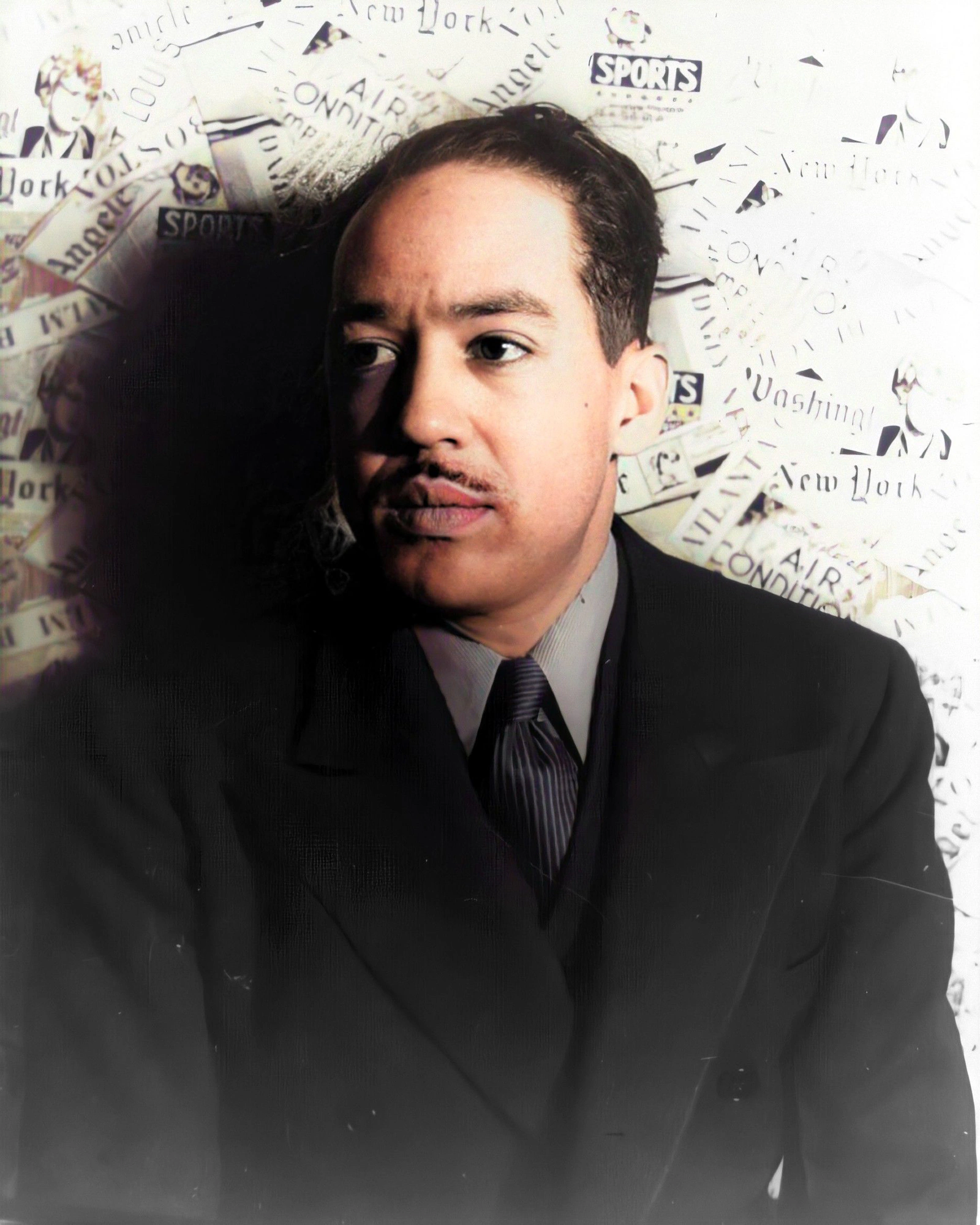
Attr: Carl Van Vechten
| 14 Quotes | |
| Born as | James Mercer Langston Hughes |
| Occup. | Poet |
| From | USA |
| Born | February 1, 1902 Joplin, Missouri, USA |
| Died | May 22, 1967 New York City, New York, USA |
| Cause | Prostate cancer |
| Aged | 65 years |
| Cite | |
Citation Formats
APA Style (7th ed.)
Langston hughes biography, facts and quotes. (2026, February 11). FixQuotes. https://fixquotes.com/authors/langston-hughes/
Chicago Style
"Langston Hughes biography, facts and quotes." FixQuotes. February 11, 2026. https://fixquotes.com/authors/langston-hughes/.
MLA Style (9th ed.)
"Langston Hughes biography, facts and quotes." FixQuotes, 11 Feb. 2026, https://fixquotes.com/authors/langston-hughes/. Accessed 25 Mar. 2026.
Early Life and Background
James Mercer Langston Hughes was born on February 1, 1902, in Joplin, Missouri, into a Black middle-class family strained by separation and migration. His parents, James Nathaniel Hughes and Caroline (Carrie) Mercer Langston, split early; his father sought opportunity and distance from American racism abroad, while his mother pursued work that kept her moving. The child became, in effect, itinerant - shuttled among relatives and towns, absorbing the textures of Black life in the Midwest at the opening of the 20th century, when Jim Crow law, racial violence, and limited economic horizons shaped every practical choice.A stabilizing figure was his maternal grandmother, Mary Patterson Langston, in Lawrence, Kansas, who filled his imagination with family histories tied to abolitionism and Reconstruction-era politics. After her death, Hughes rejoined his mother and lived in places including Lincoln, Illinois, and Cleveland, Ohio. The emotional weather of those years - longing for belonging, skepticism toward respectability, hunger for beauty amid constraint - later surfaced in poems that made the ordinary lives of Black workers, lovers, and dreamers feel central rather than marginal.
Education and Formative Influences
In Cleveland, Hughes attended Central High School, edited the school literary magazine, and began publishing poems; he also encountered the Great Migration firsthand as Northern cities reshaped under the pressure of Southern Black arrivals and industrial labor demands. In 1920-1921 he spent time in Mexico with his father, whose ambition and bitterness toward the United States pushed Hughes to define himself against both assimilation and exile. He entered Columbia University in 1921 but left after a year, drawn less to classrooms than to streets, music, and travel; he worked a string of jobs and sailed as a seaman, experiences that broadened his ear for vernacular speech and his sense of Black life as global, not provincial.Career, Major Works, and Turning Points
Hughes broke through during the Harlem Renaissance, the 1920s flowering of Black arts and politics centered in New York City. His early poem "The Negro Speaks of Rivers" (1921) announced a historical, almost mythic consciousness; his first book, The Weary Blues (1926), fused blues cadence with modernist compression, while Fine Clothes to the Jew (1927) risked controversy by refusing sanitized portrayals of poverty. He studied at Lincoln University in Pennsylvania, graduating in 1929, and went on to write across forms: the novel Not Without Laughter (1930), short stories, plays, essays, and journalism. During the Depression he aligned with labor and anti-lynching causes; in the 1930s he traveled in the Soviet sphere and reported on race and class with a sharp, unsentimental eye. Later, his "Simple" stories, beginning in the 1940s, made a barbershop philosopher a vehicle for social critique, and his 1951 poem-cycle Montage of a Dream Deferred captured postwar Harlem's bop rhythms and frayed hopes. He died in New York City on May 22, 1967, as the civil rights era he had long anticipated entered a more volatile phase.Philosophy, Style, and Themes
Hughes's inner life was marked by a disciplined insistence on possibility without naivete. He believed movement could be engineered by will, yet understood that will met structures; that tension animates his work as both lyric and argument. “I have discovered in life that there are ways of getting almost anywhere you want to go, if you really want to go”. The sentence reads like self-coaching, the voice of a man who had to build a career without the usual patronage networks, but it also hints at restlessness - the need to keep going because stopping meant being defined by others.His style made room for laughter as survival and as weapon, translating blues, jazz, street talk, and sermon rhetoric into literary art without stripping them of bite. He wrote about hunger, rent, and humiliation not as background but as shaping forces of consciousness, and he gave defiance a communal cadence: “I swear to the Lord, I still can't see, why Democracy means, everybody but me”. That line crystallizes his political psychology - patriotism tested by exclusion, faith strained into irony, the demand that national ideals finally match lived reality. Just as pointed is his most famous question, “What happens to a dream deferred? Does it dry up Like a raisin in the sun?... Or does it explode?” Hughes treated deferred dreams as a social condition with bodily consequences: fatigue, anger, mischief, and sometimes revolt. Even his tenderness - rain, music, love - is rarely escapist; it is a chosen tenderness against a world that trained people to harden.
Legacy and Influence
Hughes became the most widely read poet of the Harlem Renaissance because he insisted that Black life in its full range - elegant and rough, sacred and profane, hopeful and furious - was already worthy of art. His innovations helped legitimize jazz and blues aesthetics on the page and opened a path for later writers from Gwendolyn Brooks to Amiri Baraka, from Lorraine Hansberry (whose A Raisin in the Sun took its title from his poem) to contemporary spoken-word artists. He also modeled a public literary citizenship: writing for newspapers, theaters, schools, and mass audiences, and treating craft as a form of service. In an America that often demanded either silence or caricature, Hughes left a body of work that kept complexity audible - the music of a people insisting on their own truth.Our collection contains 14 quotes written by Langston, under the main topics: Witty One-Liners - Motivational - Funny - Art - Never Give Up.
Other people related to Langston: Walt Whitman (Poet), Gwendolyn Brooks (Poet), Arna Bontemps (Poet), Margaret Walker (Poet), Henry Louis Gates (Critic), Alfred A. Knopf (Publisher), Carl Van Vechten (Writer)
Langston Hughes Famous Works
- 1961 Black Nativity (Play)
- 1957 Simply Heavenly (Play)
- 1956 I Wonder as I Wander (Memoir)
- 1951 Montage of a Dream Deferred (Poetry Collection)
- 1934 The Ways of White Folks (Short Story Collection)
- 1930 Not Without Laughter (Novel)
Source / external links