
Leonardo da Vinci Biography Quotes 44 Report mistakes
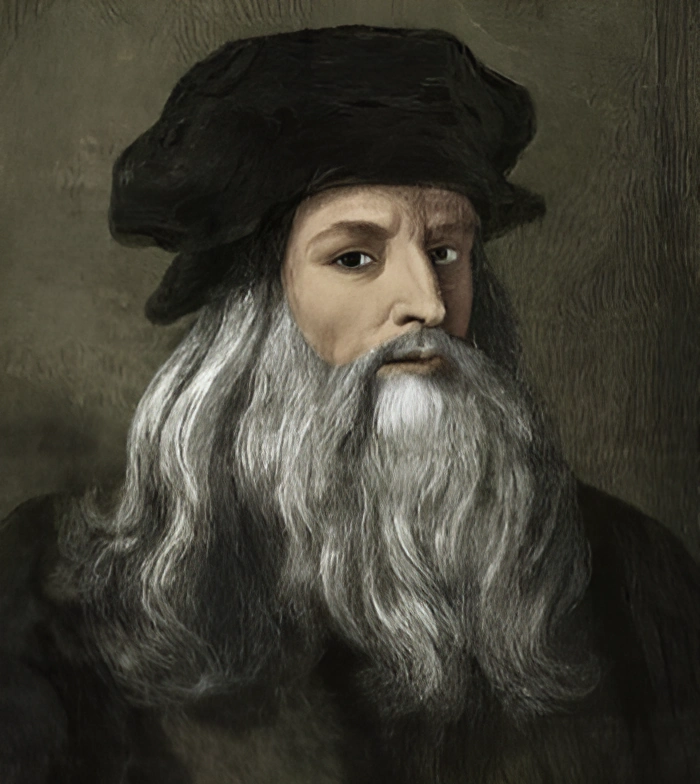
| 44 Quotes | |
| Born as | Leonardo di ser Piero da Vinci |
| Occup. | Artist |
| From | Italy |
| Born | April 15, 1452 |
| Died | May 2, 1519 |
| Aged | 67 years |
| Cite | |
Citation Formats
APA Style (7th ed.)
Leonardo da vinci biography, facts and quotes. (2026, February 11). FixQuotes. https://fixquotes.com/authors/leonardo-da-vinci/
Chicago Style
"Leonardo da Vinci biography, facts and quotes." FixQuotes. February 11, 2026. https://fixquotes.com/authors/leonardo-da-vinci/.
MLA Style (9th ed.)
"Leonardo da Vinci biography, facts and quotes." FixQuotes, 11 Feb. 2026, https://fixquotes.com/authors/leonardo-da-vinci/. Accessed 26 Mar. 2026.
Early Life and Background
Leonardo di ser Piero da Vinci was born on 1452-04-15 in or near Vinci, in the Tuscan countryside of Italy, the illegitimate son of Ser Piero, a Florentine notary, and a local woman commonly identified in later tradition as Caterina. His childhood unfolded at the seam between village craft knowledge and the bureaucratic world of Florence that his father served - a social position that granted proximity to privilege without fully belonging to it. That in-betweenness became formative: Leonardo learned early to observe, adapt, and earn his place through skill rather than inheritance.Raised largely in his father's household, he grew up amid olive groves, streams, and stone, developing the sensibility of a naturalist before he became an artist. The Tuscan landscape was not background scenery but an early laboratory: cloud forms, watercourses, strata, plants, and animal motion supplied the visual grammar that later surfaced in his painting and notebooks. The era was one of competing city-states, banking wealth, and humanist ambition - a world that prized display yet was haunted by war, plague, and political reversal.
Education and Formative Influences
Leonardo's formal Latin schooling was limited compared with university-trained humanists, a gap he would compensate for through relentless self-education and an empirical method. Around the mid-1460s he entered the Florentine workshop of Andrea del Verrocchio, where drawing, sculpture, engineering, perspective, and materials science were taught as a single craft ecology. Florence under the Medici cultivated spectacle and experimentation; Leonardo absorbed its anatomy lessons from artists, its mathematical perspective, and its appetite for ingenious machines, while building a private habit of note-taking that fused image and text into a working instrument of thought.Career, Major Works, and Turning Points
By the 1470s Leonardo was an independent master in Florence, producing works such as the Annunciation and portraits, while also navigating accusations and the precariousness of patronage. A decisive turn came in 1482 when he moved to Milan to serve Ludovico Sforza, offering himself as engineer as much as painter; there he designed court entertainments, studied fortification and hydraulics, and painted the Virgin of the Rocks and The Last Supper (1495-1498) in Santa Maria delle Grazie, a masterpiece whose experimental technique later contributed to its fragility. After the French conquest of Milan (1499) he became itinerant - working in Mantua, Venice, and Florence - and began the long, unresolved labor on the Mona Lisa, while pursuing anatomy with increasing intensity. In the 1510s he returned to Milan under French patronage, then in 1516 accepted the invitation of King Francis I and moved to Amboise, France, where he spent his final years organizing notebooks and projects until his death on 1519-05-02.Philosophy, Style, and Themes
Leonardo's inner life was governed by a discipline of attention. He distrusted mere verbal authority and treated seeing as a moral and intellectual act: to perceive accurately was to approach truth. His notebooks reveal a mind that could not stop testing - light on skin, vortices in water, the mechanics of a bird's wing - and then returning these findings to art. The resulting style, especially his sfumato, is not softness for its own sake but a philosophy of uncertainty: edges dissolve because experience does. Faces in his paintings often withhold as much as they reveal, suggesting a psychology attuned to motive, concealment, and the layered nature of perception.He also lived under the pressure of unfinishedness, drawn to problems whose solution kept receding. “Art is never finished, only abandoned”. That sentence captures both the grandeur and the cost of his perfectionism: projects expanded as his knowledge expanded, and mastery became a moving target. Yet he framed this restlessness as method, insisting on the marriage of concept and execution: “He who loves practice without theory is like the sailor who boards ship without a rudder and compass and never knows where he may cast”. His reverence for the natural world - not as romantic scenery but as optimized design - anchored his inventions and compositions: “Human subtlety will never devise an invention more beautiful, more simple or more direct than does nature because in her inventions nothing is lacking, and nothing is superfluous”. Nature, for Leonardo, was both teacher and judge, and the artist-engineer was obligated to learn her economy.
Legacy and Influence
Leonardo endures not simply as a great Italian Artist but as a model of the integrative mind: painting, anatomy, mechanics, and philosophy treated as one inquiry. His paintings set enduring standards for psychological presence and pictorial unity; The Last Supper reshaped narrative painting, while the Mona Lisa became an icon of modern visual culture. His notebooks, widely disseminated in later centuries, helped define the ideal of the artist as investigator and the scientist as draftsman, influencing academic drawing, engineering visualization, and the very myth of the Renaissance genius - a figure driven by curiosity, burdened by scope, and continually reaching beyond what a single lifetime can complete.Our collection contains 44 quotes written by Leonardo, under the main topics: Witty One-Liners - Motivational - Ethics & Morality - Truth - Wisdom.
Other people related to Leonardo: Paul Valery (Poet)
Source / external links