
Léopold Sédar Senghor Biography Quotes 8 Report mistakes
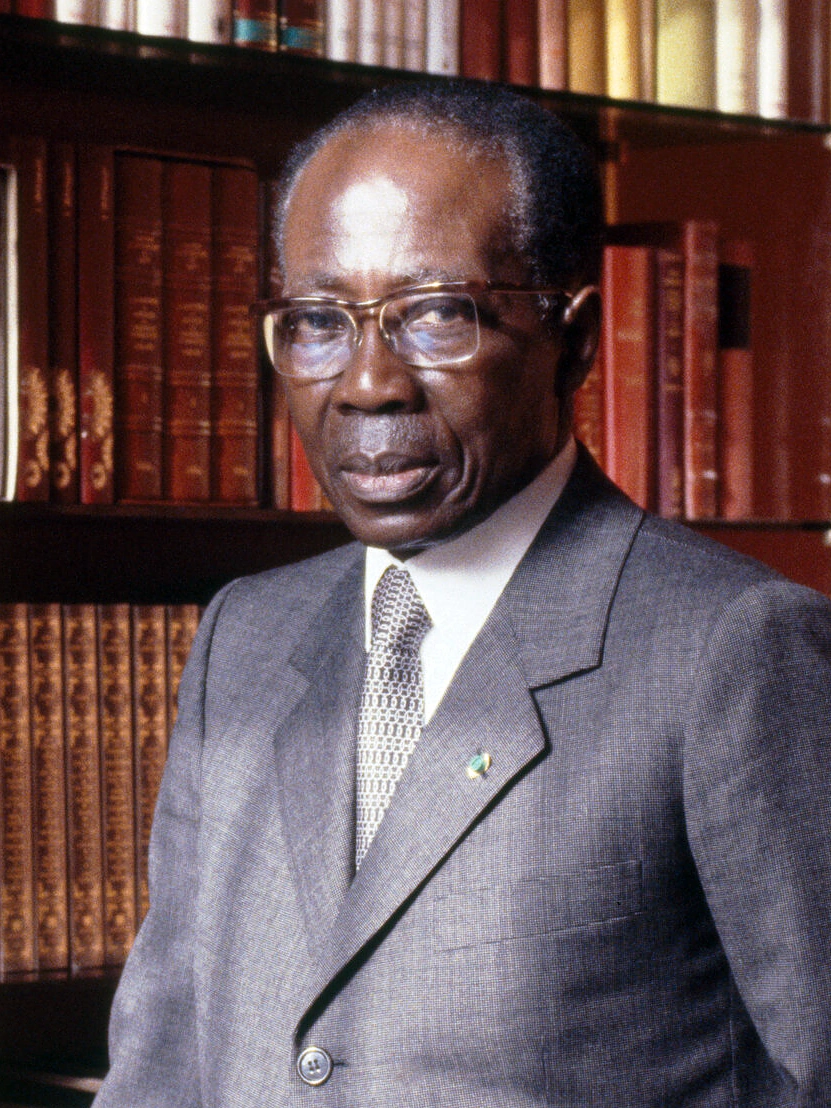
Attr: The New York Times
| 8 Quotes | |
| Occup. | President |
| From | Senegal |
| Spouses | Ginette Eboué Colette Hubert (née Colette Hubert) |
| Born | October 9, 1906 Joal-Fadiouth, Thiès Region, French West Africa (now Senegal) |
| Died | December 20, 2001 Verson, Calvados, France |
| Cause | Natural causes (age-related illness) |
| Aged | 95 years |
| Cite | |
Citation Formats
APA Style (7th ed.)
Léopold sédar senghor biography, facts and quotes. (2026, February 16). FixQuotes. https://fixquotes.com/authors/leopold-sedar-senghor/
Chicago Style
"Léopold Sédar Senghor biography, facts and quotes." FixQuotes. February 16, 2026. https://fixquotes.com/authors/leopold-sedar-senghor/.
MLA Style (9th ed.)
"Léopold Sédar Senghor biography, facts and quotes." FixQuotes, 16 Feb. 2026, https://fixquotes.com/authors/leopold-sedar-senghor/. Accessed 30 Mar. 2026.
Early Life and Background
Leopold Sedar Senghor was born in 1906 at Joal, a Serer coastal town in what was then French West Africa, and died in 2001 in France after a long retirement. His family was Catholic in a region marked by deep religious pluralism - Islam, local spiritual systems, and the mission church - and his childhood unfolded amid the everyday frictions of empire: French schools and administrators, forced economic hierarchies, and African social orders adapting under pressure.That early world gave him two lifelong coordinates: a devotion to language and ritual, and an instinct for mediation. Senghor learned the cadence of Serer oral culture and the liturgical music of Catholic worship, then watched colonial modernity reshape villages into export corridors. The result was not a simple anti-European reflex but a double awareness - pride in African rootedness paired with a determination to master the tools of the colonizer without being possessed by them.
Education and Formative Influences
He studied at missionary schools before traveling to France, entering the elite track of French education and, in 1935, becoming the first African to pass the agregation in French grammar. In Paris he moved among Black intellectual circles and formed a decisive friendship with Aime Cesaire, alongside Leon-Gontran Damas, helping articulate Negritude as a literary and philosophical response to assimilation. His formation was also scarred by war: drafted into the French army in 1939, captured in 1940, and held as a prisoner of war, he experienced both the vulnerability and the paradoxical reach of French citizenship under imperial rule.Career, Major Works, and Turning Points
After the war Senghor entered politics, serving as a deputy in the French National Assembly and later as a minister-adviser in French governments during the uncertain transition from empire to association. He became a central architect of Senegalese independence and, in 1960, the first president of Senegal, governing until 1980 in a one-party dominant system that combined parliamentary forms with firm executive control; he voluntarily stepped down, an uncommon act in the region. Parallel to statecraft ran a sustained literary career: the poetry collections Chants d'ombre (1945), Hosties noires (1948), Ethiopiques (1956), and Nocturnes (1961) shaped Francophone African letters, while his essays on culture and politics argued for African humanism, federation, and what he called a "civilization of the universal" rather than narrow nationalism.Philosophy, Style, and Themes
Senghor's inner life is best read as a continuous effort to reconcile contraries: Africa and Europe, intuition and method, village memory and administrative modernity. His notorious formulation, “Emotion is Negro, just as reason is Hellenic”. was less a biological claim than a provocative map of sensibilities, meant to dignify what colonial ideology dismissed as "primitive". It also reveals a psychological need to turn stigma into structure - to make wounded identity legible, even at the risk of essentialism. His poetry answers with music: rhythm as knowledge, not ornament, and the body as an archive where history survives when institutions fail.Negritude for Senghor was not separatism but contribution, a wager that the future required mixture without erasure. In his civic-spirited mysticism he urged participation in a common rebirth: "Let us answer “Present!” at the rebirth of the world, as the leaven that the white flour needs" . This is the psychology of a bridge-builder, sometimes accused of being too conciliatory, yet driven by a fear that pure negation would leave Africa trapped in reactive politics. His mature cultural politics insist that development begins and ends with meaning-making: “I think that these cultural problems are the fundamental problems at the beginning and end of development”. In practice, this translated into state patronage for arts and language, and an insistence that modernization without cultural dignity would become another form of dependency.
Legacy and Influence
Senghor remains a complicated emblem: poet-president, theorist of Black affirmation in the language of France, democrat by resignation yet also a leader who limited pluralism to secure stability. He helped institutionalize Francophone African literature, influenced decolonial aesthetics, and gave a vocabulary - Negritude, rhythm, universal civilization - that still frames debates about identity and globalization. His life continues to pose an enduring question for postcolonial states: whether cultural synthesis can be pursued without reproducing the hierarchies that made synthesis necessary in the first place.Our collection contains 8 quotes written by Léopold, under the main topics: Music - Deep - Reason & Logic - Poetry - New Beginnings.
Source / external links