
Linda M. Godwin Biography Quotes 21 Report mistakes
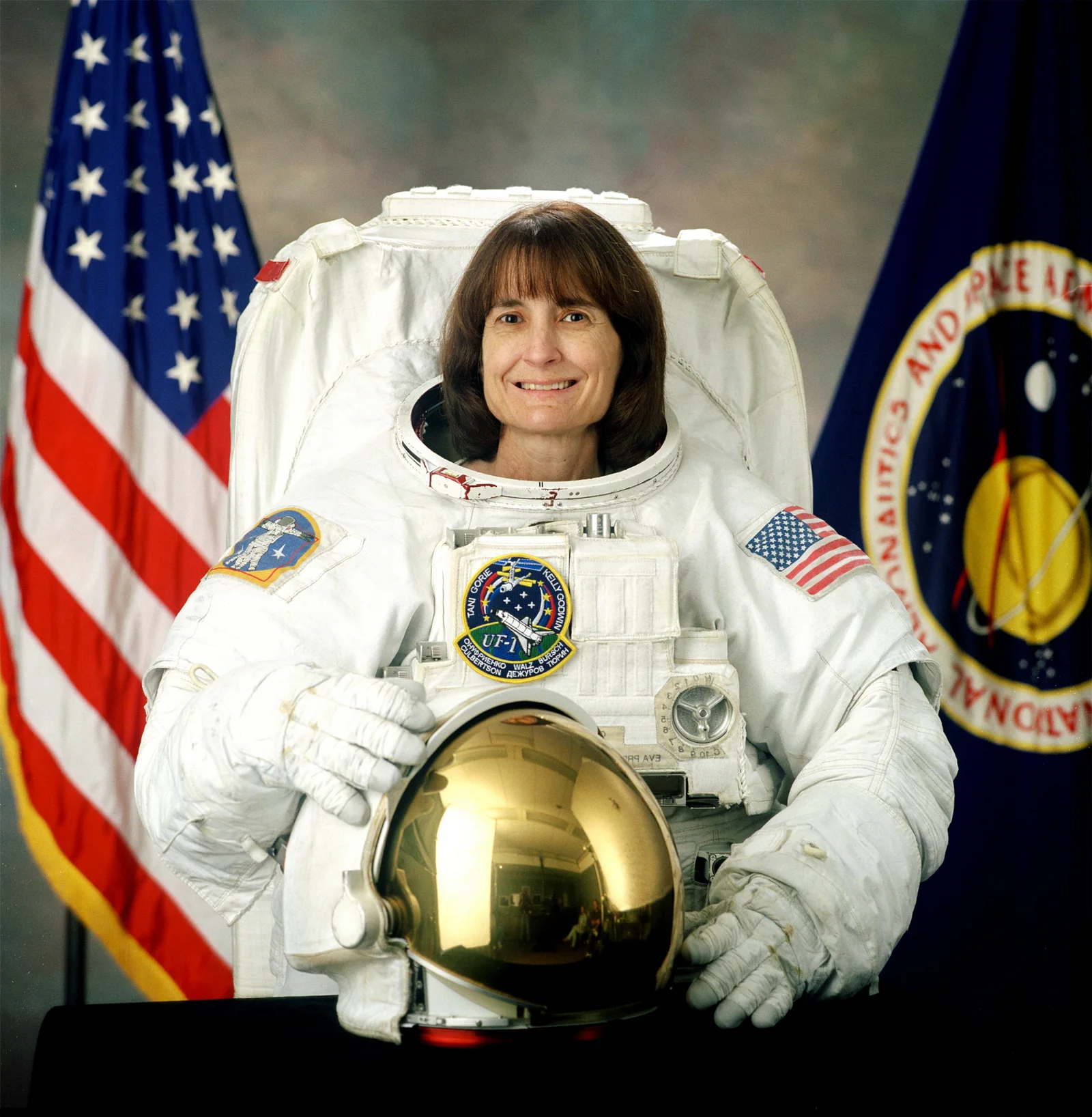
| 21 Quotes | |
| Occup. | Astronaut |
| From | USA |
| Born | July 2, 1952 |
| Age | 73 years |
| Cite | |
Citation Formats
APA Style (7th ed.)
Linda m. godwin biography, facts and quotes. (2026, February 11). FixQuotes. https://fixquotes.com/authors/linda-m-godwin/
Chicago Style
"Linda M. Godwin biography, facts and quotes." FixQuotes. February 11, 2026. https://fixquotes.com/authors/linda-m-godwin/.
MLA Style (9th ed.)
"Linda M. Godwin biography, facts and quotes." FixQuotes, 11 Feb. 2026, https://fixquotes.com/authors/linda-m-godwin/. Accessed 12 Feb. 2026.
Early Life and Background
Linda Maxine Godwin was born on July 2, 1952, in Cape Girardeau, Missouri, a river town where Midwestern practicality met the long horizon of the early Space Age. She grew up in an America that treated Apollo as nightly news and engineering as a civic religion, and that atmosphere mattered: for scientifically inclined children, the 1960s turned curiosity into an ambition that felt socially legible. Godwin later carried that blend of humility and resolve into a profession that demanded both - the ability to work quietly for years, then perform flawlessly in public.Family and community shaped her in subtler ways. Southeast Missouri offered fewer glamorous pathways into high technology, but it rewarded competence, steadiness, and team-mindedness. Those traits became signature elements of Godwin's astronaut identity: she rarely presented spaceflight as personal heroism, more as a chain of careful decisions that had to hold under stress. The consequence was a career defined less by spectacle than by the cumulative authority that comes from being trusted with complex systems.
Education and Formative Influences
Godwin pursued physics at Southeast Missouri State University, earning a B.S. in 1974, then moved into deeper technical training with an M.S. in physics from the University of Missouri, Columbia in 1976 and a Ph.D. in physics from the University of Missouri, Columbia in 1980. Her graduate years coincided with the transition from Apollo's one-off triumphs to the Shuttle era's promise of routine access to orbit - a promise that reframed space as a laboratory, not only a destination. That intellectual shift, reinforced by the developing culture of interdisciplinary "space science", helped set her compass toward research-rich missions where human operations and experiments had to coexist in tight quarters.Career, Major Works, and Turning Points
After doctoral work and scientific research, Godwin joined NASA and was selected as an astronaut in 1985, entering a corps remade by the Shuttle program's emphasis on payloads, international cooperation, and operational rigor. She flew four Space Shuttle missions: STS-37 (1991) and STS-59 (1994), both with significant scientific payloads, and later STS-76 (1996) and STS-108 (2001), missions that helped build and sustain the International Space Station. Across these flights she accumulated more than a month in space and performed an EVA during STS-76, a turning point that tested the intimate partnership between human physiology and engineered life support. Her trajectory also mirrored NASA's institutional evolution after Challenger and Columbia-era risk reassessments: professionalism became less about bravado and more about disciplined communication, redundancy, and the humility to treat every procedure as a potential line between success and catastrophe.Philosophy, Style, and Themes
Godwin's public voice consistently framed spaceflight as applied problem-solving in service of knowledge. She spoke like a physicist embedded in operations: abstract curiosity translated into hardware, timelines, and error budgets. Her interest in microgravity research was not romantic but diagnostic, rooted in the belief that the orbiting laboratory could reveal mechanisms hidden by Earth's constant pull. "There's a lot of interest from the medical community on how things develop in microgravity, and the hope, later, that is expected to apply to what the changes are in humans as well". The psychology beneath that sentence is telling - she gravitates toward downstream meaning, the way a mission's constraints justify themselves through future benefit, and she understands the body as both subject and instrument.A second theme is her attention to the prosaic, logistical reality of exploration. Godwin often emphasized that grand projects are carried by inventories, packaging discipline, and the choreography of human labor. "We're taking up some science experiments, some crystal growth things, we have a refrigerator that carries up some samples, new samples that go into the station, we bring the old ones home; we have a lot of clothing, we have a lot of food-U.S. and Russian food". Her style collapses the false boundary between "science" and "support", suggesting an inner ethic in which no item is trivial if it protects the mission's continuity. That ethic extends to her view of the ISS itself as a living system that must be completed and scaled to fulfill its diplomatic and scientific purpose. "We still have a lot of international partner modules that need to get up there to make it truly the international structure that it will be, and that's highly important; we need to get to where the crew size is bigger". In Godwin's framing, space is not conquered by solitary daring but by long-term coalition, patience, and the maturity to treat other nations' contributions as structural, not symbolic.
Legacy and Influence
Godwin's enduring influence lies in the model she offered for the Shuttle-to-Station generation: the astronaut as scientist-operator, fluent in experiment goals yet relentlessly attentive to procedures, stowage, timelines, and international interfaces. Her missions bridged two eras - the Shuttle as a stand-alone research platform and the Shuttle as a construction and logistics vehicle for a permanent outpost - and her calm, systems-oriented voice helped normalize the idea that human spaceflight is a sustained public utility rather than a series of stunts. For younger astronauts and STEM students, her biography quietly argues that excellence is built from repeatable habits: deep technical education, adaptability in mixed teams, and a belief that even the most awe-inspiring view from orbit is ultimately in service of work.Our collection contains 21 quotes written by Linda, under the main topics: Learning - Science - Health - Training & Practice - Work.
Source / external links