
Lord Chesterfield Biography Quotes 61 Report mistakes
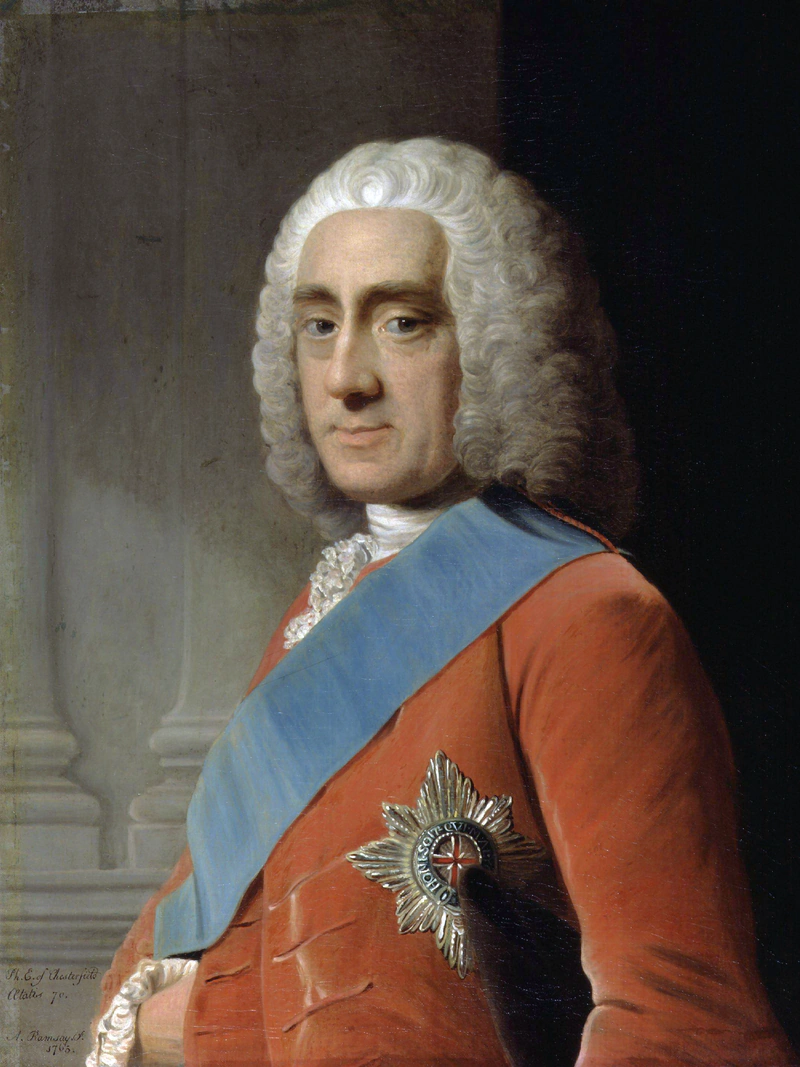
Attr: Public domain
| 61 Quotes | |
| Born as | Philip Dormer Stanhope |
| Occup. | Statesman |
| From | United Kingdom |
| Born | September 22, 1694 |
| Died | March 24, 1773 |
| Aged | 78 years |
| Cite | |
Citation Formats
APA Style (7th ed.)
Lord chesterfield biography, facts and quotes. (2026, February 11). FixQuotes. https://fixquotes.com/authors/lord-chesterfield/
Chicago Style
"Lord Chesterfield biography, facts and quotes." FixQuotes. February 11, 2026. https://fixquotes.com/authors/lord-chesterfield/.
MLA Style (9th ed.)
"Lord Chesterfield biography, facts and quotes." FixQuotes, 11 Feb. 2026, https://fixquotes.com/authors/lord-chesterfield/. Accessed 1 Apr. 2026.
Early Life and Background
Philip Dormer Stanhope was born in London on September 22, 1694, into the high Whig aristocracy at the hinge between the Restoration settlement and the fully Hanoverian age. His father, Philip Stanhope, 3rd Earl of Chesterfield, belonged to a political world in which lineage granted access but not security, and where speech, alliances, and manners could decide whether a man rose at court or was quietly ruined. The young Stanhope grew up amid the anxieties of succession politics, the memory of civil conflict, and the sharpening divide between a commercial, increasingly literate public and the older, ceremonial language of rank.His childhood carried a private wound that later shaped his obsession with polish and self-command: he was physically frail and marked by deafness from an early age, a disability that in public life could feel like vulnerability. That limitation pushed him toward a compensating mastery of observation and social tactics. In a culture that prized conversation and wit as political instruments, he trained himself to read rooms, calculate motives, and treat personal presentation not as vanity but as a form of power.
Education and Formative Influences
Educated at Trinity Hall, Cambridge, and then refined through the Grand Tour, Chesterfield absorbed the classical tradition alongside the cosmopolitan codes of Paris, The Hague, and Italian courts. The Tour mattered less as a catalog of sights than as an apprenticeship in European diplomacy: how ministers spoke when they wanted something, how salons policed status through nuance, and how a statesman could be made or unmade by tone. He returned to Britain with a Whig commitment to the post-1688 order, but also with a Continental sense that civility was not mere decorum - it was strategy.Career, Major Works, and Turning Points
Chesterfield entered Parliament as a young man and inherited the earldom in 1726, moving to the House of Lords; he served in major offices under the Whig ascendancy, including as ambassador to the Dutch Republic and, later, as Lord Lieutenant of Ireland (1745-46), where he combined conciliation with a shrewd, pragmatic governance that won him unusual popularity. Yet his relations with the inner circle of power were uneasy: he could be brilliant, but he detested political clumsiness and resented being used as ornament rather than strategist. The turning point of his public reputation came less from office than from print: his patronage of Samuel Johnson's Dictionary ended in Johnson's famous rebuke, and after Chesterfield's death his private letters to his illegitimate son, Philip Stanhope, were published as the Letters to His Son - transforming him from statesman to emblem of worldly instruction, admired for style and condemned by some as cold.Philosophy, Style, and Themes
Chesterfield's governing psychology was a tension between Enlightenment rationality and courtly realism. He believed in improvement - of mind, taste, and conduct - but also in the stubborn fact that societies reward appearances as much as merits. His advice often sounds like affection filtered through fear: fear that talent without tact will fail, and that moral certainty without social intelligence will be crushed by more adaptable rivals. This is why his counsel about generosity, civility, and measured firmness reads like a manual for survival in an age when reputation circulated quickly through clubs, pamphlets, and drawing rooms.He wrote with a scalpel: balanced clauses, memorable antithesis, and a tone that treats manners as a branch of ethics. In his world, instruction had to be palatable to be effective, and he admitted as much: “Advice is seldom welcome, and those who need it the most, like it the least”. Learning itself, he argued, should serve grace and judgment rather than self-display: “Wear your learning like your watch, in a private pocket; and do not pull it out, and strike it, merely to show that you have one”. Underneath the elegance is a hard diagnosis of status anxiety in polite society, crystallized in his bleakly modern maxim, “If you are not in fashion, you are nobody”. Taken together, these lines reveal a man who saw the self as a project - vulnerable, improvable, and perpetually audited by others.
Legacy and Influence
Chesterfield endures as one of the eighteenth century's clearest voices on the social mechanics of power: not a theorist of constitutions so much as a biographer of behavior. His letters helped codify the ideal of the "polite" gentleman - poised, multilingual, attentive, and strategically kind - and their publication influenced conduct literature for generations, from Victorian etiquette to modern leadership writing. At the same time, the moral debate he provokes remains alive: whether his refinement is humane self-mastery or cynicism with good tailoring. In either reading, he captured his era's central truth - that in public life, character and performance are never fully separable, and a statesman must learn to manage both.Our collection contains 61 quotes written by Lord, under the main topics: Witty One-Liners - Ethics & Morality - Wisdom - Leadership - Learning.
Other people related to Lord: David Mallet (Dramatist)