
Lord Kelvin Biography Quotes 7 Report mistakes
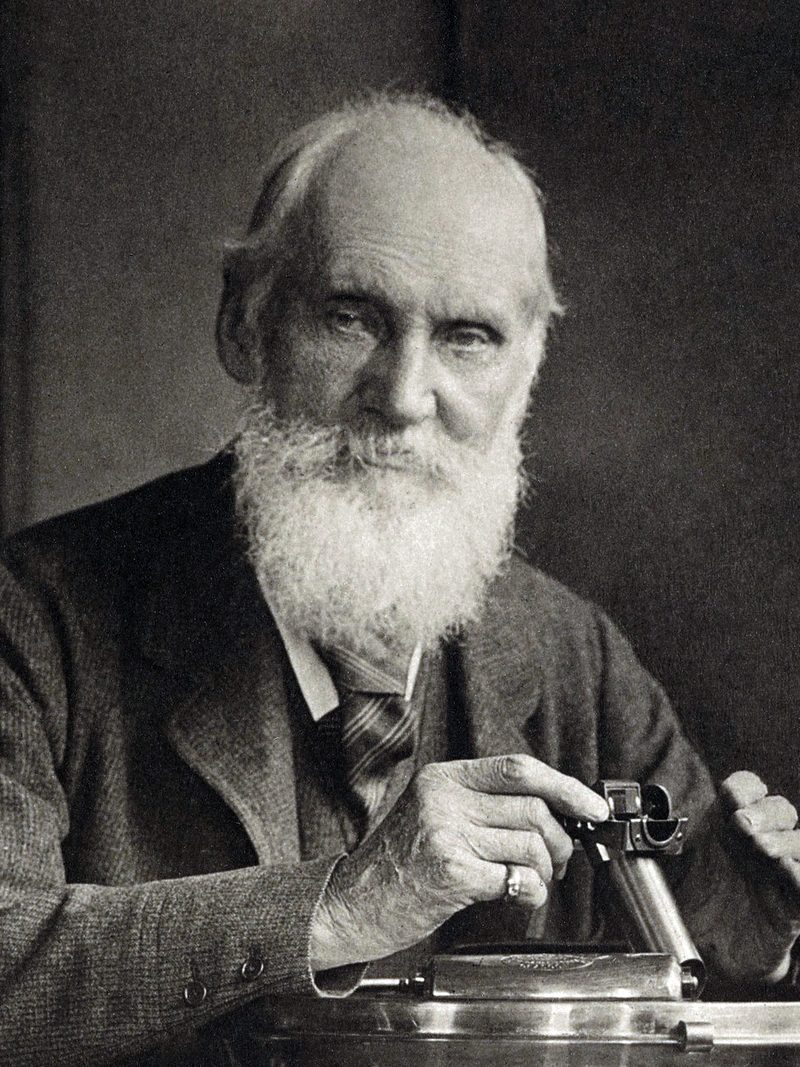
| 7 Quotes | |
| Born as | William Thomson |
| Occup. | Scientist |
| From | Ireland |
| Born | June 26, 1824 Belfast, Ireland |
| Died | December 17, 1907 Largs, Scotland |
| Aged | 83 years |
| Cite | |
Citation Formats
APA Style (7th ed.)
Lord kelvin biography, facts and quotes. (2026, February 11). FixQuotes. https://fixquotes.com/authors/lord-kelvin/
Chicago Style
"Lord Kelvin biography, facts and quotes." FixQuotes. February 11, 2026. https://fixquotes.com/authors/lord-kelvin/.
MLA Style (9th ed.)
"Lord Kelvin biography, facts and quotes." FixQuotes, 11 Feb. 2026, https://fixquotes.com/authors/lord-kelvin/. Accessed 26 Mar. 2026.
Early Life and Background
William Thomson - later Baron Kelvin of Largs - was born on 1824-06-26 in Belfast, Ireland, into a family where mathematics was both livelihood and atmosphere. His father, James Thomson, taught mathematics and cultivated in his children a disciplined, problem-solving cast of mind; the household was marked by ambition, grief, and exactitude after the early death of William's mother, Margaret Gardner Thomson. That loss, and his father's austere devotion to learning, helped form a temperament that sought security in measurable truths.In 1832 the family moved to Glasgow when James Thomson took a post at the University of Glasgow. The industrial Clyde region, with its shipyards and practical engineering, became the landscape of William's imagination - a place where theory could be tested against wire, steam, and iron. He grew into a young savant in a city that linked university science to commerce, and he absorbed the Victorian belief that progress was a moral as well as technical project.
Education and Formative Influences
Thomson entered the University of Glasgow as a child and moved quickly from classical studies to mathematics and natural philosophy, publishing early work while still a teenager. Further study in Paris under Regnault and at Cambridge University (Peterhouse) sharpened his taste for mathematical physics and the emerging language of energy. The key influences were Fourier's analysis of heat, the experimental rigor of French physics, and the British tradition of applying mathematics to machinery and measurement - training that suited a mind drawn to first principles but impatient with vague speculation.Career, Major Works, and Turning Points
In 1846, at just 22, he became professor of natural philosophy at the University of Glasgow, a chair he held for more than half a century while building a second career as an engineer-consultant. His papers on the dynamical theory of heat helped consolidate the first and second laws of thermodynamics, and his introduction of an absolute temperature scale, later named the kelvin, anchored temperature in energy rather than the properties of any single substance. With James Prescott Joule he tested and argued for the mechanical equivalent of heat; with Hermann von Helmholtz and others he helped turn "energy" into a central concept of physics. He also transformed telegraphy: he advised and invested in transatlantic cable projects, designed sensitive instruments such as the mirror galvanometer and siphon recorder, and brought mathematical analysis to signal propagation in long submarine lines. Honors followed - knighthood in 1866, a peerage in 1892 - yet he also endured public missteps, including his overconfident estimates that placed the Earth's age far below what geology and, later, radioactivity would support, and his skepticism toward some emerging technologies.Philosophy, Style, and Themes
Kelvin's inner life was defined by a moralized ideal of exactness. He distrusted what could not be reduced to calculation, and his personality - orderly, industrious, often combative in debate - reflected a Victorian conviction that nature was intelligible and that intelligibility carried ethical weight. “Science is bound, by the everlasting vow of honour, to face fearlessly every problem which can be fairly presented to it”. For Kelvin, this was not rhetorical flourish: it described a self-image in which intellectual courage meant refusing both superstition and hand-waving, whether in thermodynamic arguments, electrical standards, or the practical dangers of cable-laying in the Atlantic.His style also revealed the limits of that creed. He could be brilliantly conservative - protecting the hard-won coherence of classical physics - and therefore wrong in ways that illuminate his psychology. “Heavier-than-air flying machines are impossible”. The sentence captures a habit of mind: extrapolating from known constraints and treating engineering unknowns as physical impossibilities, a tendency reinforced by his success in telegraphy where small improvements in instruments and theory had huge payoffs. Kelvin's piety was likewise not merely private; it organized his sense of order in the universe. “The more thoroughly I conduct scientific research, the more I believe that science excludes atheism”. He read the lawfulness he measured as a sign of providence, and this conviction helped sustain his confidence even when controversies - the age of the Earth, the ether, the edges of classical mechanics - pressed against the boundaries of his framework.
Legacy and Influence
Kelvin died on 1907-12-17 and was buried in Westminster Abbey near Isaac Newton, a symbolic placement for a life spent making measurement the bridge between theory and power. His enduring influence is both conceptual and infrastructural: the kelvin remains a base unit in the SI system; his work helped canonize energy, entropy, and absolute temperature as the grammar of physical explanation; and his instruments and standards professionalized electrical engineering. At the same time, his celebrated errors have become cautionary tales about authority in science, reminding later generations that even a master of calculation can mistake the temporary limits of technique for the limits of nature.Our collection contains 7 quotes written by Lord, under the main topics: Witty One-Liners - Honesty & Integrity - Faith - Science - God.
Other people related to Lord: James Prescott Joule (Physicist), James C. Maxwell (Mathematician), John Joly (Scientist)
Lord Kelvin Famous Works
- 1867 Treatise on Natural Philosophy (with P. G. Tait) (Book)
- 1867 On Vortex Atoms (Essay)
- 1862 On the Secular Cooling of the Earth (Essay)
- 1848 On an Absolute Thermometric Scale (Essay)