
Louis Pasteur Biography Quotes 13 Report mistakes
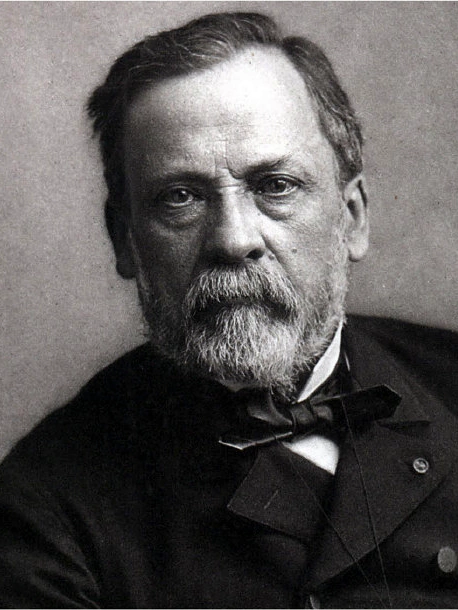
Attr: pasteur.fr
| 13 Quotes | |
| Occup. | Scientist |
| From | France |
| Born | December 27, 1822 Dole, France |
| Died | September 28, 1895 Marnes-la-Coquette, France |
| Aged | 72 years |
| Cite | |
Citation Formats
APA Style (7th ed.)
Louis pasteur biography, facts and quotes. (2026, February 11). FixQuotes. https://fixquotes.com/authors/louis-pasteur/
Chicago Style
"Louis Pasteur biography, facts and quotes." FixQuotes. February 11, 2026. https://fixquotes.com/authors/louis-pasteur/.
MLA Style (9th ed.)
"Louis Pasteur biography, facts and quotes." FixQuotes, 11 Feb. 2026, https://fixquotes.com/authors/louis-pasteur/. Accessed 6 Mar. 2026.
Early Life and Background
Louis Pasteur was born on 1822-12-27 in Dole, in France's Jura region, and grew up mainly in Arbois, a small wine town whose rhythms - vineyards, barrels, spoilage, and seasonal labor - later made his laboratory conclusions feel like answers to everyday economic pain. His father, Jean-Joseph Pasteur, a former Napoleonic soldier turned tanner, carried the habits of discipline and patriotic seriousness; his mother, Jeanne-Etiennette Roqui, anchored a household where thrift and persistence mattered more than polish. Pasteur's earliest temperament was not that of a flamboyant prodigy but of a watchful, dutiful son, steady enough to absorb the moral weight his father placed on work and reputation.As a teenager, he showed talent for drawing and portraiture, making careful pastels of neighbors that reveal an eye trained on small differences - a skill that would later migrate from faces to crystals and microbes. Yet he was also homesick when sent away to study, returning to Arbois after a brief attempt at boarding school; the episode hints at a man who needed emotional continuity to do ambitious work. That tension - provincial attachment paired with national aspiration - stayed with him: he would become a Parisian scientific power without losing the accent and stubbornness of the Jura.
Education and Formative Influences
Pasteur studied at the College d'Arbois and the College Royal at Besancon, then entered the Ecole Normale Superieure in Paris (1843), where the rigorous training of French higher education in the July Monarchy and early Second Republic shaped his habits: exact measurement, controlled comparison, and the prestige of state service through science. He earned his doctorate in 1847 with work in physics and chemistry, and soon fell under the influence of Jean-Baptiste Biot and the tradition of optical experimentation; from them he learned that a tiny anomaly, patiently pursued, could overturn settled explanation.Career, Major Works, and Turning Points
His first major breakthrough came in 1848 at Strasbourg and then Lille, when he explained the optical activity of tartaric acid by demonstrating molecular dissymmetry in crystals - an early bridge between chemistry and life. At Lille, surrounded by industrial fermentation problems, he turned to alcohol and lactic fermentations, arguing they were driven by living microorganisms rather than vague "spontaneous" processes. That led to his celebrated swan-neck flask experiments (1860s), which helped discredit spontaneous generation and anchored the emerging germ theory. He developed pasteurization to prevent spoilage in wine and beer, then tackled crises central to the French economy: silkworm diseases (pebrine and flacherie) in the mid-1860s, saving sericulture through microscopic diagnosis and controlled breeding. After a stroke in 1868 left him partially paralyzed, his work became even more focused and urgent. In the 1870s-1880s he pioneered attenuation of pathogens and produced vaccines for chicken cholera, anthrax (publicly tested at Pouilly-le-Fort in 1881), and rabies, treating Joseph Meister in 1885. The success accelerated the creation of the Institut Pasteur in Paris (1887-1888), designed as a hybrid of research center, teaching school, and public-health engine.Philosophy, Style, and Themes
Pasteur's inner life fused piety-like devotion to truth with the temperament of an administrator and combatant. He worked as if clarity were a moral duty owed to family, nation, and the vulnerable - a stance sharpened by the 19th century's collision of industry, war, and epidemic disease. His laboratory style was relentlessly staged: define the question, invent the apparatus, isolate variables, and then win in public with demonstrations that were as persuasive to farmers and ministers as to academicians. He distrusted fashionable doubt when it became an excuse to stop at half-knowledge, insisting, “Do not let yourself be tainted with a barren skepticism”. The line is less a plea for credulity than a psychological self-command: he knew how easily a scientist could retreat into safe ambiguity instead of committing to a testable claim.Two themes recur: preparation and tenacity. Pasteur framed discovery as earned luck - “Where observation is concerned, chance favors only the prepared mind”. - because his own breakthroughs came from seeing significance in what others called contamination, noise, or trivial asymmetry. And he mythologized endurance not as romance but as method, telling students and patrons alike, “Let me tell you the secret that has led me to my goal. My strength lies solely in my tenacity”. This is the psychology of a man who had to convert personal rigidity into scientific advantage: he could be combative, protective of priority, and fierce in disputes, yet those same traits sustained years-long campaigns against invisible causes of ruin - sour wine, dying silkworms, fatal bites - until the evidence yielded.
Legacy and Influence
Pasteur died on 1895-09-28 at Marnes-la-Coquette near Paris, having helped transform medicine from bedside interpretation to laboratory-backed prevention. His influence is institutional and conceptual: the Pasteurian model of linking basic research, clinical application, and public funding became a template for modern biomedical science; germ theory reshaped surgery, obstetrics, sanitation, and epidemiology; and vaccination, reimagined as a deliberate, experimental practice, became one of public health's strongest tools. In France he embodied the 19th-century faith that the state could be strengthened by knowledge; internationally, his name became shorthand for the idea that microscopic life governs macroscopic destiny - and that disciplined observation can turn fear into control.Our collection contains 13 quotes written by Louis, under the main topics: Motivational - Wisdom - Parenting - Overcoming Obstacles - Science.
Other people related to Louis: Luc Montagnier (Scientist), Paul Muni (Actor)
Louis Pasteur Famous Works
- 1881 Memoir on Anthrax and Its Vaccination (Memoir)
- 1880 Memoir on Chicken Cholera (Memoir)
- 1876 Studies on Beer (Book)
- 1866 Studies on Wine (Book)
- 1865 Studies on the Disease of the Silkworm (Non-fiction)
- 1861 Memoir on the Organized Particles in the Atmosphere (Memoir)
- 1857 Memoir on Alcoholic Fermentation (Memoir)
- 1857 Memoir on Lactic Fermentation (Memoir)
- 1848 Research on the Relations between Crystalline Form and Chemical Composition (Non-fiction)
Source / external links