
Louis XIV Biography Quotes 12 Report mistakes
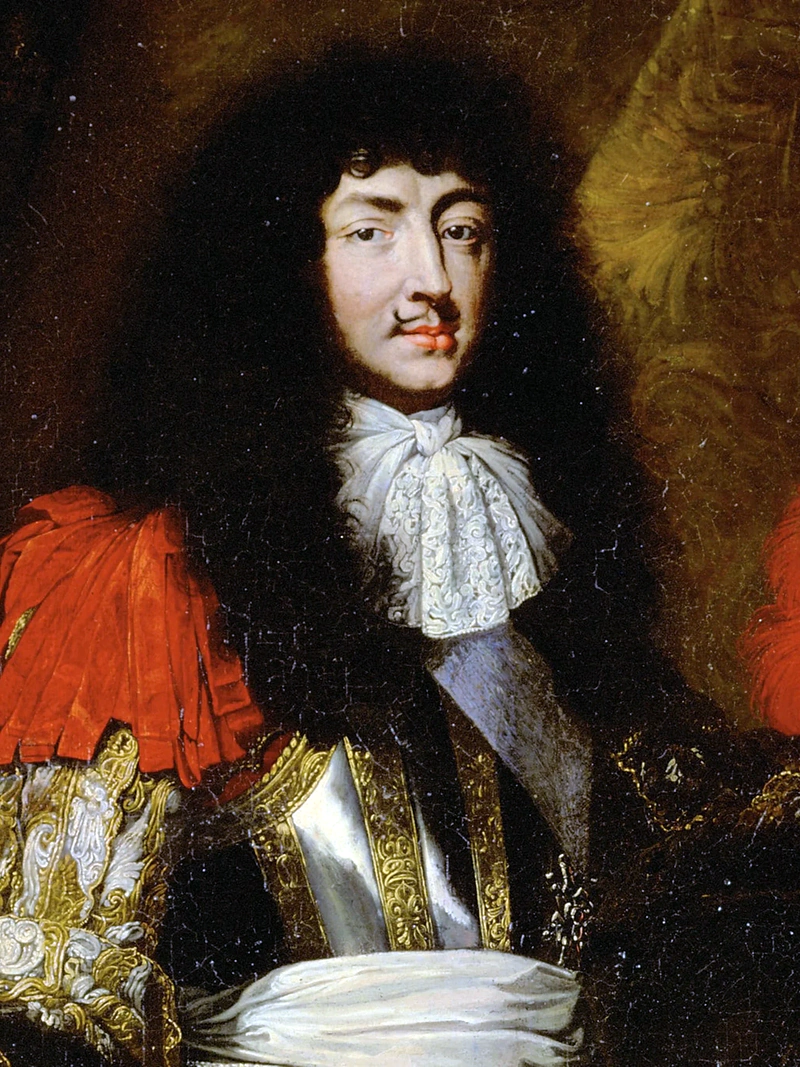
Attr: history.com
| 12 Quotes | |
| Born as | Louis-Dieudonne |
| Known as | Sun King |
| Occup. | Royalty |
| From | France |
| Born | September 5, 1638 Saint-Germain-en-Laye, France |
| Died | September 1, 1715 Versailles, France |
| Cause | gangrene |
| Aged | 76 years |
| Cite | |
Citation Formats
APA Style (7th ed.)
Louis xiv biography, facts and quotes. (2026, February 11). FixQuotes. https://fixquotes.com/authors/louis-xiv/
Chicago Style
"Louis XIV biography, facts and quotes." FixQuotes. February 11, 2026. https://fixquotes.com/authors/louis-xiv/.
MLA Style (9th ed.)
"Louis XIV biography, facts and quotes." FixQuotes, 11 Feb. 2026, https://fixquotes.com/authors/louis-xiv/. Accessed 26 Mar. 2026.
Early Life and Background
Louis XIV was born Louis-Dieudonne on 1638-09-05 at Saint-Germain-en-Laye, the long-awaited heir of Louis XIII and Anne of Austria. His very name, "God-given", reflected a dynasty anxious about survival after years of childlessness, and the infant prince entered a France strained by war, heavy taxation, and a nobility accustomed to bargaining with the crown. Cardinal Richelieu had already bent the state toward central authority; Louis inherited both that machinery and the resentments it created.The defining trauma of his childhood was the Fronde (1648-1653), a complex series of revolts by magistrates and princes that repeatedly threatened the monarchy and forced the young king to flee Paris. The experience imprinted a lifelong suspicion of the capital, a preference for controlled ceremonial distance, and a conviction that disorder began when great men believed the state existed for their private ambitions. That fear was not merely political; it shaped his inner life into a discipline of performance, vigilance, and memory, where personal safety and public authority fused into the same instinct.
Education and Formative Influences
Under the regency of his mother and the tutelage of Cardinal Mazarin, Louis received an education designed less for scholarly brilliance than for sovereign competence: religion, Latin and history, military review, and the arts of negotiation, all filtered through the practical lesson that power must be managed daily. Mazarin modeled patience, intelligence networks, and the use of patronage as a weapon; Anne modeled piety and dynastic pride. By the time Louis assumed full personal rule after Mazarin's death in 1661, he was not a theorist but a trained practitioner who had watched ministers rise and fall and had learned to treat governance as a continuous act of control.Career, Major Works, and Turning Points
From 1661 until his death on 1715-09-01, Louis made himself the center of French government, refusing a first minister and working through councils while relying on powerful specialists: Colbert in finance and administration, Louvois in war, and later figures such as Vauban in fortification and Chamlay in strategy. He expanded France in the War of Devolution (1667-1668), the Dutch War (1672-1678), the Nine Years' War (1688-1697), and the War of the Spanish Succession (1701-1714), projecting France as the leading continental power while exhausting its people with taxes, requisitions, and demographic strain. His most enduring "work" was institutional and symbolic: Versailles, transformed from a hunting lodge into a political engine that domesticated nobles through ritual, access, and dependence; alongside it came administrative centralization, the proliferation of intendants in the provinces, and a cultural program that made French taste a European standard. Turning points included the Revocation of the Edict of Nantes in 1685, which damaged commerce and reputation through the persecution and flight of Huguenots, and the late reign crises of famine and debt, when victory narrowed into survival and the grandeur of the early decades acquired a harsher, more brittle edge.Philosophy, Style, and Themes
Louis XIV's inner psychology was a pursuit of mastery shaped by early humiliation: he turned fear of disorder into an ethic of order, and order into spectacle. His kingship depended on visibility - daily lever and coucher, controlled audiences, ranks and insignia - because he believed that politics was made of attention, and attention could be engineered. The Sun King image was not mere vanity; it was policy, a way to radiate hierarchy into every corner of court and province until obedience felt natural. Yet that same need for control also made him acutely sensitive to ingratitude and the limits of favor, a private bitterness inside the public smile.His absolutism was less an abstract doctrine than a working assumption that sovereignty must not be shared. “I am the state”. Whether or not he uttered it in precisely that form, it captures his practice: the crown as the single point where law, war, taxation, and honor converged. Still, Louis also understood the resentment manufactured by distributing privilege, admitting, “Every time I bestow a vacant office I make a hundred discontented persons and one ingrate”. - a revealing confession of how patronage binds ruler and ruled in mutual disappointment. When he insisted, “It is legal because I wish it”. , he exposed the tensile strength of his system: legality grounded in will, effective so long as the will could compel armies, officials, and belief. His themes, in policy and self-fashioning, were unity over pluralism, Catholic uniformity over toleration, and glory as both shield and hunger - a constant need to prove that France, and the king, were synonymous.
Legacy and Influence
Louis XIV left France larger, culturally dominant, and administratively more centralized, but also socially strained and financially burdened, with a model of monarchy that dazzled Europe even as it set traps for successors. Versailles became a template for court politics from Vienna to St. Petersburg, while French language, theater, architecture, and etiquette traveled as instruments of soft power. At the same time, his wars and fiscal demands sharpened debates about sovereignty, rights, and the costs of glory; later critics would treat his reign as both the apex of absolutism and a warning about its human price. The enduring influence of Louis-Dieudonne lies in this dual inheritance: the modern state strengthened by administration and symbolism, and the moral question his life forces on history - how much order, splendor, and unity can be purchased without finally consuming the society that pays for them.Our collection contains 12 quotes written by Louis, under the main topics: Witty One-Liners - Wisdom - Justice - Leadership - Self-Discipline.
Other people related to Louis: Voltaire (Writer), Charles de Montesquieu (Philosopher), Jean de La Fontaine (Poet), Jean de La Bruyère (Philosopher), Jean Racine (Dramatist), Charles de Secondat (Philosopher), Francois Fenelon (Clergyman), Philip IV (Royalty), Jacques Delille (Poet), Claud-Adrian Helvetius (Philosopher)