
Lyndon B. Johnson Biography Quotes 70 Report mistakes
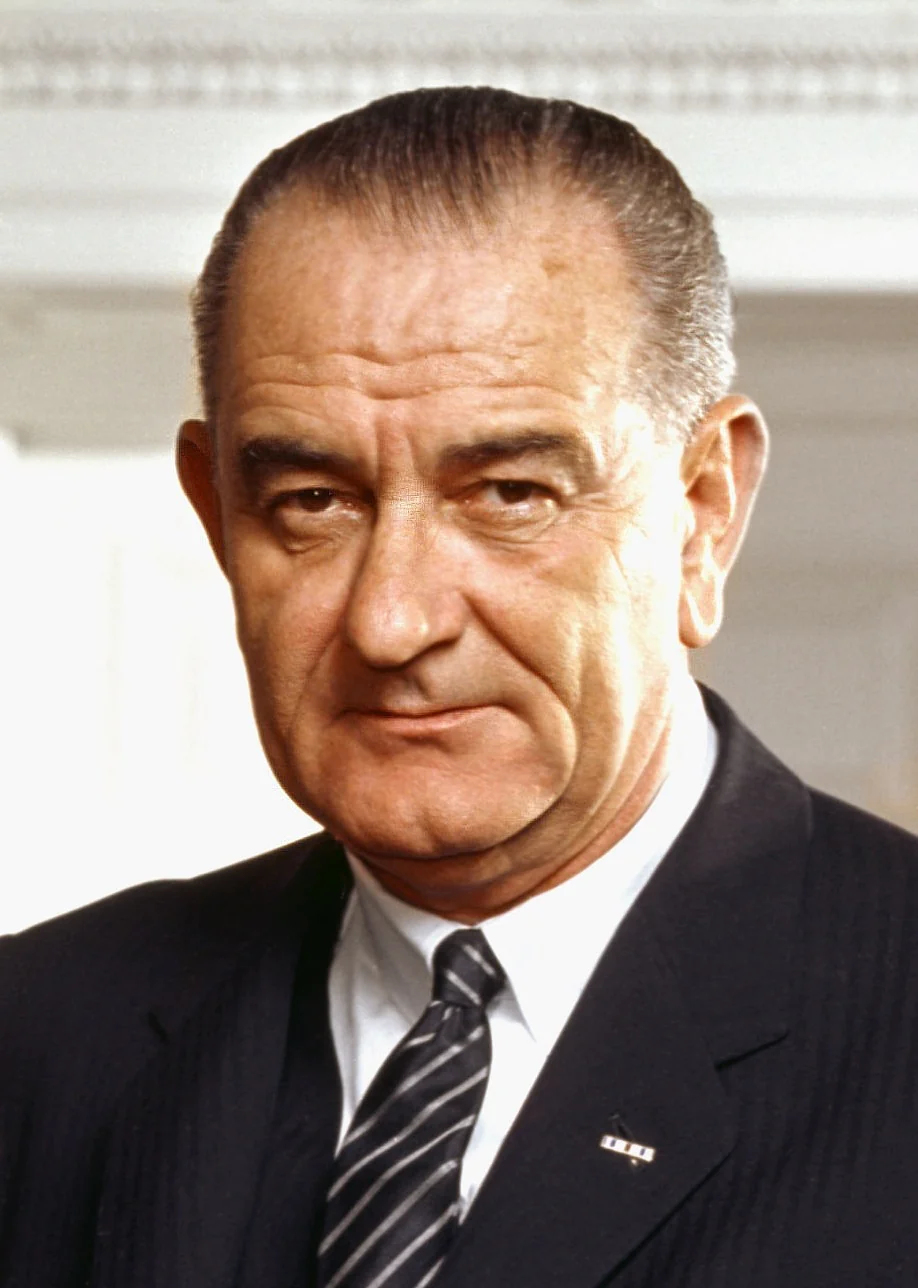
| 70 Quotes | |
| Born as | Lyndon Baines Johnson |
| Occup. | President |
| From | USA |
| Born | August 27, 1908 |
| Died | January 22, 1973 |
| Aged | 64 years |
| Cite | |
Citation Formats
APA Style (7th ed.)
Lyndon b. johnson biography, facts and quotes. (2026, February 2). FixQuotes. https://fixquotes.com/authors/lyndon-b-johnson/
Chicago Style
"Lyndon B. Johnson biography, facts and quotes." FixQuotes. February 2, 2026. https://fixquotes.com/authors/lyndon-b-johnson/.
MLA Style (9th ed.)
"Lyndon B. Johnson biography, facts and quotes." FixQuotes, 2 Feb. 2026, https://fixquotes.com/authors/lyndon-b-johnson/. Accessed 5 Mar. 2026.
Early Life and Background
Lyndon Baines Johnson was born on August 27, 1908, near Stonewall in the Texas Hill Country, into a family that mixed local stature with chronic financial strain. His father, Samuel Ealy Johnson Jr., served in the Texas legislature and carried the populist instincts - and debts - of rural politics; his mother, Rebekah Baines Johnson, brought a sharper literary and moral ambition. The landscape of limestone, drought, and hard bargaining left him with an early sense that life was won through will, alliance, and the ability to read a room as quickly as a weather front.In boyhood Johnson absorbed two lasting lessons: the pride of Texas independence and the humiliation of scarcity. He could be tender and theatrical, but also watchful, storing slights as fuel. The Hill Country was racially stratified and economically precarious; the young Johnson saw who had power, who was excluded, and how favors substituted for formal safety nets. Those contradictions - compassion alongside a craving for dominance - formed the private engine of his public life.
Education and Formative Influences
After uneven early schooling, Johnson attended Southwest Texas State Teachers College in San Marcos (graduating in 1930) and worked as a teacher in Cotulla, where he taught Mexican American children in a segregated system. The classroom experience was not a sentimental origin story so much as a revelation of how policy touched bodies: hunger, language, and dignity were political facts. He also learned the persuasive arts of institutions - how to manage patrons, budgets, and expectations - while the New Deal era convinced him that government could act at scale, if someone had the nerve to drive it.Career, Major Works, and Turning Points
Johnson rose as a New Deal congressional aide and then as a Texas congressman (1937), mastering patronage, infrastructure, and the intimate mechanics of power; he married Claudia "Lady Bird" Taylor in 1934, gaining a partner with financial acumen and steadier nerves. Elected to the Senate in 1948 after a razor-thin, bitter primary, he became Senate Majority Leader (1955), the era's most effective legislative tactician. As John F. Kennedy's vice president, he was thrust into the presidency after the assassination in Dallas on November 22, 1963; he then won a landslide in 1964 and pressed the Great Society into law - the Civil Rights Act (1964), Voting Rights Act (1965), Medicare and Medicaid (1965), federal aid to education, and an ambitious anti-poverty program - even as the Vietnam War metastasized into the defining crisis of his presidency. By 1968, drained and cornered by war, protests, and party fracture, he declined to seek reelection; he died on January 22, 1973, at his ranch near Johnson City.Philosophy, Style, and Themes
Johnson's inner life was a contest between uplift and fear: the boy who had known deprivation became a man who could not bear losing, whether an argument, a vote, or a narrative. He treated politics as a craft, not a sermon, and his morality was often transactional - yet the transactions aimed, at their best, at structural change. His humor could be cruel, his intimacy invasive, his appetite for control relentless, but he believed the state could enlarge ordinary lives. The Great Society was his attempt to convert personal empathy into federal architecture, a builder's response to a nation's barn-raising needs.His governing voice mixed homespun analogy with fatalistic realism, exposing a psyche that alternated between swagger and siege. “Any jackass can kick down a barn but it takes a good carpenter to build one”. The line is more than a quip: Johnson wanted to be remembered as the carpenter - the man who could assemble majorities and institutions - and it hints at his contempt for purity without results. Yet he also understood the presidency as sustained punishment, a role that stripped ego while inflaming it: “Being president is like being a jackass in a hailstorm. There's nothing to do but to stand there and take it”. That sense of battering helps explain his Vietnam tragedy - the belief that retreat would destroy him, his party, and American credibility - and his paranoia about media and elites, summed up in the bitter joke, "If one morning I walked on top of the water across the Potomac River, the headline that afternoon would read: "President Can't Swim."" . Johnson's themes, across speeches and private talk alike, were power as necessity, dignity as policy, and the terror of appearing weak.
Legacy and Influence
Johnson remains a split-level giant in American memory: architect of the most far-reaching domestic reforms since Franklin D. Roosevelt, and steward of an expanded war that scarred trust in government. His legislative record reshaped citizenship through civil rights enforcement, expanded the social contract through health and welfare programs, and set enduring benchmarks for federal responsibility. At the same time, Vietnam hardened skepticism toward presidential candor and accelerated political realignment, especially in the South. His influence persists in the tools he perfected - coalition-building, procedural mastery, and the ruthless arithmetic of votes - and in the unresolved question he embodied: how a leader can be both nation-builder and nation-wounder in the same span of years.Our collection contains 70 quotes written by Lyndon, under the main topics: Witty One-Liners - Motivational - Ethics & Morality - Wisdom - Sarcastic.
Other people related to Lyndon: Hubert H. Humphrey (Politician), John W. Gardner (Educator), Michael Harrington (Writer), Bill Moyers (Journalist), Lady Bird Johnson (First Lady), Whitney M. Young (Activist), Stewart Udall (Politician), Ramsey Clark (Public Servant), W. Averell Harriman (Politician), Carl T. Rowan (Journalist)
Lyndon B. Johnson Famous Works
- 1971 The Vantage Point: Perspectives of the Presidency 1963–1969 (Book)
- 1965 Remarks Upon Signing the Voting Rights Act of 1965 (Essay)
- 1965 Inaugural Address (January 20, 1965) (Essay)
- 1965 We Shall Overcome (Essay)
- 1964 The Great Society (Essay)
- 1964 Remarks Upon Signing the Civil Rights Act of 1964 (Essay)
- 1964 State of the Union Address (1964) (Essay)