
Mahatma Gandhi Biography Quotes 161 Report mistakes
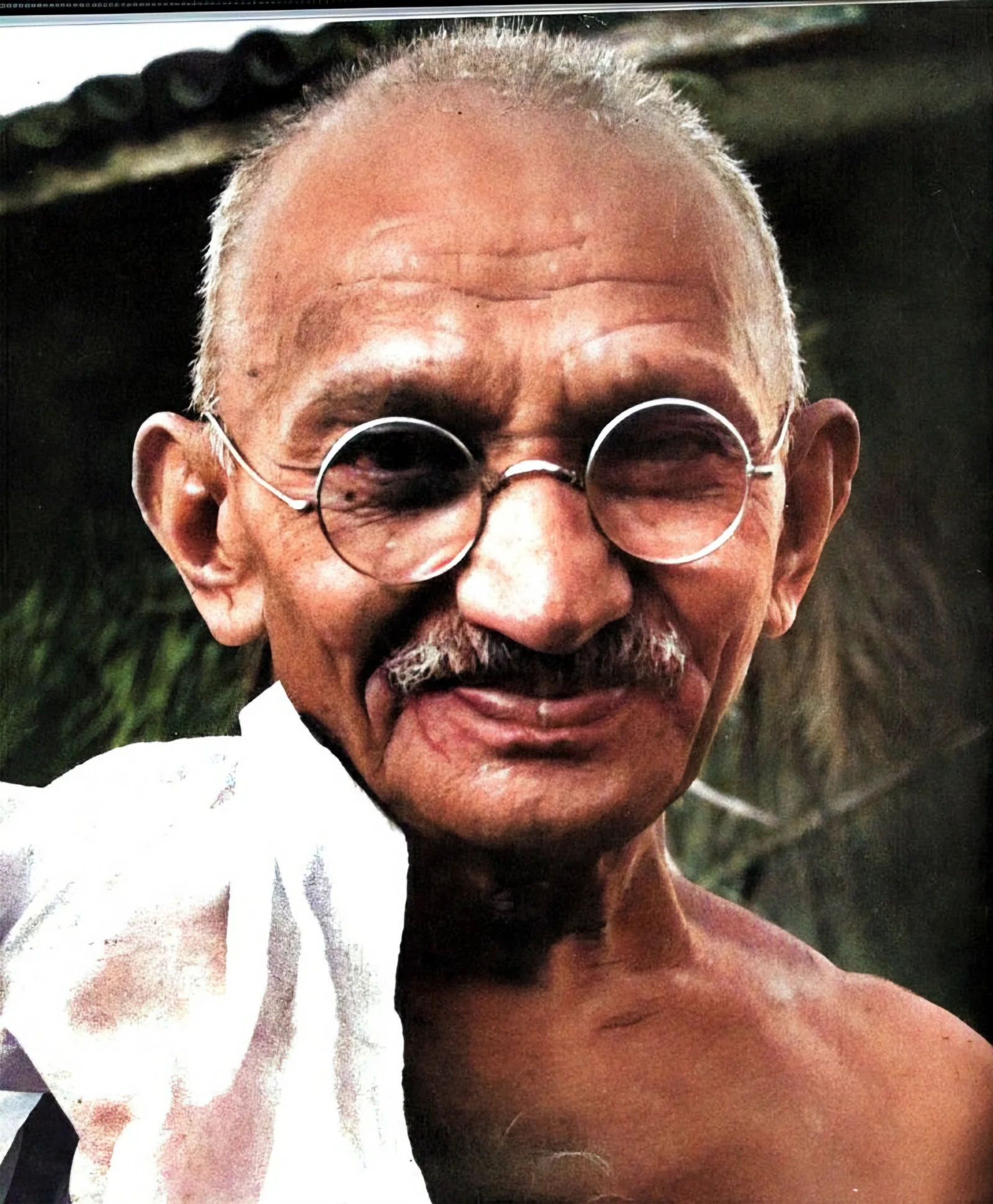
| 161 Quotes | |
| Born as | Mohandas Karamchand Gandhi |
| Occup. | Leader |
| From | India |
| Born | October 2, 1869 Porbandar, Kathiawar Agency, British India |
| Died | January 30, 1948 New Delhi, Dominion of India |
| Aged | 78 years |
| Cite | |
Citation Formats
APA Style (7th ed.)
Mahatma gandhi biography, facts and quotes. (2026, February 10). FixQuotes. https://fixquotes.com/authors/mahatma-gandhi/
Chicago Style
"Mahatma Gandhi biography, facts and quotes." FixQuotes. February 10, 2026. https://fixquotes.com/authors/mahatma-gandhi/.
MLA Style (9th ed.)
"Mahatma Gandhi biography, facts and quotes." FixQuotes, 10 Feb. 2026, https://fixquotes.com/authors/mahatma-gandhi/. Accessed 21 Mar. 2026.
Early Life and Background
Mohandas Karamchand Gandhi was born on October 2, 1869, in Porbandar, a small coastal princely state in Kathiawar (now Gujarat), into the pragmatic world of western Indian court politics. His father, Karamchand Gandhi, served as diwan (chief minister) in Porbandar and later in Rajkot; his mother, Putlibai, was shaped by Vaishnava devotion, Jain-inflected discipline, fasting, and vows. From childhood Gandhi absorbed a household ethic where public duty and private self-restraint were inseparable, and where moral authority often spoke through quiet endurance rather than command.The India of his youth was already reordered by the British Raj and by new railways, law courts, and English schools that promised advancement while thinning older sovereignties. Gandhi grew up shy and impressionable, haunted by scruples about truth-telling and self-control, and he later returned obsessively to the memory of early experiments with desire, diet, and guilt. A teenage marriage to Kasturba Makhanji (1883) bound him to family responsibilities even as he increasingly imagined life as a moral test, a tension that would become a defining engine of his leadership.
Education and Formative Influences
After schooling in Rajkot, Gandhi sailed to London in 1888 to study law at the Inner Temple, qualifying as a barrister in 1891. In England he encountered a cosmopolitan marketplace of ideas and disciplines - vegetarian societies, The Bhagavad Gita in translation, the Sermon on the Mount, and writers such as Leo Tolstoy and John Ruskin - and he learned to treat belief not as inheritance alone but as something argued with the self. Returning to India, he found legal practice ill-suited to his temperament, and the mismatch between his training and his inward hesitations helped push him toward a different kind of public vocation.Career, Major Works, and Turning Points
A contract case took Gandhi to South Africa in 1893, where racial humiliation - famously at Pietermaritzburg station - catalyzed a new identity as organizer and moral strategist. Over two decades he built institutions and campaigns among Indian communities, founded Phoenix Settlement and Tolstoy Farm, edited Indian Opinion, and forged satyagraha - disciplined noncooperation aimed at converting an opponent rather than crushing them. Back in India from 1915, he emerged as the Indian National Congresss most potent mass mobilizer, linking elite politics to village life through swadeshi, khadi, and campaigns in Champaran (1917) and Kheda (1918). He led the Non-Cooperation movement (1920-22) and, after calling it off amid violence at Chauri Chaura, accepted prison and criticism as the price of moral consistency. The Salt March to Dandi (1930) made civil disobedience legible to the world; his fasts turned his own body into a barometer of communal and political conscience. In the 1940s he opposed both imperial repression and sectarian fragmentation, but Partition arrived with independence in 1947. On January 30, 1948, in New Delhi, he was assassinated by Nathuram Godse, a Hindu nationalist who saw Gandhis pluralism as betrayal.Philosophy, Style, and Themes
Gandhis inner life was a workshop: he treated the self as raw material to be refined by vows of truth (satya), nonviolence (ahimsa), celibacy, simplicity, and service. His politics was therefore inseparable from personal discipline, and he insisted that means create ends, not merely justify them. He distrusted modernity when it severed life from conscience, warning that acceleration can become a substitute for purpose: “There is more to life than increasing its speed”. Yet he was not a romantic primitivist; he aimed to subordinate tools, industry, and administration to human dignity, local self-rule, and the moral education of desire.His style blended prophetic bluntness with self-interrogation - public campaigns punctuated by retreat, prison, and fasting - because he believed power without inner conversion is ultimately violent. Even prayer, for him, was not escape but a mode of concentrated agency: “Prayer is not an old woman's idle amusement. Properly understood and applied, it is the most potent instrument of action”. Nonviolence was similarly misread as passivity; Gandhi treated it as a strenuous discipline that demanded fearlessness, willingness to suffer, and readiness to name the violence inside oneself. This is why he could say, with unsettling honesty, “It is better to be violent, if there is violence in our hearts, than to put on the cloak of nonviolence to cover impotence”. In that psychological candor lies the key to his charisma: he invited followers not merely to oppose an empire, but to uncover the empires within.
Legacy and Influence
Gandhi endures as the modern eras most influential theorist-practitioner of nonviolent mass politics, shaping movements from the U.S. civil rights struggle to anti-apartheid organizing and contemporary human-rights activism. His legacy is also a living argument - over the limits of moral witness amid state violence, over caste and gender blind spots, over whether spiritualized politics clarifies justice or risks sanctifying it. Still, his central wager remains historically rare and persistently disruptive: that political freedom without self-rule is hollow, and that the deepest revolution begins in the disciplines by which ordinary people learn to refuse humiliation without becoming humiliators.Our collection contains 161 quotes written by Mahatma, under the main topics: Witty One-Liners - Motivational - Ethics & Morality - Truth - Wisdom.
Other people related to Mahatma: Martin Luther King Jr. (Minister), Munshi Premchand (Writer), Satish Kumar (Activist), Lord Halifax (Politician), Eknath Easwaran (Author), Lal Bahadur Shastri (Leader)
Frequently Asked Questions
- Mahatma Gandhi family tree: Father: Karamchand Gandhi, Mother: Putlibai Gandhi, Spouse: Kasturba Gandhi, Children: Harilal, Manilal, Ramdas, Devdas
- Mahatma Gandhi mother name: Putlibai Gandhi
- Mahatma Gandhi family: Wife: Kasturba Gandhi; Sons: Harilal, Manilal, Ramdas, Devdas
- Mahatma Gandhi Story: Leader of India's non-violent independence movement against British rule.
- Mahatma Gandhi religion: Hinduism
- Mahatma Gandhi father name: Karamchand Gandhi
- Mahatma Gandhi death date: January 30, 1948
- How old was Mahatma Gandhi? He became 78 years old
Mahatma Gandhi Famous Works
- 1962 The Essential Gandhi (Book)
- 1955 My Religion (Book)
- 1927 An Autobiography (Autobiography)
- 1927 The Story of My Experiments with Truth (Autobiography)
- 1909 Hind Swaraj (Book)
Source / external links