
Malcolm X Biography Quotes 32 Report mistakes
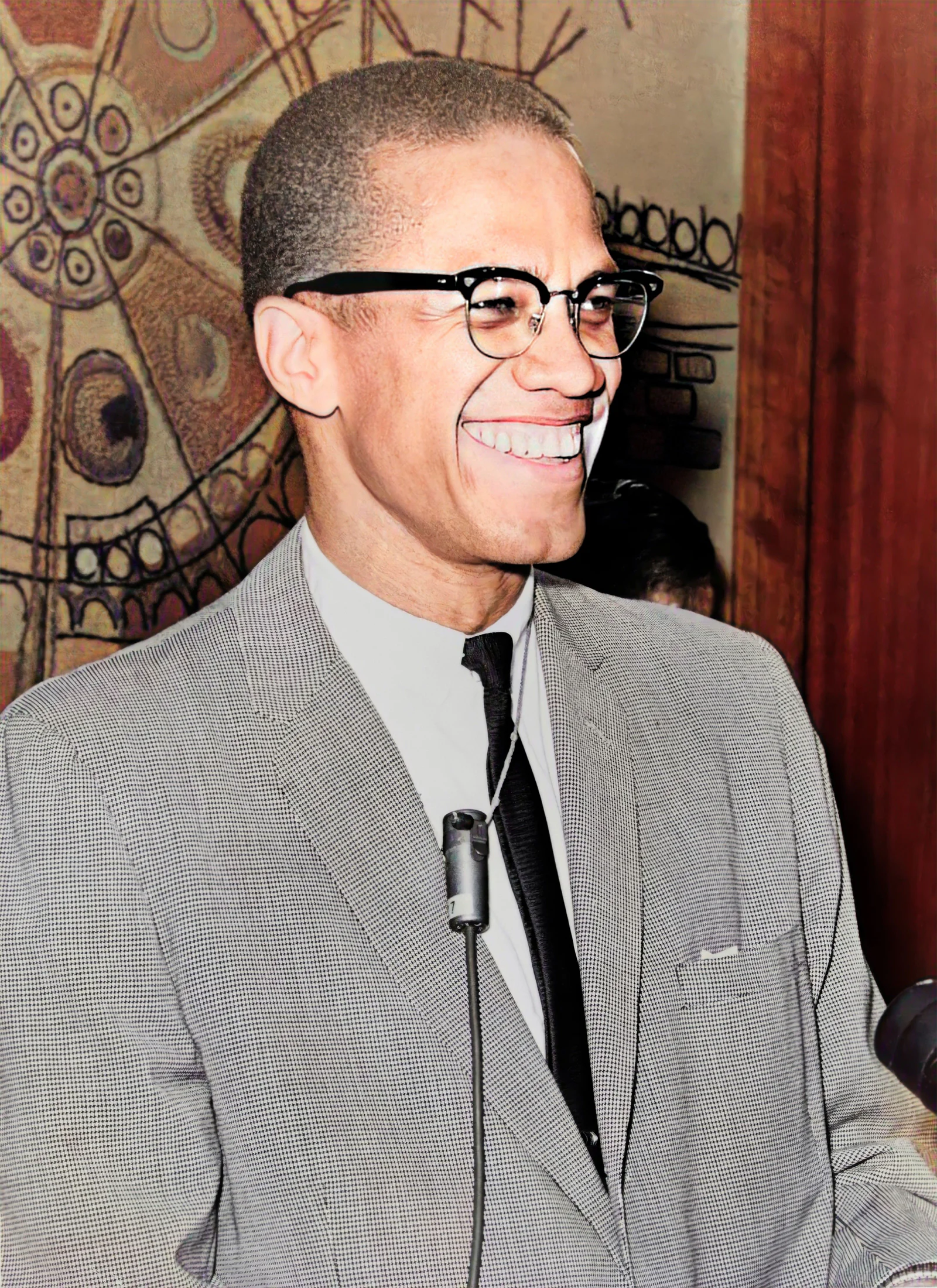
| 32 Quotes | |
| Born as | Malcolm Little |
| Occup. | Activist |
| From | USA |
| Born | May 19, 1925 |
| Died | February 21, 1965 |
| Aged | 39 years |
| Cite | |
Citation Formats
APA Style (7th ed.)
Malcolm x biography, facts and quotes. (2026, February 2). FixQuotes. https://fixquotes.com/authors/malcolm-x/
Chicago Style
"Malcolm X biography, facts and quotes." FixQuotes. February 2, 2026. https://fixquotes.com/authors/malcolm-x/.
MLA Style (9th ed.)
"Malcolm X biography, facts and quotes." FixQuotes, 2 Feb. 2026, https://fixquotes.com/authors/malcolm-x/. Accessed 26 Mar. 2026.
Early Life and Background
Malcolm X was born Malcolm Little on May 19, 1925, in Omaha, Nebraska, the fourth of Earl and Louise Little's children, in a country where Black aspiration was routinely met with organized terror. His father, a Baptist preacher and an outspoken supporter of Marcus Garvey's UNIA, lived under threat from white supremacist groups; the family moved repeatedly, including to Lansing, Michigan, seeking work and a measure of safety. The violence he witnessed was not abstract politics but domestic weather - night riders, intimidation, and the constant lesson that Black self-reliance invited punishment.In 1931 Earl Little died after being struck by a streetcar in Lansing; Malcolm's family long believed the killing was engineered, and official indifference hardened that suspicion into a worldview. The Great Depression and racist welfare policies helped fracture the household: Louise Little was eventually institutionalized, and the children were dispersed among foster homes and relatives. Malcolm's adolescence became a study in abrupt disinheritance - not only of parents, but of any stable narrative about the nation's fairness - and he learned early that respectability could not guarantee protection.
Education and Formative Influences
At school Malcolm showed intellectual quickness and rhetorical flair, but he also encountered the ceiling of expectation: after excelling, he was discouraged from imagining a professional future, a humiliation that helped sever him from formal education. He left Michigan for Boston in the early 1940s, living with his half-sister Ella Collins in Roxbury, then moved to Harlem, where the wartime city offered both glamour and predation. Hustling, numbers running, and petty crime followed, and in 1946 he was arrested in Massachusetts for burglary and sentenced to prison, the decisive crucible of his self-reinvention.Career, Major Works, and Turning Points
In prison Malcolm turned his appetite for speed into discipline, educating himself through voracious reading and a dictionary, and embracing the Nation of Islam under Elijah Muhammad; paroled in 1952, he took the surname "X" to mark an African name erased by slavery. As the Nation's most electrifying minister and organizer, he built temples, recruited widely, and became a national figure after the 1959 TV documentary "The Hate That Hate Produced" and his own relentless public debates. The early 1960s brought both ascendance and strain: his response to the JFK assassination, internal scrutiny, and widening disagreement over the Nation's direction led to his 1964 break, after which he founded Muslim Mosque, Inc. and the Organization of Afro-American Unity, traveled through Africa and the Middle East, and performed the most public evolution of his life - from sectarian separatism toward a more internationalist, human-rights-driven Black politics. On February 21, 1965, in New York City, he was assassinated while speaking at the Audubon Ballroom; later that year, "The Autobiography of Malcolm X" (with Alex Haley) fixed his voice in American memory.Philosophy, Style, and Themes
Malcolm's inner life was defined by relentless self-audit. He treated adversity not as a moral alibi but as training, the furnace that made clarity possible: “There is no better than adversity. Every defeat, every heartbreak, every loss, contains its own seed, its own lesson on how to improve your performance the next time”. That sentence reads like autobiography compressed into a credo - the foster homes, the prison cell, the severing from mentors, and the courage to change course in public without pretending continuity. His charisma was partly this seriousness: he spoke as someone who had paid for knowledge, and he demanded that listeners pay attention with their lives, not just their opinions.His style fused courtroom logic, street vernacular, and prophetic cadence, always circling the same questions: who controls interpretation, and what kind of power can answer power? He distrusted the manufacture of consensus - “The media's the most powerful entity on earth. They have the power to make the innocent guilty and to make the guilty innocent, and that's power. Because they control the minds of the masses”. - because he had lived the gap between official stories and lived truth. He was equally unsparing toward national myth, insisting, “You're not supposed to be so blind with patriotism that you can't face reality. Wrong is wrong, no matter who says it”. In practice, this produced a politics of self-defense, psychological liberation, and institutional building, delivered with a precision that made moderation feel like complicity and made his own revisions feel like integrity rather than retreat.
Legacy and Influence
Malcolm X endures because his life staged, in accelerated form, the moral and intellectual pressures of mid-20th-century America: Jim Crow's violence, Northern segregation's hypocrisy, Cold War propaganda, and the global revolt against colonialism. He helped widen the civil-rights era's vocabulary from integration to dignity, from law to power, and from national reform to international accountability; his late turn toward coalition and human-rights language remains a template for activists trying to connect local policing, economic extraction, and global racism. Through the Autobiography, his speeches, and the example of his self-remaking, he became less a fixed doctrine than a disciplined method - confront reality, name the system, and accept the personal cost of telling the truth.Our collection contains 32 quotes written by Malcolm, under the main topics: Motivational - Ethics & Morality - Justice - Freedom - Learning.
Other people related to Malcolm: Denzel Washington (Actor), Huey Newton (Activist), Ossie Davis (Actor), Bobby Seale (Activist), John Henrik Clarke (Author), Eldridge Cleaver (Activist), Angela Bassett (Actress), Tavis Smiley (Author), Amiri Baraka (Poet), Debi Mazar (Actress)
Source / external links