
Manuel Puig Biography Quotes 49 Report mistakes
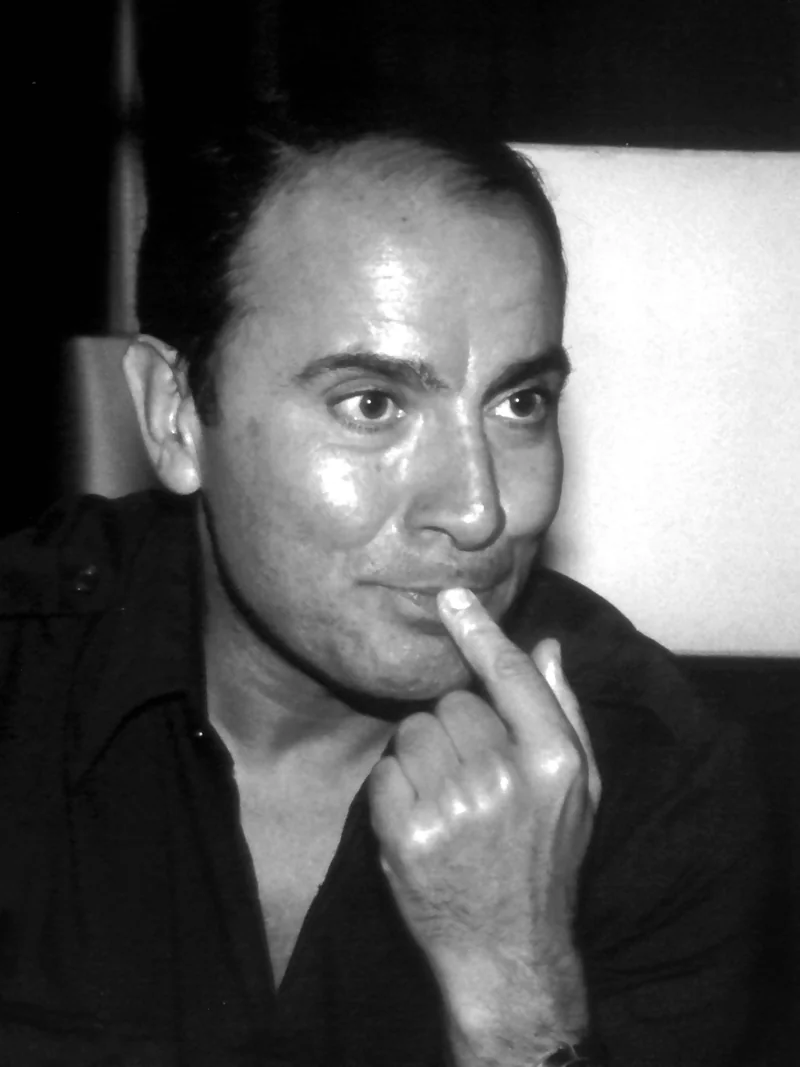
| 49 Quotes | |
| Occup. | Author |
| From | Argentina |
| Born | December 28, 1932 General Villegas, Buenos Aires, Argentina |
| Died | July 22, 1990 Cuernavaca, Mexico |
| Aged | 57 years |
| Cite | |
Citation Formats
APA Style (7th ed.)
Manuel puig biography, facts and quotes. (2026, February 2). FixQuotes. https://fixquotes.com/authors/manuel-puig/
Chicago Style
"Manuel Puig biography, facts and quotes." FixQuotes. February 2, 2026. https://fixquotes.com/authors/manuel-puig/.
MLA Style (9th ed.)
"Manuel Puig biography, facts and quotes." FixQuotes, 2 Feb. 2026, https://fixquotes.com/authors/manuel-puig/. Accessed 5 Mar. 2026.
Early Life and Background
Manuel Puig was born on December 28, 1932, in General Villegas, a railway town on the flat pampas of Buenos Aires Province. He grew up in a household where his mother, Malena Delledonne, cultivated an intense moviegoing habit that became the boy's first private education in desire, glamour, and narrative. The Argentine 1930s and 1940s - marked by political volatility, censorship, and the rise of Peronism - formed an atmosphere in which official discourse and private fantasy often diverged; Puig learned early how people speak differently in public than they do at home, a split that later became the engine of his fiction.As a sensitive child attracted to the language of women, melodrama, and the coded life of the cinema, Puig also absorbed the tacit rules of masculinity in a provincial town. That tension - between the self one is and the self one is permitted to perform - never left him. The town's gossip, the radio serials, the boleros, and the movie magazine synopses offered him both refuge and a vocabulary for longing, while the constraints of class, religion, and heteronormativity taught him the cost of being legible to others.
Education and Formative Influences
Puig moved to Buenos Aires as a young man, studied at the Instituto de Cinematografia of the Universidad Nacional del Litoral in Santa Fe, and oriented himself toward film before literature claimed him. Grants and work took him abroad: he lived in Rome in the late 1950s, moving in the orbit of Cinecitta at a moment when postwar Italian cinema and international co-productions were reshaping visual storytelling; later he spent time in Stockholm and elsewhere in Europe, doing subtitling and related jobs that sharpened his ear for spoken rhythms. Those years gave him an artist's apprenticeship in montage, voice, and the social life of genres - techniques he would transplant into the novel with unusually Argentine materials.Career, Major Works, and Turning Points
Puig debuted with La traicion de Rita Hayworth (1968), a mosaic of interior monologues, school compositions, letters, and overheard speech that re-created his pampas childhood without the prestige varnish of traditional realism; Boquitas pintadas (1969) made him internationally visible by turning the sentimental apparatus of tango lyrics, photo captions, and serial romance into a ruthless social x-ray of small-town life. Exile became a defining condition: after Argentina's 1976 military coup, and amid persecution of dissidents and sexual minorities, he lived largely outside the country, notably in Mexico, New York, and Brazil. His most famous novel, El beso de la mujer arana (1976), set in a prison cell where a gay window dresser and a political militant share stories and vulnerability, was adapted for stage and the 1985 film Kiss of the Spider Woman. Later works such as Pubis angelical (1979), Maldicion eterna a quien lea estas paginas (1980), Sangre de amor correspondido (1982), and Cae la noche tropical (1988) expanded his experiments with dialogue, testimony, and popular forms, while controversy - including censorship battles and critical condescension toward his "low" materials - never fully abated. Puig died on July 22, 1990, in Cuernavaca, Mexico, after complications related to gallbladder surgery, leaving a body of work that had already changed what Spanish-language fiction could sound like.Philosophy, Style, and Themes
Puig wrote as a dramatist of consciousness: not omniscient, but distributed across voices that reveal themselves by what they borrow, omit, or repeat. He treated mass culture not as escapism but as an archive of collective feeling - a place where the poor, the closeted, and the socially minor learn scripts for desire and survival. His training in cinema shows in his cuts and crossfades: scenes arrive as if subtitled from life, with the reader positioned like a spectator piecing together motives from speech and gesture. Yet beneath the technical bravura lies an ethical wager - that intimacy can be built out of stories, and that the most stigmatized forms (melodrama, gossip, confession) can carry truth more precisely than official language.His psychology as an artist was built around autonomy from gatekeepers and a fierce belief in the unconscious. “For someone who writes fiction, in order to activate the imagination and the unconscious, it's essential to be free”. Freedom, for Puig, meant freedom from literary priesthoods as much as from dictatorships; he distrusted the notion that critics could certify meaning from above. “Book reviews have never helped me. Most of them erred in their interpretations and their work has been a waste of time”. That refusal was not mere petulance but a strategy of self-protection: he built novels where authority is always contested by competing voices, where tenderness coexists with manipulation, and where conviction is crafted, not presumed. Even his compositional method was less a plan than a surrender to inner momentum: “I allow my intuition to lead my path”. , a line that fits his willingness to let a letter, a police report, a film plot retold in the dark, or a fragment of slang become the structural spine of a book.
Legacy and Influence
Puig is now read as one of the decisive innovators of Latin American narrative after the Boom - a writer who smuggled feminism, queer experience, and working- and middle-class speech into the center of the novel without asking permission. His influence runs through writers who treat popular culture as serious evidence and who build fiction from documents, dialogue, and the noise of everyday life; his prison duet in El beso de la mujer arana remains a touchstone for representations of sexuality, politics, and solidarity under repression. In Argentina, where the dictatorship tried to police both bodies and stories, Puig's work endures as a reminder that the most intimate fantasies can be political facts - and that the language people use to dream may be the truest record they leave behind.Our collection contains 49 quotes written by Manuel, under the main topics: Funny - Wisdom - Art - Music - Writing.
Manuel Puig Famous Works
- 1979 Pubis angelical (Novel)
- 1976 El beso de la mujer araña (Novel)
- 1969 Boquitas pintadas (Novel)
- 1968 La traición de Rita Hayworth (Novel)