
Marco Rubio Biography Quotes 59 Report mistakes
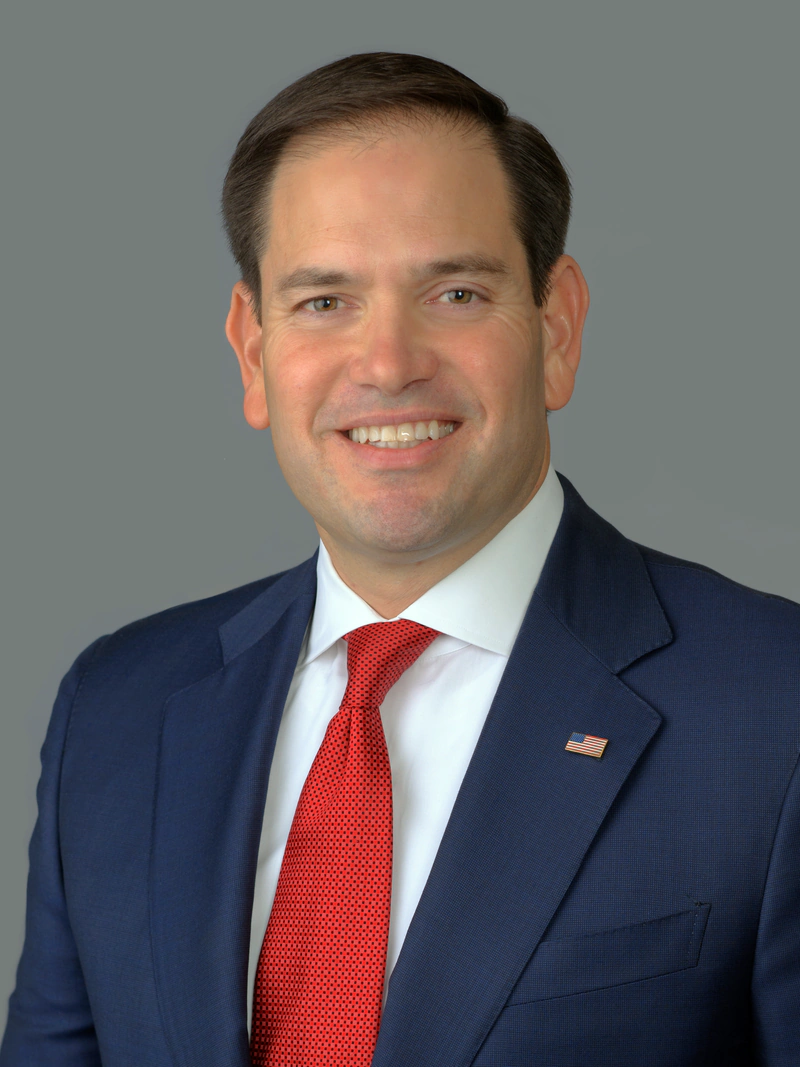
Attr: United States Senate
| 59 Quotes | |
| Born as | Marco Antonio Rubio |
| Occup. | Politician |
| From | USA |
| Born | May 28, 1971 Miami, Florida, United States |
| Age | 54 years |
| Cite | |
Citation Formats
APA Style (7th ed.)
Marco rubio biography, facts and quotes. (2026, February 11). FixQuotes. https://fixquotes.com/authors/marco-rubio/
Chicago Style
"Marco Rubio biography, facts and quotes." FixQuotes. February 11, 2026. https://fixquotes.com/authors/marco-rubio/.
MLA Style (9th ed.)
"Marco Rubio biography, facts and quotes." FixQuotes, 11 Feb. 2026, https://fixquotes.com/authors/marco-rubio/. Accessed 31 Mar. 2026.
Early Life and Background
Marco Antonio Rubio was born May 28, 1971, in Miami, Florida, into a Cuban exile family shaped by the long aftershocks of the Cold War. His parents, Mario Rubio and Oriales Garcia, had left Cuba in the 1950s; like many in the working-class diaspora, they carried an anti-communist politics that fused gratitude to the United States with a wary eye toward government power. Rubio grew up amid the bilingual neighborhoods and upward strivings of South Florida, where the story of reinvention was not abstract but lived - and where politics was woven into conversations about identity, freedom, and belonging.The Rubio household was modest: his father worked as a bartender and his mother as a hotel maid, and the family moved within Florida during his childhood, including a period in Las Vegas, Nevada. That itinerary - migration inside a nation built by migrants - later became one of Rubio's core narrative assets: the child of service workers who spoke in the idiom of aspiration. The emotional center of that story was not only material rise, but a moral claim that citizenship is a promise offered to strivers, a claim he would later translate into a politics of opportunity, patriotism, and cultural cohesion.
Education and Formative Influences
Rubio studied at South Miami Senior High School, attended Tarkio College in Missouri, then completed a BA in political science at the University of Florida in 1993, followed by a JD from the University of Miami School of Law in 1996. His early formation combined the institutional ladder of American mobility with South Florida's exile memory: anti-Castro activism, the Republican realignment among many Cuban Americans, and the rise of conservative talk-radio and post-Reagan policy argumentation. The result was a politician comfortable in both policy language and story - treating biography as evidence that ideas about markets, family, and nationhood could be personally verified.Career, Major Works, and Turning Points
Rubio entered Florida politics through the state legislature, serving in the Florida House of Representatives from 2000 to 2008 and rising to Speaker (2006-2008), where he helped craft the "100 Innovative Ideas for Florida's Future" agenda and built a reputation as a young conservative reformer. In 2010, against expectations, he won the U.S. Senate seat from Florida in a three-way race, becoming a national figure amid Tea Party-era insurgency and fiscal alarm. His first presidential run in 2016 vaulted him into the front rank of Republican leaders, even as it exposed the tension between movement rhetoric and coalition-building. He returned to the Senate with a focus on national security, China policy, and domestic competitiveness, and after the 2020 election he became a prominent voice on voting rules, cultural conflict, and a more worker-aware conservative economic message - a continued recalibration between populist mood and institutional conservatism.Philosophy, Style, and Themes
Rubio's worldview is best understood as an ethic of guarded optimism: he sells America as an engine that can lift those who work and those who are not yet secure. “And that is that we have never been: a nation of haves and have-nots. We are a nation of haves and soon-to-haves, of people who have made it and people who will make it. And that's who we need to remain”. Psychologically, this framing reveals both confidence and anxiety - confidence that the national story still works, and anxiety that it can be broken by stagnation, resentment, or failed institutions. His speeches often treat opportunity as a civic mood that must be protected as much as an economic outcome.That same psychology animates his suspicion of expansive administration and his insistence that government is a steward, not a redeemer. “Americans chose a limited government that exists to protect our rights, not to grant them”. In Rubio's rhetoric, freedom is fragile: it can be eroded by regulators who forget the human being behind a rule, by debt that mortgages the future, or by ideologies that reinterpret citizenship as grievance. Yet he also tries to make conservatism sound protective rather than punitive, especially on safety-net politics. “When you talk about entitlement programs, it's not just about - it's not about cutting those programs. It is about saving those programs. Those programs are on a path of fiscal unsustainability”. The theme is recurring: preserve the moral legitimacy of the American promise by reforming what threatens it, while portraying opponents as risking national decline through either overreach or denial.
Legacy and Influence
Rubio's enduring significance lies less in a single statute than in his role as a bridge figure in a turbulent Republican era: a post-Reagan conservative with exile-rooted anti-authoritarian instincts, who adapted to a party increasingly shaped by populism, cultural combat, and geopolitical rivalry. He helped normalize a newer Republican emphasis on China as a defining strategic challenge, kept Cuba and Venezuela central to U.S. hemispheric debate, and offered a durable template for aspirational language grounded in immigrant biography. Whether history judges him as a translator of conservatism to a diversifying nation or as a symptom of its contradictions, Rubio has left a distinct imprint on how Republicans talk about dignity, work, and national identity in the early 21st century.Our collection contains 59 quotes written by Marco, under the main topics: Witty One-Liners - Justice - Sarcastic - Leadership - Freedom.
Other people related to Marco: Charlie Crist (Politician), Jeff Flake (Politician), Cesar Conda (Public Servant)