
Marcus Garvey Biography Quotes 24 Report mistakes
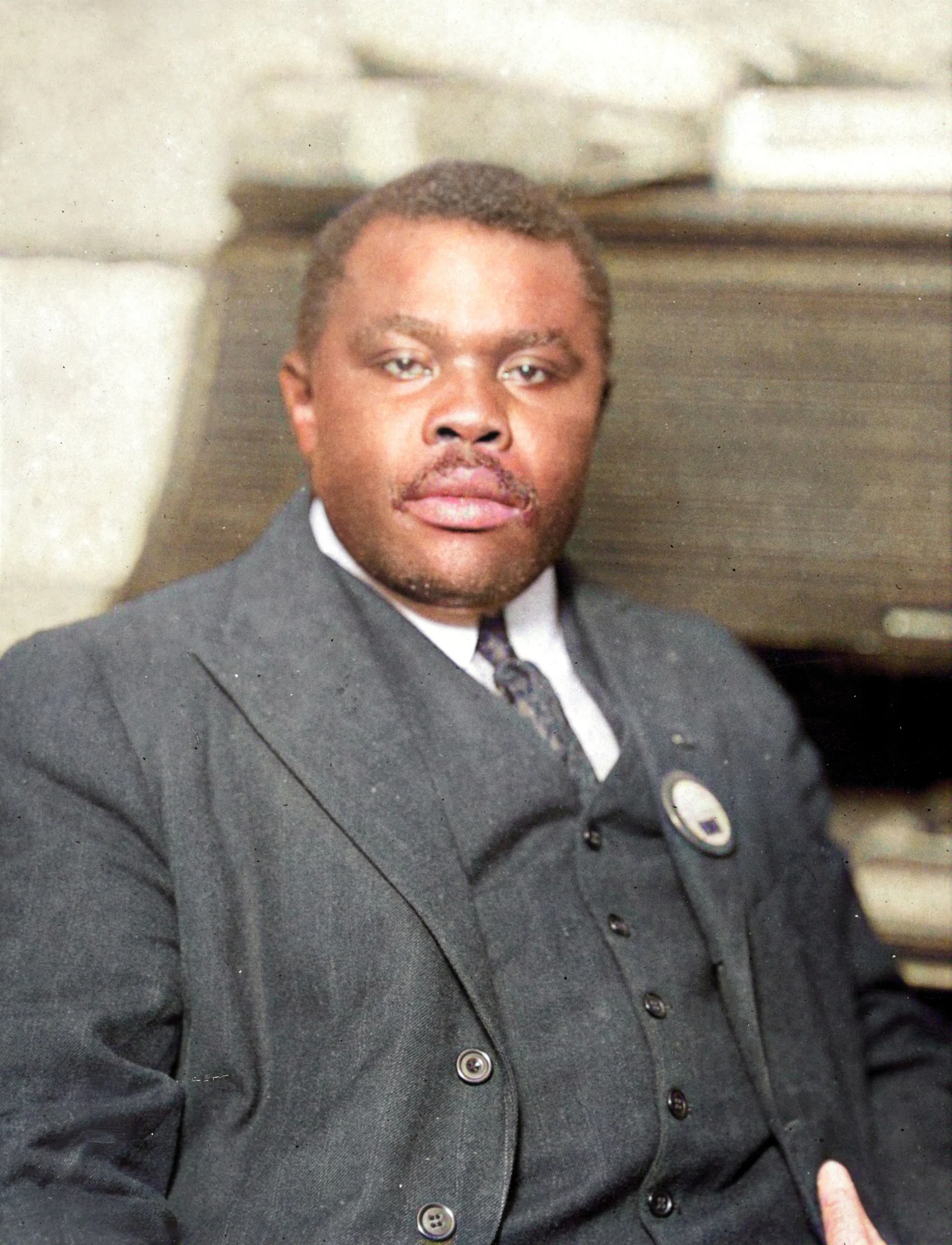
Attr: By Keystone View Company
| 24 Quotes | |
| Born as | Marcus Mosiah Garvey Jr. |
| Occup. | Publisher |
| From | Jamaica |
| Spouses | Amy Ashwood (1919-1922) Amy Jacques (1922) |
| Born | August 17, 1887 St. Ann's Bay, Saint Ann, Jamaica |
| Died | June 10, 1940 London, England, United Kingdom |
| Cause | Stroke |
| Aged | 52 years |
| Cite | |
Citation Formats
APA Style (7th ed.)
Marcus garvey biography, facts and quotes. (2026, February 2). FixQuotes. https://fixquotes.com/authors/marcus-garvey/
Chicago Style
"Marcus Garvey biography, facts and quotes." FixQuotes. February 2, 2026. https://fixquotes.com/authors/marcus-garvey/.
MLA Style (9th ed.)
"Marcus Garvey biography, facts and quotes." FixQuotes, 2 Feb. 2026, https://fixquotes.com/authors/marcus-garvey/. Accessed 5 Mar. 2026.
Early Life and Background
Marcus Mosiah Garvey Jr. was born on August 17, 1887, in St. Ann's Bay, Jamaica, a small port town shaped by colonial hierarchies and the afterlife of slavery. His father, Malchus Garvey, was a mason and a serious reader with a personal library, while his mother, Sarah Jane Richards, anchored the household in the everyday discipline of working-class survival. Garvey grew up amid sharp color and class divisions that structured opportunity in British Jamaica, and he absorbed early the lesson that respectability and self-command could be weapons when formal power was denied.Childhood combined bookish aspiration with the abrasions of poverty and social contempt. He later recalled being taunted for his dark skin and country origins, experiences that helped forge his lifelong preoccupation with race pride and collective dignity. The island's political economy - a plantation legacy, limited Black advancement, and an imperial education system - made "uplift" not an abstraction but a daily argument over what a Black life could be.
Education and Formative Influences
Garvey had limited formal schooling but was shaped by voracious reading and early work as a printer's apprentice in Kingston, where the print shop taught him how ideas become institutions through paper, discipline, and distribution. In Jamaica he encountered labor agitation and the fragile power of organized workers; abroad, he widened his horizon. Travel in Central America exposed him to the harsh conditions of Afro-Caribbean migrants on banana enclaves, and in London in 1912 he moved through a world of imperial debate and Black intellectual networks, reading Booker T. Washington and attending lectures while drafting the outlines of a mass movement that could speak beyond elite circles.Career, Major Works, and Turning Points
In 1914 Garvey founded the Universal Negro Improvement Association (UNIA) in Kingston, then relocated to Harlem in 1916, where World War I, the Great Migration, and race riots created a combustible audience for racial self-determination. He built a publishing and organizing machine: the Negro World newspaper; the Black Star Line shipping venture; the Negro Factories Corporation; and immense conventions that staged pageantry alongside policy, including a "Declaration of Rights of the Negro Peoples of the World" (1920). His message drew millions across the United States, the Caribbean, Central America, and Africa, alarming colonial administrators and competing Black leaders. The Black Star Line's mismanagement and sabotage allegations, followed by a U.S. mail fraud conviction (1923), shattered the movement's financial core; after imprisonment, he was deported in 1927. Garvey continued publishing and organizing from Jamaica and then London, where he died on June 10, 1940, after years of political exile and reputational war.Philosophy, Style, and Themes
Garvey's inner life was defined by a paradox: intense vulnerability to humiliation paired with an almost theatrical insistence on grandeur as a cure. He treated psychology as political infrastructure, arguing that the most durable captivity was internalized. “Liberate the minds of men and ultimately you will liberate the bodies of men”. That line condensed his strategy: before ships, factories, or votes could matter, Black people had to recover a sense of historical authorship and personal efficacy.His style fused preacher cadence, printer's pragmatism, and nationalist spectacle - uniforms, parades, and symbols designed to make dignity visible. He made history itself a weapon, insisting that memory and culture were prerequisites for sovereignty: “A people without the knowledge of their past history, origin and culture is like a tree without roots”. Yet he was not merely nostalgic; he was a futurist of Black capacity, repeatedly returning to a doctrine of confidence as the engine of mass action. “Up, you mighty race, accomplish what you will”. In practice, this became a politics of race pride, economic self-help, and separatist possibility - not always a literal program of repatriation, but a demand that Black life be organized around power rather than pleading.
Legacy and Influence
Garvey's immediate enterprises rose and fell, but the template endured: a global Black nationalism that could operate through newspapers, fraternal lodges, commerce, and ritual, speaking to ordinary people in a language of pride and destiny. His influence ran through later Pan-Africanism and anticolonial leadership, including figures such as Kwame Nkrumah, and through movements that treated culture and self-definition as political battlegrounds, from Rastafari in Jamaica to mid-20th-century Black Power currents in the United States. Controversial for his authoritarian streak, business failures, and polarizing alliances, he nonetheless remains one of the era's most consequential publishers of mass Black consciousness - a man who understood that a movement is, before anything else, a story people can live inside.Our collection contains 24 quotes written by Marcus, under the main topics: Motivational - Truth - Justice - Leadership - Freedom.
Other people related to Marcus: Malcolm X (Activist), John Henrik Clarke (Author), Claude McKay (Writer)
Frequently Asked Questions
- What are Marcus Garvey's famous words? One of Marcus Garvey's most famous quotes is, 'Up, you mighty race, accomplish what you will.'
- Why was Marcus Garvey jailed? Marcus Garvey was jailed in the United States in 1925 for mail fraud related to the Black Star Line shipping company.
- What did Marcus Garvey say about mixed race people? Marcus Garvey advocated for unity among all people of African descent, but some of his views on mixed race individuals were controversial and reflected the racial attitudes and divisions of his time.
- What is Marcus Garvey best known for? Marcus Garvey is best known for founding the Universal Negro Improvement Association (UNIA) and promoting Black pride, economic self-sufficiency, and pan-Africanism.
- How old was Marcus Garvey? He became 52 years old
Source / external links