
Margaret Atwood Biography Quotes 28 Report mistakes
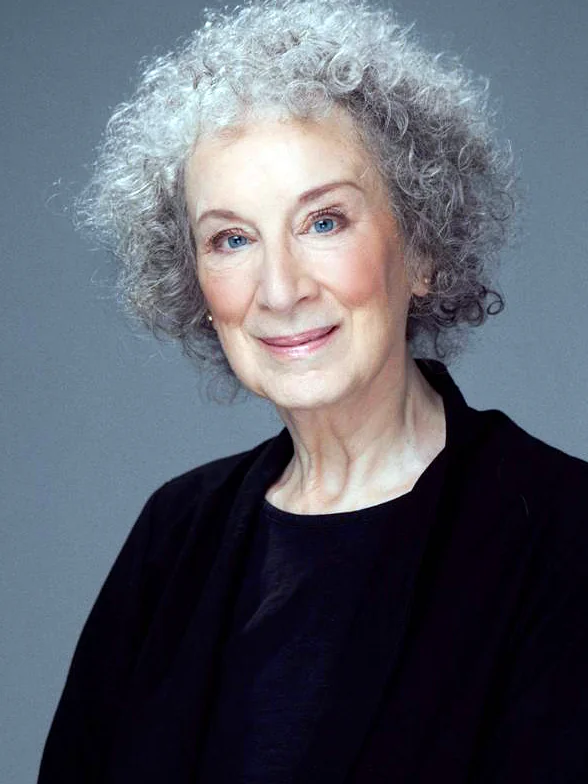
Attr: National Arts Centre
| 28 Quotes | |
| Born as | Margaret Eleanor Atwood |
| Occup. | Novelist |
| From | Canada |
| Born | November 18, 1939 Ottawa, Ontario, Canada |
| Age | 86 years |
| Cite | |
Citation Formats
APA Style (7th ed.)
Margaret atwood biography, facts and quotes. (2026, February 11). FixQuotes. https://fixquotes.com/authors/margaret-atwood/
Chicago Style
"Margaret Atwood biography, facts and quotes." FixQuotes. February 11, 2026. https://fixquotes.com/authors/margaret-atwood/.
MLA Style (9th ed.)
"Margaret Atwood biography, facts and quotes." FixQuotes, 11 Feb. 2026, https://fixquotes.com/authors/margaret-atwood/. Accessed 5 Mar. 2026.
Early Life and Background
Margaret Eleanor Atwood was born on November 18, 1939, in Ottawa, Ontario, and grew up with one foot in the capital's institutions and the other in the Canadian bush. Her father, Carl Edmund Atwood, was an entomologist whose fieldwork shaped the family's rhythms; her mother, Margaret Killam Atwood, anchored the household amid constant relocation. In the 1940s and early 1950s Atwood spent long stretches in northern Quebec and Ontario, where winters were severe, communities were small, and the line between human order and nonhuman indifference was always visible.That early oscillation between city and wilderness left her with a double vision that would become lifelong - affection for the pragmatic, wary Canadian temperament, and a sharp sense that civilization is a veneer. The isolation of field stations also produced a private intensity: books arrived as lifelines, and storytelling became both entertainment and instrument, a way to test what people will do when social scripts disappear. The mid-century backdrop mattered too: a child of World War II's aftermath and the Cold War's anxieties, she absorbed how quickly the "normal" can be reorganized by fear, propaganda, and necessity.
Education and Formative Influences
Atwood began writing early, but her direction firmed at Victoria College at the University of Toronto, where she studied English and absorbed the emerging confidence of Canadian letters alongside the older British canon; she earned her BA in 1961. Graduate work followed at Radcliffe College, Harvard University, where she pursued Victorian and American literature (MA, 1962) and continued doctoral studies without completing a PhD. The period placed her at the crossroads of postwar academia, second-wave feminism, and a North American literary scene increasingly alert to power, voice, and national identity - themes she would refract through satire, myth, and speculative realism.Career, Major Works, and Turning Points
Atwood first established herself as a poet in the 1960s, then expanded into fiction and criticism while teaching at institutions including the University of British Columbia and York University. The Edible Woman (1969) announced her as a novelist with a mordant eye for gendered social consumption; Surfacing (1972) fused psychological unmooring with a Canadian landscape that refuses sentimentality. Her critical study Survival: A Thematic Guide to Canadian Literature (1972) helped codify debates about Canadian cultural self-conception. The Assassin's Bride (1976) and Cat's Eye (1988) deepened her interest in memory, cruelty, and self-invention. The Handmaid's Tale (1985) became the turning-point work that married her political intelligence to an indelible narrative engine; later, the MaddAddam trilogy - Oryx and Crake (2003), The Year of the Flood (2009), MaddAddam (2013) - extended her reach into bioengineering, climate collapse, and corporate theocracy. Her long partnership with novelist Graeme Gibson, and the practical life of a working writer in Toronto, kept her grounded even as her readership became global.Philosophy, Style, and Themes
Atwood's inner life as a writer is defined by alertness: to how people rationalize harm, to how institutions rewrite reality, to how private desire intersects with public permission. Her style is famously lucid, but the clarity is a trapdoor - a plain sentence can open onto dread, comedy, or both. She distrusts grand abstractions and prefers systems observed at human scale: a kitchen, a classroom, a prison, a lab, a marriage. Even when her plots tilt toward dystopia, she insists she is describing tendencies already present; her imagination is less a prediction machine than a moral microscope.Her psychology as an artist centers on language as both weapon and refuge. “A word after a word after a word is power”. That aphorism is not merely a writer's credo; it is a theory of governance in miniature, explaining why her books return to slogans, scripture, contracts, testimonies, and the bureaucratic sentence that turns a person into a category. She pushes further into the ethics of speech: “War is what happens when language fails”. In Atwood, breakdowns of meaning precede breakdowns of peace - when dialogue becomes impossible, coercion fills the vacuum. Against that, she frames voice as a survival organ rather than a luxury: “A voice is a human gift; it should be cherished and used, to utter fully human speech as possible. Powerlessness and silence go together”. This is why so many Atwood protagonists narrate under pressure, scavenging for the right words while forces around them attempt to confiscate vocabulary itself.
Legacy and Influence
Atwood stands among the defining Canadian writers of the modern era, a figure whose work helped move Canadian literature from perceived provincialism into international centrality without surrendering its local weather, skepticism, and humor. She has shaped contemporary feminist thought in literature, not through slogans but through anatomies of complicity, desire, and fear; she has also influenced speculative fiction by insisting on political plausibility and intimate stakes. The Handmaid's Tale became a touchstone for debates about the policing of bodies and belief, while her later climate and biotech novels gave narrative form to 21st-century anxieties. Beyond the page she has been a public intellectual - engaged, disputatious, and precise - whose enduring lesson is that the future is built sentence by sentence, and that vigilance begins with how we speak and what we allow words to do.Our collection contains 28 quotes written by Margaret, under the main topics: Witty One-Liners - Art - Justice - Love - Writing.
Other people related to Margaret: Virginia Woolf (Author), Elizabeth Moss (Actress), Sarah Polley (Actress)
Margaret Atwood Famous Works
- 2019 The Testaments (Novel)
- 2016 Hag-Seed (Novel)
- 2013 MaddAddam (Novel)
- 2009 The Year of the Flood (Novel)
- 2008 Payback: Debt and the Shadow Side of Wealth (Non-fiction)
- 2005 The Penelopiad (Novella)
- 2003 Oryx and Crake (Novel)
- 2002 Negotiating with the Dead: A Writer on Writing (Non-fiction)
- 2000 The Blind Assassin (Novel)
- 1996 Alias Grace (Novel)
- 1993 The Robber Bride (Novel)
- 1988 Cat's Eye (Novel)
- 1985 The Handmaid's Tale (Novel)
- 1981 Bodily Harm (Novel)
- 1979 Life Before Man (Novel)
- 1977 Dancing Girls and Other Stories (Collection)
- 1976 Lady Oracle (Novel)
- 1972 Surfacing (Novel)
- 1969 The Edible Woman (Novel)
- 1961 Double Persephone (Poetry)