
Maria Corina Machado Biography Quotes 6 Report mistakes
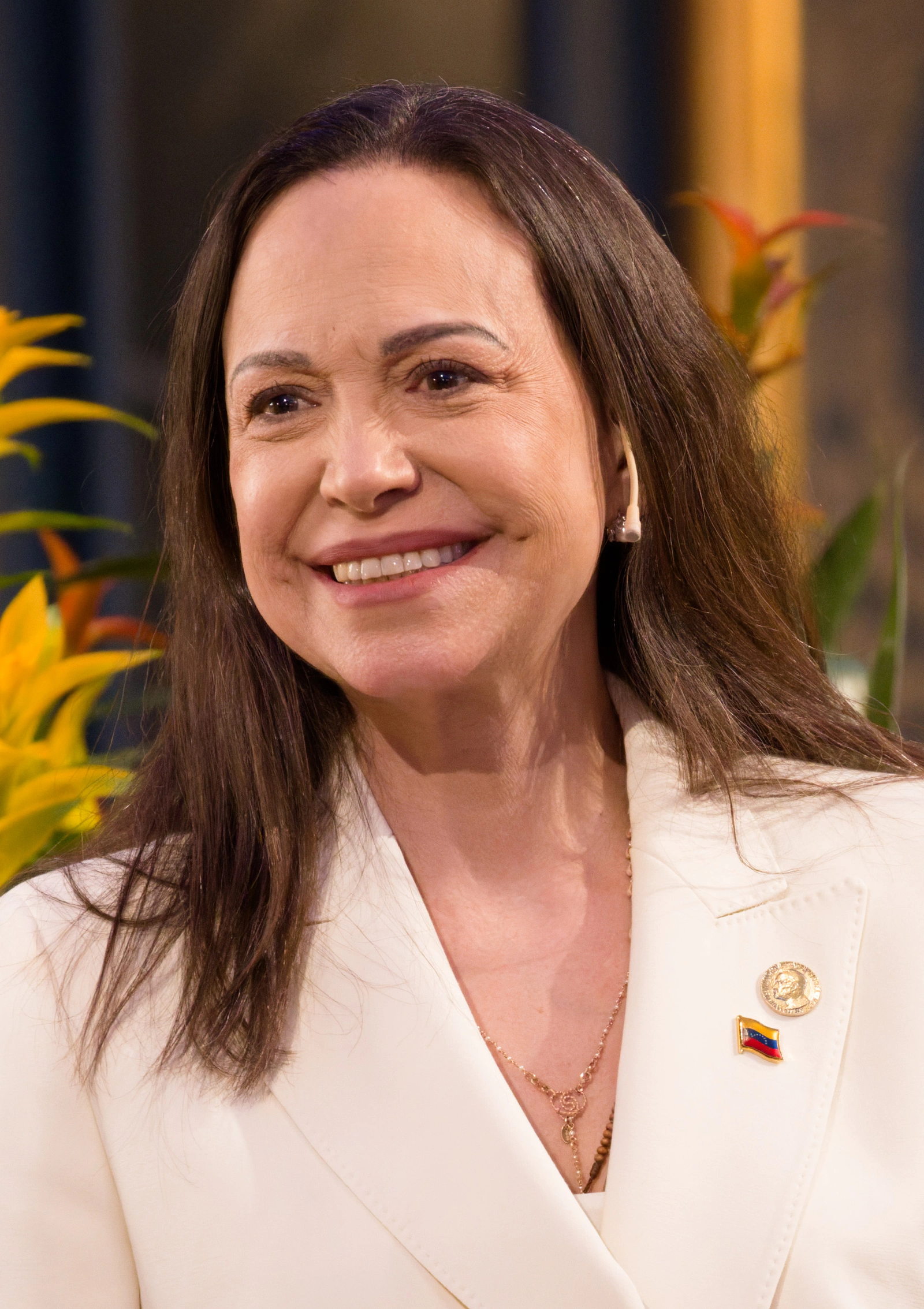
Attr: Kevin Payravi
| 6 Quotes | |
| Born as | María Corina Machado Parisca |
| Known as | María Corina Machado |
| Occup. | Politician |
| From | Venezuela |
| Born | October 7, 1967 Caracas, Distrito Federal, Venezuela |
| Age | 58 years |
| Cite | |
Citation Formats
APA Style (7th ed.)
Maria corina machado biography, facts and quotes. (2026, February 11). FixQuotes. https://fixquotes.com/authors/maria-corina-machado/
Chicago Style
"Maria Corina Machado biography, facts and quotes." FixQuotes. February 11, 2026. https://fixquotes.com/authors/maria-corina-machado/.
MLA Style (9th ed.)
"Maria Corina Machado biography, facts and quotes." FixQuotes, 11 Feb. 2026, https://fixquotes.com/authors/maria-corina-machado/. Accessed 5 Mar. 2026.
Early Life and Background
Maria Corina Machado Parisca was born on October 7, 1967, in Venezuela, into a Caracas milieu shaped by late-20th-century oil wealth, private enterprise, and a political order that claimed democratic stability while quietly accumulating institutional rot. Her family belonged to the country s established economic class, a background that later made her both a symbol and a target - praised by supporters as independent from patronage networks, and portrayed by adversaries as an avatar of elite privilege. That tension would follow her everywhere: it sharpened her awareness of property, autonomy, and civic rights, while also forcing her to become unusually disciplined about legitimacy, transparency, and public accountability.Machado came of age during the exhaustion of the Puntofijo era and the social shocks that exposed it. Venezuela s optimism fractured with the 1989 Caracazo riots and the deadly state response, events that impressed on many young Venezuelans a grim lesson: institutions could fail, and violence could be administered in the name of order. The 1992 coup attempts and the rise of Hugo Chavez reframed politics as a moral struggle rather than a negotiation among parties. In that atmosphere, Machado developed a temperament that was neither sentimental nor resigned - a person inclined to treat politics as a test of character under pressure, and to measure leaders by whether they defended the citizen as a rights-bearing individual rather than as a client of the state.
Education and Formative Influences
She trained as an industrial engineer, studying in Caracas and later at the IESA business school, where management disciplines, systems thinking, and metrics-based decision making informed the way she would later speak about governance - as execution, incentives, and rule-bound institutions rather than charisma. Those years coincided with the early consolidation of Chavismo, when the language of revolution began to absorb the vocabulary of the state. Machado absorbed the era s central contradiction: a movement promising popular sovereignty while centralizing power, narrowing pluralism, and redefining dissent as treason.Career, Major Works, and Turning Points
Machado entered public life through civil society activism, co-founding the election-monitoring organization SUMATE in 2002, amid the polarization that followed the April coup attempt, the PDVSA strike, and a deepening struggle over constitutional legitimacy. SUMATE became a key vehicle for promoting voter registration and oversight, and it made her a prominent antagonist of the Chavez government, which accused the group of foreign-backed subversion. Her leap from activism to elected office came in 2010 when she won a seat in the National Assembly for Miranda, building a profile as a sharp parliamentary critic of authoritarian drift, expropriations, and the politicization of the judiciary and armed forces. A major rupture followed in 2014 when she was stripped of her legislative post after accepting appointment as an alternate representative to the Organization of American States from Panama, a maneuver she used to denounce repression but that opponents framed as disqualifying. In subsequent years she became identified with the opposition s most uncompromising current, arguing that negotiated coexistence without institutional restoration simply prolonged the system. Her 2023 opposition primary campaign, culminating in a landslide victory, repositioned her as the central figure of the anti-Chavista coalition even as state institutions moved to block her candidacy and constrain the electoral field ahead of the 2024 contest.Philosophy, Style, and Themes
Machado s political psychology is grounded in a systems diagnosis rather than a personal feud. She repeatedly frames Venezuela s crisis as structural - a fusion of patronage, coercion, and captured institutions - and insists that leadership change without institutional change is theater. “Democratic exit is not achieved by changing one man; it requires combating a system”. The line clarifies her refusal to treat authoritarianism as a misunderstanding to be negotiated away; for her it is a design to be dismantled. That worldview also explains her impatience with opposition cycles of hope and disappointment: she speaks like an engineer of transitions, emphasizing sequencing, enforcement, and the rebuilding of incentives that make legality more profitable than predation.Her style blends moral absolutism with procedural reverence, a combination that lets her speak to both indignation and civic duty. She elevates voting not as a ritual but as an assertion of ownership over the state: “The vote is the sacred exercise of the power of the citizen”. In practice, she pairs that language with a hard-edged defense of personal autonomy against state intrusion, tying property, family life, and national belonging into a single bundle of rights. “What is yours is yours - your property, your home, and your country - and we will not allow them to take it from us”. The sentence functions as both promise and confession: it reveals a leader whose deepest fear is dispossession by arbitrary power, and whose deepest appeal is to restore boundaries - between party and state, soldier and civilian, ruler and citizen - that the revolutionary era blurred.
Legacy and Influence
Machado s enduring influence lies in how she helped move Venezuelan opposition politics from episodic protest into a language of institutional reconstruction, election integrity, and citizen primacy - even when the electoral arena itself is constrained. To supporters, she embodies coherence under intimidation, a leader who treats legality as a cause rather than a tactic and who forced uncomfortable clarity about the costs of accommodation. To critics, she represents a polarizing rigidity that can complicate coalition management in a fragmented opposition. Yet across these arguments, her imprint is unmistakable: she made civil society organizing, the defense of the ballot, and the insistence on private and civic rights central themes of the anti-authoritarian narrative of 21st-century Venezuela, and she remains a decisive reference point for how a post-Chavista transition is imagined, debated, and demanded.Our collection contains 6 quotes written by Maria, under the main topics: Freedom - Human Rights - Team Building.
Frequently Asked Questions
- Maria Corina Machado Nobel Prize: The Norwegian Nobel Committee has decided to award the Nobel Peace Prize for 2025 to Maria Corina Machado “for her tireless work promoting democratic rights for the people of Venezuela and for her struggle to achieve a just and peaceful transition from dictatorship to democracy.
- María Corina Machado religion: Public sources usually describe María Corina Machado as coming from a traditionally Catholic Venezuelan background, though she is primarily known for her political, not religious, role.
- María Corina Machado daughter: María Corina Machado has a daughter among her three children, but detailed information about her is generally kept private.
- Maria Corina Machado Palestine: María Corina Machado is mainly known for her positions on Venezuelan politics; there is no widely reported, central role of hers in the Palestine–Israel issue.
- María Corina Machado husband: María Corina Machado was married to Henrique Sallustro, with whom she has three children; they later separated.
- María Corina Machado News: María Corina Machado frequently appears in the news as a leading Venezuelan opposition figure, known for criticizing the Maduro government and advocating for democratic reforms.
- Maria Corina Machado children: María Corina Machado has three children.
- Maria Corina Machado Trump: María Corina Machado is a Venezuelan opposition leader; she is not known to have any formal political alliance with Donald Trump, though she has supported strong international pressure on the Maduro government, including from the United States.
- How old is Maria Corina Machado? She is 58 years old
Source / external links