
Mark Twain Biography Quotes 180 Report mistakes
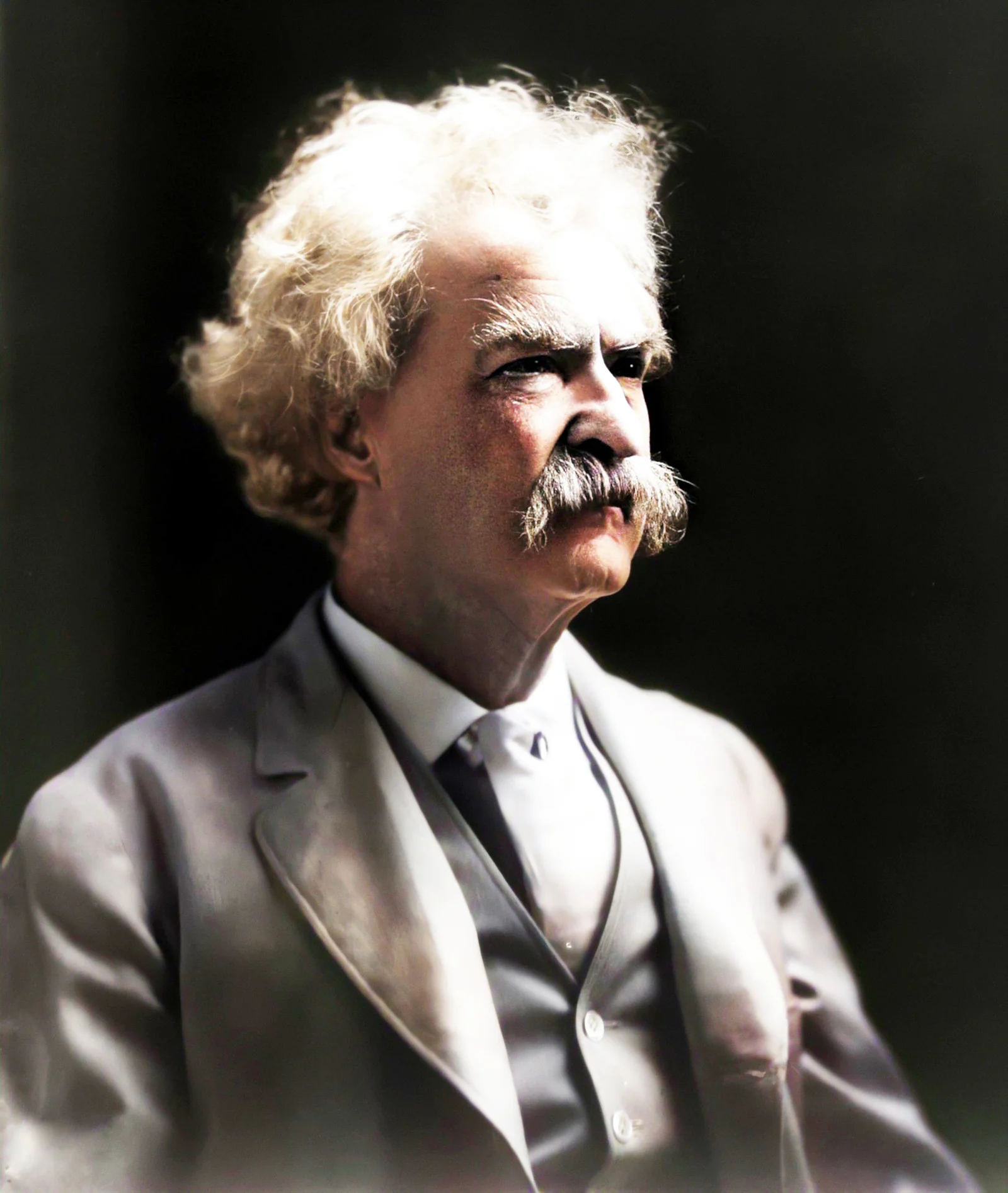
| 180 Quotes | |
| Born as | Samuel Langhorne Clemens |
| Occup. | Author |
| From | USA |
| Spouse | Olivia Langdon |
| Born | November 30, 1835 Florida, Missouri, USA |
| Died | April 21, 1910 Redding, Connecticut, USA |
| Cause | Heart disease (often described as angina pectoris/heart attack) |
| Aged | 74 years |
| Cite | |
Citation Formats
APA Style (7th ed.)
Mark twain biography, facts and quotes. (2026, February 2). FixQuotes. https://fixquotes.com/authors/mark-twain/
Chicago Style
"Mark Twain biography, facts and quotes." FixQuotes. February 2, 2026. https://fixquotes.com/authors/mark-twain/.
MLA Style (9th ed.)
"Mark Twain biography, facts and quotes." FixQuotes, 2 Feb. 2026, https://fixquotes.com/authors/mark-twain/. Accessed 6 Mar. 2026.
Early Life and Background
Samuel Langhorne Clemens was born on November 30, 1835, in Florida, Missouri, and raised from age four in Hannibal, a river town that pressed the Mississippi into a boy's imagination. His father, John Marshall Clemens, was a lawyer and judge who struggled financially; his mother, Jane Lampton Clemens, supplied the household with storytelling, music, and a sharp ear for human folly. The family lived in the border-state shadow of slavery, and the daily theater of steamboats, feuds, religion, and courtroom talk became the raw material Twain would later refine into a national myth.In 1847, his father died, and the eleven-year-old was pushed early into work, first as a printer's apprentice and then a typesetter. The print shop gave him two permanent instruments: a feel for the spoken American sentence and a skepticism hardened by deadlines and gossip. Hannibal also gave him lifelong contradictions - affection for community alongside a clear view of cruelty - and the memory of enslaved people whose voices and silences would haunt his later writing.
Education and Formative Influences
Clemens had limited formal schooling, but he educated himself in newsrooms and on the move, reading widely while working for printers in St. Louis and, by 1853, traveling east to New York, Philadelphia, and Washington, D.C. The era was a boom time for newspapers and a fracture time for the republic; he absorbed the rhythms of partisan editorials, comic sketches, and lecture-hall performance. By the late 1850s he found his true apprenticeship on the Mississippi, training as a steamboat pilot under Horace Bixby, a demanding mentor who taught him to read the river like a text - precise, shifting, and unforgiving.Career, Major Works, and Turning Points
The Civil War ended his piloting career when the river traffic collapsed; after a brief, half-hearted stint with a Confederate militia, he headed west with his brother Orion to Nevada Territory in 1861. There he became a miner in name and a journalist in fact, adopting "Mark Twain" and breaking out nationally with "The Celebrated Jumping Frog of Calaveras County" (1865). Travel and performance followed: "The Innocents Abroad" (1869) made him the era's most popular humorist; marriage to Olivia Langdon in 1870 anchored him in Hartford's literary circle even as he kept roaming on the lecture circuit. His major novels - "The Adventures of Tom Sawyer" (1876), "Adventures of Huckleberry Finn" (1884), and "A Connecticut Yankee in King Arthur's Court" (1889) - deepened the comedy into moral argument. Financial disaster from the Paige typesetter and a failing publishing venture drove him to an exhausting world lecture tour to repay debts; personal catastrophe followed with the deaths of Susy Clemens (1896), his wife (1904), and daughter Jean (1909). He died on April 21, 1910, in Redding, Connecticut, after becoming, in old age, a global emblem of American speech.Philosophy, Style, and Themes
Twain's style looked effortless but was engineered: a spoken cadence, a reporter's detail, and the stagecraft of timing. He distrusted grand abstractions and tested ideas by putting them in a boy's mouth, a con man's patter, or a senator's slogan. He believed comedy was not decoration but a tool of survival and exposure - “The human race has one really effective weapon, and that is laughter”. The laughter in his best work is therefore not weightless; it is the sound of a mind refusing to be bullied by cant, whether the cant is religious, patriotic, or genteel.Under the jokes ran a darker inquiry into how people defend what they want to believe. His river novels turn moral choice into lived moment - a whisper of conscience against the roar of custom - and his later essays and satires sharpen into open contempt for imperialism, mob certainty, and respectable hypocrisy. “It ain't what you don't know that gets you into trouble. It's what you know for sure that just ain't so”. That line captures the psychology of Twain's adulthood: a man who saw how easily "civilization" manufactures certainty, and how often certainty becomes permission to harm. Even his craft ethic carried an edge of realism: “The right word may be effective, but no word was ever as effective as a rightly timed pause”. In his hands, the pause is where the audience hears its own complicity.
Legacy and Influence
Mark Twain helped invent the modern American voice in literature - vernacular, morally alert, suspicious of authority, and confident that the national story includes the liar, the orphan, the drifter, and the enslaved. "Huckleberry Finn" reshaped the possibilities of narrative point of view and remains a central, contested text in debates about race, language, and education. His late anti-imperialist writings and unsparing wit influenced journalists, satirists, and novelists from H.L. Mencken to Kurt Vonnegut, while his public persona established the template of the American author as performer and truth-teller. More than a humorist, he endures as a diagnostician of self-deception - and as a writer who proved that a joke can be a form of conscience.Our collection contains 180 quotes written by Mark, under the main topics: Witty One-Liners - Motivational - Ethics & Morality - Wisdom - Truth.
Other people related to Mark: Josh Billings (Comedian), Charles Farrar Browne (Writer), William Dean Howells (Author), Hal Holbrook (Actor), Bret Harte (Author), Carl Clinton Van Doren (Critic), Nigel Rees (Author), Rachael Leigh Cook (Actress), Roger Miller (Musician), Joseph Jefferson (Artist)
Frequently Asked Questions
- Mark Twain meaning: Pen name from riverboat slang meaning two fathoms (12 feet) of safe water
- Mark Twain award: Namesake of the Mark Twain Prize for American Humor; received an Oxford honorary Doctor of Letters (1907)
- Mark Twain famous works: Adventures of Huckleberry Finn; The Adventures of Tom Sawyer; Life on the Mississippi; A Connecticut Yankee in King Arthur's Court; The Prince and the Pauper
- Short stories by Mark Twain: The Celebrated Jumping Frog of Calaveras County; The Man That Corrupted Hadleyburg; The $1,000,000 Bank-Note; Luck; A Dog's Tale
- Mark Twain cause of death: Heart failure (angina pectoris), 1910
- Mark Twain books: The Adventures of Tom Sawyer; Adventures of Huckleberry Finn; The Prince and the Pauper; A Connecticut Yankee in King Arthur's Court; Life on the Mississippi; The Innocents Abroad; Roughing It
- How old was Mark Twain? He became 74 years old
Mark Twain Famous Works
- 1894 The Tragedy of Pudd'nhead Wilson (Novel)
- 1889 A Connecticut Yankee in King Arthur's Court (Novel)
- 1884 Adventures of Huckleberry Finn (Novel)
- 1883 Life on the Mississippi (Memoir)
- 1881 The Prince and the Pauper (Novel)
- 1876 The Adventures of Tom Sawyer (Novel)
- 1869 The Innocents Abroad (Travel literature)
Source / external links