
Martin Luther Biography Quotes 49 Report mistakes
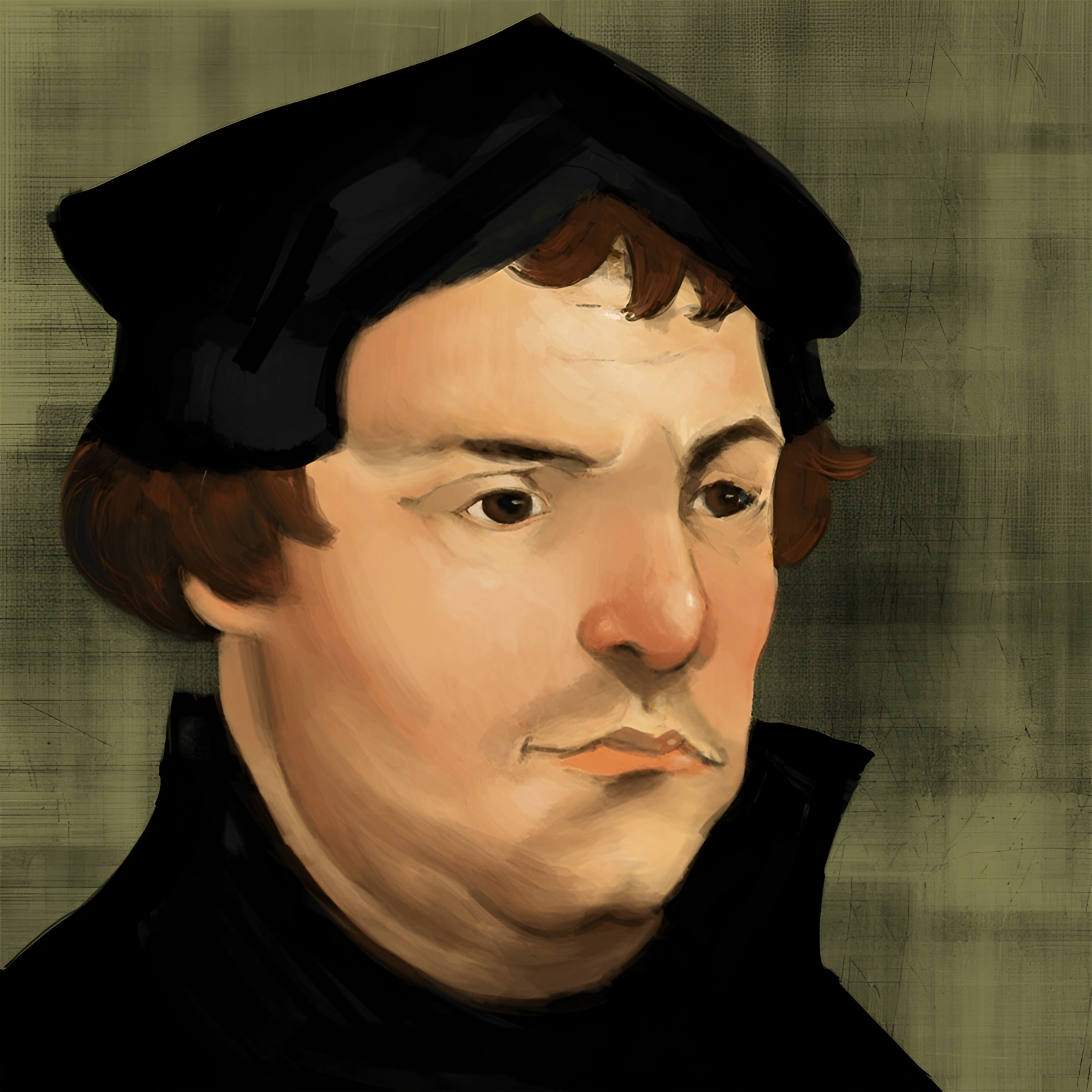
| 49 Quotes | |
| Occup. | Professor |
| From | Germany |
| Born | November 10, 1483 |
| Died | February 18, 1546 |
| Aged | 62 years |
| Cite | |
Citation Formats
APA Style (7th ed.)
Martin luther biography, facts and quotes. (2026, February 11). FixQuotes. https://fixquotes.com/authors/martin-luther/
Chicago Style
"Martin Luther biography, facts and quotes." FixQuotes. February 11, 2026. https://fixquotes.com/authors/martin-luther/.
MLA Style (9th ed.)
"Martin Luther biography, facts and quotes." FixQuotes, 11 Feb. 2026, https://fixquotes.com/authors/martin-luther/. Accessed 12 Feb. 2026.
Early Life and Background
Martin Luther was born on November 10, 1483, in Eisleben in the County of Mansfeld (in today's Saxony-Anhalt, Germany), and died on February 18, 1546, in the same town while traveling to mediate a dispute among Mansfeld counts. His life unfolded inside the nervous, competitive patchwork of the Holy Roman Empire, where imperial politics, papal authority, and local princes contended for power amid rising towns, printing presses, and anxious piety. Luther's Germany was saturated with sermons about judgment and the afterlife, and with practical negotiations over taxes, ecclesiastical fees, and legal jurisdictions - conditions that made theological questions inseparable from ordinary economic and civic life.He was raised in a driven, upwardly mobile household. His father, Hans Luder, moved the family from Eisleben to Mansfeld and worked toward prosperity in mining and smelting; his mother, Margarethe, kept a stern domestic order. Luther later recalled the discipline of his childhood as harsh, yet it formed in him a lifelong sensitivity to authority, guilt, and the desperate need for assurance. That interior pressure - the fear of failing God and the simultaneous longing for a gracious Father - became the emotional engine of his later revolt against what he viewed as a salvation system built on anxiety.
Education and Formative Influences
Luther was educated at Latin schools in Mansfeld, Magdeburg, and Eisenach, then entered the University of Erfurt in 1501, earning a B.A. (1502) and M.A. (1505). He was trained in scholastic logic and nominalist theology and was prepared for a legal career, but a spiritual crisis culminated in his entry into the Augustinian monastery at Erfurt in 1505. There he pursued extreme confession, fasting, and prayer, not from theatrical zeal but from scrupulous dread: he sought certainty that God could be trusted. Ordained in 1507 and sent to study further, he received a doctorate in theology in 1512 and joined the University of Wittenberg, where his vocation as professor, preacher, and biblical lecturer fused scholarship with pastoral urgency.Career, Major Works, and Turning Points
As professor at Wittenberg, Luther's lectures on Psalms, Romans, Galatians, and Hebrews (1513-1518) sharpened his conviction that justification is God's gift received by faith rather than earned through works. The indulgence campaign associated with Johann Tetzel catalyzed his public challenge, and on October 31, 1517, he sent his Ninety-Five Theses for academic debate. Escalation followed: the Leipzig Debate (1519) pushed him toward rejecting papal supremacy; in 1520 he issued a trilogy of reforming treatises, including Address to the Christian Nobility of the German Nation, The Babylonian Captivity of the Church, and The Freedom of a Christian. Excommunicated in 1521 and confronted at the Diet of Worms, he refused recantation and was sheltered at the Wartburg, where he began translating the New Testament into German (1522), a linguistic and cultural turning point. Returning to Wittenberg, he helped shape evangelical worship and church order, married the former nun Katharina von Bora (1525), wrote catechisms (1529), and navigated the upheavals of the Peasants' War (1524-1525) and the confessionalization of German territories, becoming both a spiritual liberator and a contested public voice.Philosophy, Style, and Themes
Luther's inner life revolved around a single question: how can a sinner stand before a holy God without self-deception? His answer centered on the Word as promise - Christ given to the conscience through Scripture and preaching. He read the Bible not as a ladder of merit but as a cradle of divine self-giving: "The Bible is the cradle wherein Christ is laid". That sentence is theological and psychological at once. It reveals his need for a tangible place where mercy can be encountered again and again, against the mind's tendency to spiral into accusation. His famous insistence that God justifies the ungodly was not an abstract theory but a strategy for surviving despair.His style matched his diagnosis of the human condition: direct, musical, earthy, and combative. He distrusted the capacity of unaided intellect to deliver salvation or peace, and he could weaponize that distrust into shocking rhetoric - "Reason is a whore, the greatest enemy that faith has". The provocation was aimed less at learning itself (he remained a professor to the end) than at the soul's habit of turning reasoning into a self-justifying idol. Likewise, his view of moral agency emphasized captivity and contest rather than autonomous self-mastery: "The will is a beast of burden. If God mounts it, it wishes and goes as God wills; if Satan mounts it, it wishes and goes as Satan wills; Nor can it choose its rider... the riders contend for its possession". This grim anthropology fueled both his comfort to the terrified (salvation depends on God) and his severity toward what he saw as spiritual counterfeit.
Legacy and Influence
Luther helped fracture Western Christendom and accelerated the emergence of Protestant churches, while also prompting Catholic reform and hardening confessional boundaries that reshaped European politics. His German Bible and hymns (including "Ein feste Burg ist unser Gott") strengthened vernacular literacy and linked faith to common speech, while his catechisms and preaching modeled a new kind of mass pastoral instruction. As a professor who became a public theologian, he set patterns for modern religious argument in the age of print: polemical, accessible, and institution-shaping. Yet his legacy is inseparable from his contradictions - courage and tenderness alongside ferocity and damaging polemics - making him enduringly influential not as a plaster saint but as a man whose anxieties, convictions, and gifts remade the religious imagination of Europe.Our collection contains 49 quotes written by Martin, under the main topics: Witty One-Liners - Ethics & Morality - Wisdom - Truth - Justice.
Source / external links