
Martina Navratilova Biography Quotes 20 Report mistakes
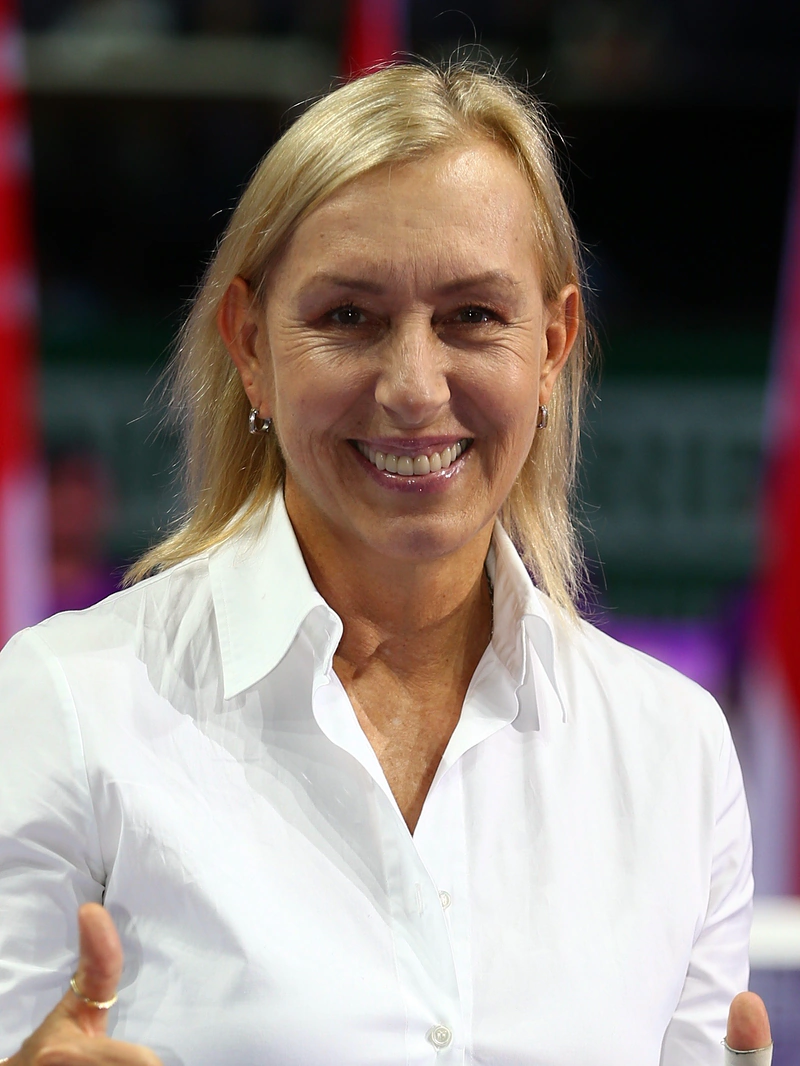
Attr: gspeakers.com
| 20 Quotes | |
| Occup. | Athlete |
| From | USA |
| Born | October 18, 1956 Prague, Czechoslovakia |
| Age | 69 years |
| Cite | |
Citation Formats
APA Style (7th ed.)
Martina navratilova biography, facts and quotes. (2026, February 11). FixQuotes. https://fixquotes.com/authors/martina-navratilova/
Chicago Style
"Martina Navratilova biography, facts and quotes." FixQuotes. February 11, 2026. https://fixquotes.com/authors/martina-navratilova/.
MLA Style (9th ed.)
"Martina Navratilova biography, facts and quotes." FixQuotes, 11 Feb. 2026, https://fixquotes.com/authors/martina-navratilova/. Accessed 24 Mar. 2026.
Early Life and Background
Martina Navratilova was born on October 18, 1956, in Prague, Czechoslovakia, into a country where sport was both a public pride and a state-managed system. Her earliest identity formed around motion and competition: as a child she showed quick reflexes and a stubborn appetite for repetition, the kind of temperament that turns practice into refuge. When her parents separated, her mother Jana and stepfather Mirek Navratil became the stabilizing forces; Mirek, himself a skilled tennis player, gave her not only a surname but a model of exacting standards.Czechoslovakia in the 1960s and early 1970s offered opportunity and constraint in the same breath. Talented juniors could rise, travel, and earn state support - but at the cost of surveillance, limited autonomy, and the constant pressure to represent a system. Navratilova grew up with the double consciousness common to Eastern Bloc athletes: gratitude for structured access to training, and a simmering sense that her life belonged to committees as much as to herself. That tension, between personal freedom and institutional control, would later harden into one of the defining turning points of modern sport.
Education and Formative Influences
Her education unfolded largely through sport: long days split between school and training, with tennis functioning as a parallel curriculum teaching cause-and-effect, self-regulation, and emotional containment. As a teenager she became the top Czech player, winning national titles and drawing attention for her left-handed power, aggressive net instincts, and competitive fearlessness. The international tennis circuit - with its different languages, freer press, and visible professionalism - became her window into an adult life she could choose, and it sharpened a private resolve to control her own career, body, and identity.Career, Major Works, and Turning Points
Navratilova turned professional in 1975 and, while competing at the US Open, defected from Czechoslovakia and sought political asylum in the United States, later becoming an American citizen (1981) - a decision that redefined her as both athlete and symbol. On court she built one of the most comprehensive records in tennis history: 18 Grand Slam singles titles, 31 Grand Slam doubles titles, and 10 Grand Slam mixed doubles titles, alongside a record 167 singles titles and 177 doubles titles. Her prime, especially from 1982-1987, fused relentless fitness, precision serving, and ruthless volleying; the 1984 season (74-2) captured her dominance. Rivalries shaped her public narrative - first with Chris Evert, a contrast of styles that elevated women's tennis, then with Steffi Graf as the sport shifted to baseline power. She extended her career unusually long, winning major doubles titles into her late 40s, turning longevity itself into a craft, and after retirement she became a prominent commentator and advocate, often courting controversy with the same plainspoken certainty she brought to match points.Philosophy, Style, and Themes
Navratilova's tennis was a philosophy in motion: take the initiative, shorten the point, accept risk, and train until risk becomes routine. Her commitment to conditioning and nutrition helped professionalize women's tennis, and her game - lefty serve wide, first volley deep, close the net like a door - expressed a personality allergic to passivity. She treated weakness not as shame but as data, living out her own maxim: “The mark of great sportsmen is not how good they are at their best, but how good they are their worst”. The line reads like autobiography: her greatness was not a perpetual peak, but a disciplined refusal to collapse on off-days, in hostile crowds, or under political and personal scrutiny.Her inner life was forged in the collision of excellence and exposure. As one of the first openly gay superstars in global sport, she carried both the liberating force of truth and the exhausting labor of being watched. She challenged the era's stereotypes head-on, noting how fear policed girls' ambition: “People in the States used to think that if girls were good at sports their sexuality would be affected”. That insight reveals a psychology honed by constant mislabeling - and it connects to her broader insistence on personhood over categorization: “Labels are for filing. Labels are for clothing. Labels are not for people”. Even her spirituality remained practical rather than mystical, grounded in the idea that sport can remake the self from the inside out, in routine, pain, and attention.
Legacy and Influence
Navratilova endures as more than a record holder: she is a hinge figure between the amateur past and the fully professional present of women's tennis. Her training standards, attacking patterns, and doubles intellect still function as a blueprint, while her public life helped widen the space for openly LGBTQ athletes to compete without apology. The long arc of her story - from a controlled childhood in Prague to self-authorship in the United States - turned tennis into a language of freedom, and her example continues to argue that greatness is built not only in trophies, but in the daily decision to live as oneself under pressure.Our collection contains 20 quotes written by Martina, under the main topics: Witty One-Liners - Motivational - Victory - Life - Sports.
Other people related to Martina: Martina Hingis (Athlete), Monica Seles (Athlete), Tracy Austin (Athlete), Steffi Graf (Athlete)