
Mia Hamm Biography Quotes 17 Report mistakes
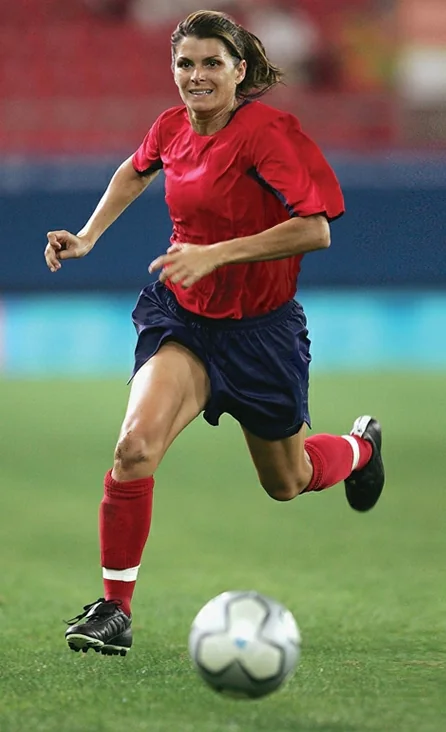
| 17 Quotes | |
| Born as | Mariel Margaret Hamm |
| Occup. | Athlete |
| From | USA |
| Born | March 17, 1972 Selma, Alabama, United States |
| Age | 53 years |
| Cite | |
Citation Formats
APA Style (7th ed.)
Mia hamm biography, facts and quotes. (2026, February 11). FixQuotes. https://fixquotes.com/authors/mia-hamm/
Chicago Style
"Mia Hamm biography, facts and quotes." FixQuotes. February 11, 2026. https://fixquotes.com/authors/mia-hamm/.
MLA Style (9th ed.)
"Mia Hamm biography, facts and quotes." FixQuotes, 11 Feb. 2026, https://fixquotes.com/authors/mia-hamm/. Accessed 12 Feb. 2026.
Early Life and Background
Mariel Margaret "Mia" Hamm was born on March 17, 1972, in Selma, Alabama, to Bill and Stephanie Hamm. As the daughter of a U.S. Air Force officer, she grew up in motion, living in several postings before the family settled in San Antonio, Texas. That itinerant childhood quietly trained her for a sport that rewards adaptability: new fields, new teammates, new expectations, and the need to belong quickly.Soccer entered her life early, and so did responsibility. She was one of six children, including an adopted brother, Garrett, whose serious health challenges shaped Hamm's emotional vocabulary around resilience and perspective. Friends and coaches later described her as intensely competitive but not showy - a child who preferred the work to the spotlight, and who learned to fold personal ambition into a larger family and team life.
Education and Formative Influences
Hamm became the youngest player ever selected to the U.S. women's national team when she debuted in 1987 at age 15, a formative jolt that accelerated her adolescence. In 1990 she enrolled at the University of North Carolina at Chapel Hill, playing for Anson Dorrance and helping UNC win four NCAA championships (1990-1993). The Tar Heels' training culture - relentless fitness, tactical discipline, and competitive internal standards - fused with her national-team experiences, turning raw talent into a repeatable professional habit: first touch under pressure, runs timed to the second, and a willingness to be judged by the hardest rooms.Career, Major Works, and Turning Points
Hamm's international career (1987-2004) tracked the rise of women's soccer from niche to mass spectacle. She won the FIFA Women's World Cup in 1991 and 1999, added Olympic gold medals in 1996 (the first women's Olympic soccer tournament) and 2004, and helped redefine the attacking winger-forward role with pace, vision, and an instinct for the final pass. By the early 2000s she became the sport's most recognizable American face, setting long-standing national-team records in goals and assists (later surpassed), while injuries and grueling travel tested her longevity. A major turning point came in 1999: the Rose Bowl final, decided on penalties, converted the national team into cultural icons and placed Hamm at the center of a new commercial and media era for women's athletics. She finished her career with the Washington Freedom in the Women's United Soccer Association and retired from international play after the 2004 Olympics, closing a chapter defined by both dominance and durability.Philosophy, Style, and Themes
Hamm's game was built on speed of thought as much as speed of body - a low center of gravity, a clean first touch, and an ability to turn defensive moments into instant counterattacks. Teammates often noted how rarely she wasted motion; she played as if conserving energy for the decisive run. That economy reflected an inner temperament: controlled intensity, a private worker's pride, and a belief that excellence is not an event but a system.Her most revealing statements are about labor, not glory. "The vision of a champion is bent over, drenched in sweat, at the point of exhaustion, when nobody else is looking". It reads like autobiography: the psychological comfort she found in repetition, in being unseen, in letting preparation carry the ego. She also framed improvement as a daily reckoning with error - "Failure happens all the time. It happens every day in practice. What makes you better is how you react to it". - a mindset that protected her from both complacency and the fragility of perfectionism. And because her stardom arrived within a team project that had to sell the sport as well as win, she emphasized interdependence: "I am a member of a team, and I rely on the team, I defer to it and sacrifice for it, because the team, not the individual, is the ultimate champion". In Hamm's inner life, the team was not a slogan but a psychological anchor - the place where pressure could be shared and meaning expanded beyond personal records.
Legacy and Influence
Mia Hamm became a template for the modern American soccer star: technically elite, relentlessly fit, media-ready without seeming manufactured, and publicly committed to the legitimacy of women's sport. Her peak coincided with Title IX's maturation and the 1990s boom in women's athletics, making her both beneficiary and engine of cultural change. By proving that women's soccer could command stadium crowds, sponsorships, and national attention, she widened the pipeline for later generations - from youth participation to professional leagues and global ambitions - while leaving behind an ethic of work that still defines how champions in the sport describe themselves.Our collection contains 17 quotes written by Mia, under the main topics: Motivational - Victory - Sports - Resilience - Success.
Other people related to Mia: Brandi Chastain (Athlete), Will Ferrell (Comedian), Lorrie Fair (Athlete), Nomar Garciaparra (Athlete)
Source / external links