
Michael Phelps Biography Quotes 16 Report mistakes
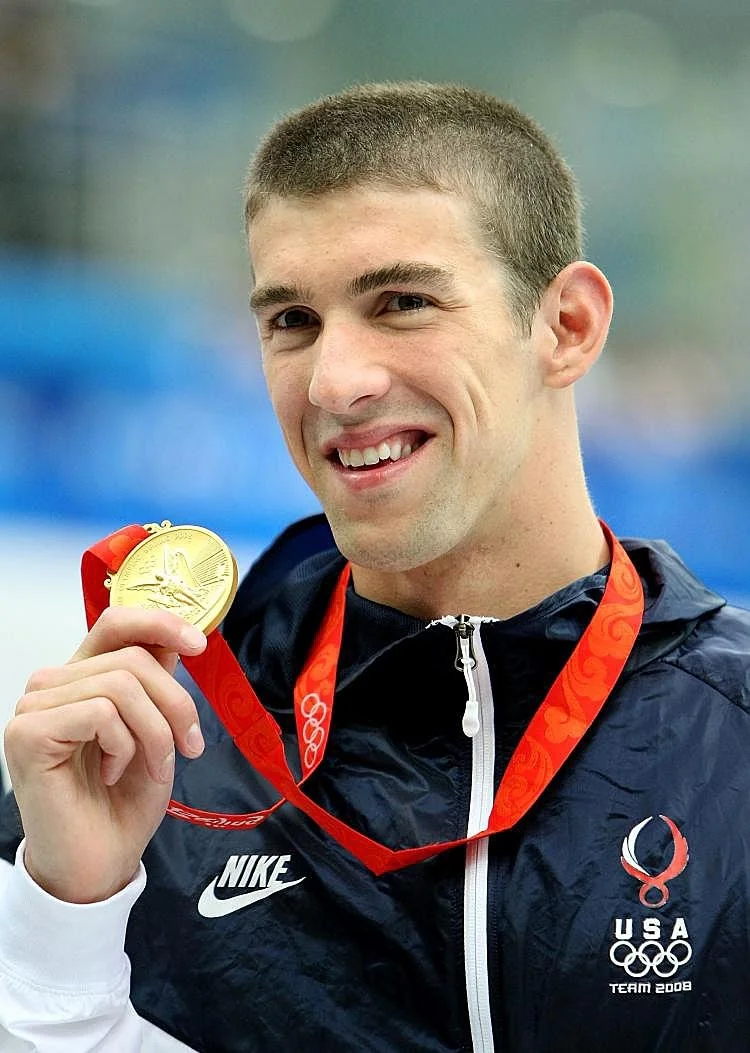
| 16 Quotes | |
| Occup. | Athlete |
| From | USA |
| Born | June 30, 1985 Baltimore, Maryland |
| Age | 40 years |
| Cite | |
Citation Formats
APA Style (7th ed.)
Michael phelps biography, facts and quotes. (2026, February 3). FixQuotes. https://fixquotes.com/authors/michael-phelps/
Chicago Style
"Michael Phelps biography, facts and quotes." FixQuotes. February 3, 2026. https://fixquotes.com/authors/michael-phelps/.
MLA Style (9th ed.)
"Michael Phelps biography, facts and quotes." FixQuotes, 3 Feb. 2026, https://fixquotes.com/authors/michael-phelps/. Accessed 27 Mar. 2026.
Early Life and Background
Michael Fred Phelps II was born June 30, 1985, in Baltimore, Maryland, the youngest of three children in a close but later divided household. His mother, Deborah, a middle-school principal, ran the family with a teacher's insistence on routines and accountability; his father, Fred, was a Maryland state trooper. When his parents divorced in the 1990s, the domestic ground shifted in a way Phelps has often described as disorienting, and swimming - predictable lanes, measurable clocks - offered a substitute order.He was a restless, high-energy kid in Towson, drawn to water partly because his sisters swam and partly because the pool gave his body a channel. Diagnosed with ADHD, he carried the stigma and impatience of a child whose mind ran faster than classrooms could handle. In the water, that same intensity became an advantage: long limbs, unusual ankle flexibility, and an early appetite for repetition that made the black line at the bottom of the pool feel like a target rather than a constraint.
Education and Formative Influences
Phelps attended Rodgers Forge Elementary, Dumbarton Middle, and Towson High School, but his real education was the daily apprenticeship of American age-group swimming at the end of the 1990s, when the sport was professionalizing yet still organized around brutal early-morning practices. Under coach Bob Bowman at the North Baltimore Aquatic Club, he learned to treat talent as raw material and to treat boredom as an enemy. Bowman imposed process - splits, technique, accountability, mental rehearsal - and Phelps supplied obsession, a combination that turned adolescent energy into a system.Career, Major Works, and Turning Points
At 15, Phelps became the youngest male on a U.S. Olympic swim team in 68 years at Sydney 2000; he did not medal, but the experience hardened his expectations. He broke his first world record (200m butterfly) in 2001, then erupted at Athens 2004 with six gold and two bronze medals, signaling a new multi-event model built around butterfly, freestyle, and the medley. Beijing 2008 made him a global figure: eight gold medals, seven world records, one Olympic record, and a nightly escalation of pressure that he met with near-mechanical precision. He retired after London 2012 as the most decorated Olympian in history, returned from retirement to win five gold and one silver at Rio 2016, and left the sport with 28 Olympic medals (23 gold). His career also included public stumbles - a 2004 DUI arrest and the 2009 bong photo controversy - episodes that punctured the superhero narrative and forced him to confront the costs of living as both athlete and symbol.Philosophy, Style, and Themes
Phelps' inner life was defined by an uneasy bargain: the pool offered comfort, but comfort demanded totality. His training style was volume plus specificity - relentless aerobic work, punishing race-pace sets, and an obsessive attention to turns and underwater dolphin kicks, where he often created the decisive meters. Psychologically, he pursued control through routine, sometimes to the edge of compulsion, and he has admitted that a subpar swim could hijack his entire day. “If I didn't swim my best, I'd think about it at school, at dinner, with my friends. It would drive me crazy”. That sentence captures the engine of his greatness - and the seed of his later battles with depression and emptiness after major meets, when the stopwatch stopped providing meaning.His public philosophy, often framed as inspiration, was also a personal survival strategy: turn anxiety into a plan, then execute the plan. “I think that everything is possible as long as you put your mind to it and you put the work and time into it. I think your mind really controls everything”. In practice this meant pre-race visualization, narrowing attention to controllables, and using Bowman as an external conscience when motivation wavered. Yet ambition was never purely individual; he saw himself as a lever on the sport's ceiling. “I want to be able to look back and say, 'I've done everything I can, and I was successful.' I don't want to look back and say I should have done this or that. I'd like to change things for the younger generation of swimmers coming along”. Behind the medals sits a recurring theme: legacy as responsibility, not victory as entertainment.
Legacy and Influence
Phelps reshaped modern swimming by proving that a single athlete could dominate across strokes and distances through scientific preparation, underwater mastery, and year-round discipline; the template influenced national programs, NCAA training, and the marketing of the Olympics themselves. He also altered the cultural conversation around elite sport by speaking candidly about mental health, reframing the champion not as an invulnerable machine but as a person built out of habits, fears, and repair. Through his foundation, swim-safety advocacy, and the standard he set for professionalism in a once-amateur landscape, Phelps remains both a record-holder and a reference point - for how far a body can be trained, and what it costs a mind to chase the limit.Our collection contains 16 quotes written by Michael, under the main topics: Motivational - Sports - New Beginnings - Goal Setting - Success.
Other people related to Michael: Mark Spitz (Athlete), Ian Thorpe (Athlete)
Source / external links