
Michelangelo Biography Quotes 35 Report mistakes
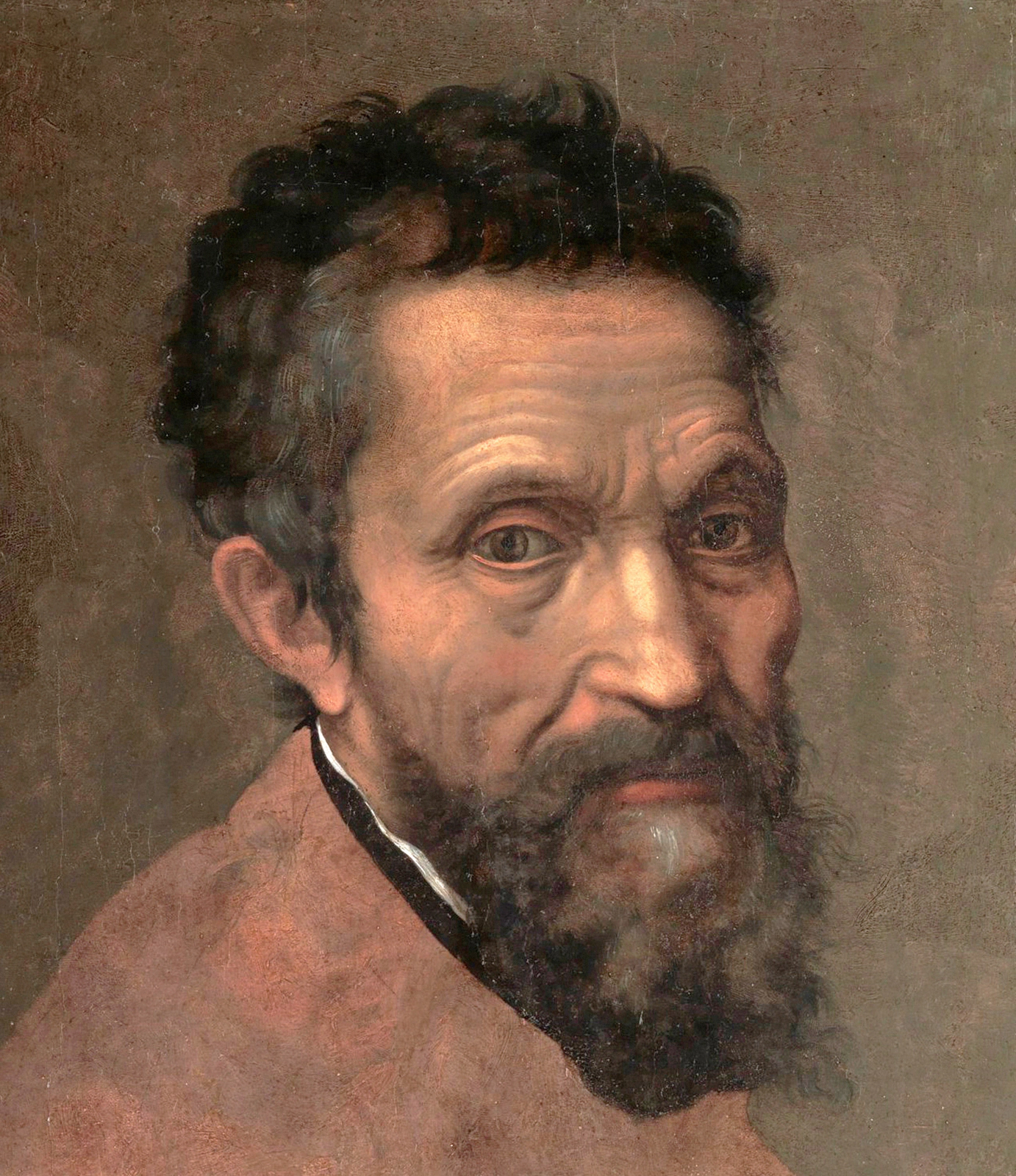
Attr: By Attributed to Daniele da Volterra
| 35 Quotes | |
| Born as | Michelangelo di Lodovico Buonarroti Simoni |
| Occup. | Artist |
| From | Italy |
| Born | March 6, 1475 Caprese Michelangelo, Tuscany, Italy |
| Died | March 18, 1564 Rome, Lazio, Italy |
| Cause | Brief illness |
| Aged | 89 years |
| Cite | |
Citation Formats
APA Style (7th ed.)
Michelangelo biography, facts and quotes. (2026, February 11). FixQuotes. https://fixquotes.com/authors/michelangelo/
Chicago Style
"Michelangelo biography, facts and quotes." FixQuotes. February 11, 2026. https://fixquotes.com/authors/michelangelo/.
MLA Style (9th ed.)
"Michelangelo biography, facts and quotes." FixQuotes, 11 Feb. 2026, https://fixquotes.com/authors/michelangelo/. Accessed 31 Mar. 2026.
Early Life and Background
Michelangelo di Lodovico Buonarroti Simoni was born on 1475-03-06 in Caprese, in the Tuscan Apennines, while his father served as a local official for Florence. The family soon returned to Florentine territory, and Michelangelo was raised largely in Settignano, a stonecutters' village where, by later recollection, the landscape of quarries and chisels entered his body before it entered his mind. That origin story mattered in a Renaissance culture that prized lineage and civic identity: he grew up poor in cash but rich in the hard Florentine conviction that talent could contend with birth.From the beginning he carried a tense inner duality: a proud, solitary temperament and a hunger for recognition that he would later deny even as he pursued it. He was emotionally tied to the city-state's fierce politics and to the idea of the artist as an almost sovereign maker, yet he also feared dependency and betrayal, hoarding money, guarding drawings, and limiting intimacy. The Italy of his youth was an archipelago of rival courts and papal power, with Florence oscillating between republican ideals and Medici dominance - a volatility that shaped his instinct to anchor himself in work rather than in institutions.
Education and Formative Influences
Apprenticed in 1488 to Domenico Ghirlandaio, he absorbed the craft discipline of fresco and the workshop's brisk narrative clarity, but his decisive formation came in the Medici orbit, where Lorenzo de' Medici drew him into a circle of humanists and antiquarians. In the Medici garden he studied classical fragments as if they were living anatomy, learning that antiquity was not imitation but a standard to be surpassed. Encounters with Neoplatonic talk of ideal form, with the sermons and crisis atmosphere that culminated in Savonarola's rule, and with Florentine dissection practices that sharpened anatomical truth all fused into a sensibility at once intellectual, devotional, and relentlessly physical.Career, Major Works, and Turning Points
His Roman Pieta (1498-1499), carved for St. Peter's, announced a new kind of solemn beauty - youthful, controlled, and technically audacious - and returned him to Florence as a public contender; David (1501-1504) made that contention civic myth, a colossal nude aligned with republican vigilance. Summoned by Pope Julius II, he was dragged into the political theater of patronage: the aborted, decades-long Tomb of Julius became his torment and engine, producing Moses and the Slaves, while the Sistine Chapel ceiling (1508-1512) turned a sculptor into a painter of cosmic anatomy. Later commissions tightened the knot between art, power, and faith: Medici Chapel tombs in San Lorenzo, the Laurentian Library vestibule, and then in Rome the Last Judgment (1536-1541), controversial for its naked terror. In his final decades, made chief architect of St. Peter's in 1546, he simplified the basilica into a monumental unity crowned by the dome, working to the end as if deadlines were metaphysical.Philosophy, Style, and Themes
Michelangelo's inner life reads as a moral struggle staged in stone: longing for absolute form and suspicion of the world's compromises. He defended labor as a kind of truth-telling, insisting, “If people knew how hard I worked to get my mastery, it wouldn't seem so wonderful at all”. The line is not modesty but discipline speaking - a man who mistrusted ease, used exhaustion as proof of vocation, and treated craft as an ethical practice. Even his poetry circles the same anxiety: that love, fame, and patronage are unstable, while work endures as the one arena where the self can be judged.Stylistically he pushed the human body into a theology of tension - muscular prophets, twisting sibyls, saints and damned as anatomy under judgment - because for him flesh was not decoration but revelation. His sculptural thought rests on the belief that form is latent and the artist is a liberator: “The marble not yet carved can hold the form of every thought the greatest artist has”. That credo explains both his triumphs and his famous non finito, where figures seem to fight their way out of the block as if becoming were more honest than completion. At the same time his ambition never lowered its horizon: "The greater danger for most of us lies not in setting our aim too high and falling short; but in setting our aim too low, and
Our collection contains 35 quotes written by Michelangelo, under the main topics: Motivational - Art - Mortality - Nature - Learning.
Other people related to Michelangelo: Benjamin Haydon (Artist), Joshua Reynolds (Artist), Romain Rolland (Novelist), Giorgio Vasari (Artist), Gustave Moreau (Artist), Leonardo DaVinci (Artist)
Frequently Asked Questions
- Michelangelo architecture: St. Peter’s Basilica (dome), Laurentian Library, Medici Chapel, Capitoline Hill redesign.
- Michelangelo sculptures: David; Pietà; Moses; Dying Slave & Rebellious Slave; Bacchus.
- Michelangelo pronunciation: English: MY-kəl-AN-jə-loh; Italian: mee-keh-LAHN-djeh-loh.
- Michelangelo Buonarroti: Italian Renaissance master, sculptor, painter, architect, and poet (1475–1564).
- Michelangelo paintings: Sistine Chapel ceiling (Creation of Adam), The Last Judgment, Doni Tondo.
- How did Michelangelo die: After a brief fever (natural causes) in Rome on February 18, 1564.
- How old was Michelangelo? He became 89 years old
Source / external links