
Michelangelo Biography Quotes 35 Report mistakes
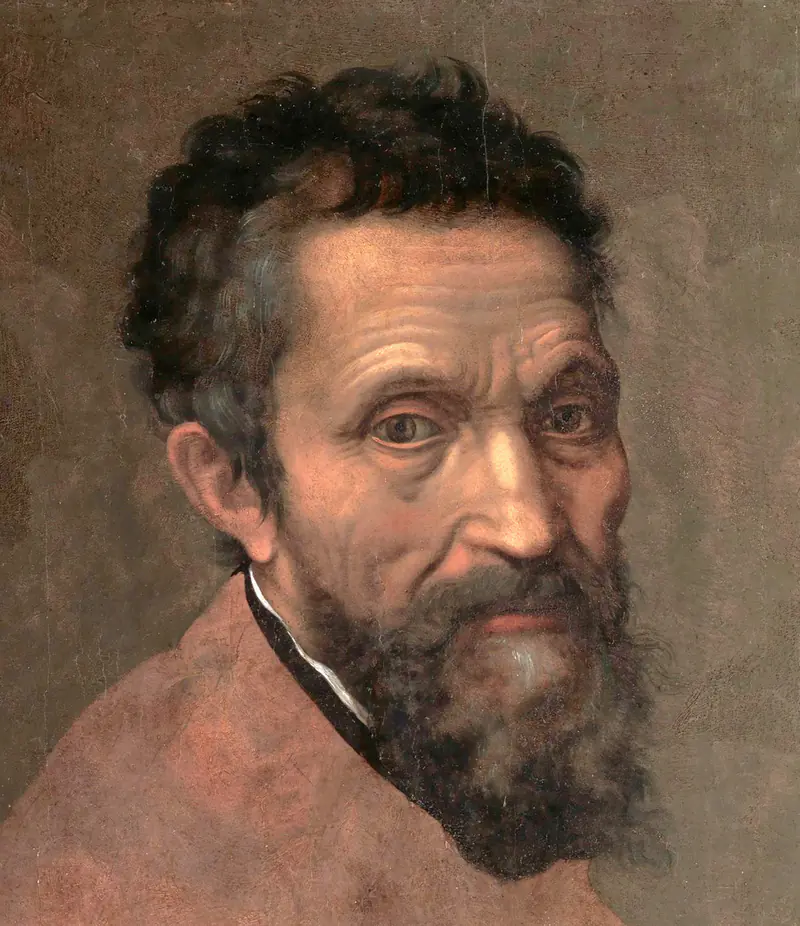
Attr: By Attributed to Daniele da Volterra
| 35 Quotes | |
| Born as | Michelangelo di Lodovico Buonarroti Simoni |
| Occup. | Artist |
| From | Italy |
| Born | March 6, 1475 Caprese Michelangelo, Tuscany, Italy |
| Died | March 18, 1564 Rome, Lazio, Italy |
| Cause | Brief illness |
| Aged | 89 years |
Michelangelo di Lodovico Buonarroti Simoni was born on March 6, 1475, in Caprese, near Arezzo, in the Republic of Florence (now Italy). His family belonged to minor Florentine nobility, though their fortunes had waned. Shortly after his birth they returned to Florence, the artistic and political center that would shape his identity. His father, Lodovico di Leonardo Buonarroti Simoni, held various administrative posts; his mother, Francesca di Neri, died when Michelangelo was young. Despite his father’s hopes that he enter a respectable profession, Michelangelo’s aptitude for drawing asserted itself early.
Training and the Medici Circle
At thirteen, Michelangelo apprenticed to the leading Florentine painter Domenico Ghirlandaio (1488, 1489), learning drawing, fresco technique, and workshop practice. Lorenzo de’ Medici (“il Magnifico”) soon noticed the gifted youth and brought him into the Medici garden of sculpture, where Bertoldo di Giovanni oversaw a collection of ancient statuary that became Michelangelo’s informal academy. Among his earliest extant reliefs are the Madonna of the Stairs and the Battle of the Centaurs, already showing his fascination with the human body and classical form. Lorenzo’s death in 1492 and the turmoil that followed, marked by the rise of the fiery preacher Girolamo Savonarola, dispersed the Medici circle and briefly sent Michelangelo to Bologna and then back to Florence.
First Roman Sojourn and the Pietà
A forged “antique” Sleeping Cupid that drew Roman interest led to Michelangelo’s first trip to Rome in 1496. There he carved the Bacchus, sensuous and provocative, and then the Vatican Pietà (1498, 1499), a tour de force that married crystalline finish with poignant emotion. Signed on the Virgin’s sash, it established his reputation across Italy: the youthful Mary supports the dead Christ with a serenity that became a benchmark of High Renaissance sculpture.
Return to Florence: David and Republican Commissions
Back in Florence (1501, 1504), Michelangelo carved the colossal David from a weathered block of marble abandoned for decades. Installed before the Palazzo Vecchio, it became the emblem of Florentine civic pride. He painted the Doni Tondo, a rare panel painting by his hand, and began a grand cartoon for the Battle of Cascina, a never-executed fresco meant to rival Leonardo da Vinci’s Battle of Anghiari; both designs electrified younger artists with their muscular, dynamic nudes.
Pope Julius II and the Sistine Ceiling
Summoned by Pope Julius II in 1505, Michelangelo embarked on a turbulent, decades-long relationship centered on the pope’s monumental tomb. Disputes and shifting priorities redirected him to the Sistine Chapel ceiling (1508, 1512). Working largely alone on scaffolding he designed, he frescoed more than 300 figures, Creation scenes, prophets, sibyls, and ancestral narratives. The Creation of Adam, with its electrifying near-touch, became an icon of Western art. The Julius tomb, repeatedly scaled back, eventually found its reduced form in San Pietro in Vincoli, anchored by the commanding Moses and flanked by the unfinished “Slaves” or “Prisoners, ” whose rough surfaces helped define the expressive “non-finito.”
Medici Popes: Architecture and the New Sacristy
Under the Medici popes Leo X and Clement VII, Michelangelo was tasked with projects for San Lorenzo in Florence. His façade design for the church remained unbuilt, but he created the New Sacristy (Medici Chapel) and initiated the Laurentian Library. In the chapel, monumental tomb figures, Day and Night, Dawn and Dusk, redefine funerary sculpture with their allegorical bodies poised on sarcophagi, while the architecture’s elastic moldings and dynamic wall rhythms anticipate Mannerism. During the 1529, 1530 siege of Florence, he briefly served as the republic’s supervisor of fortifications, fell out of favor, fled, and was eventually pardoned.
Roman Maturity: The Last Judgment and Late Frescoes
After relocating permanently to Rome in 1534, Michelangelo painted the Last Judgment on the altar wall of the Sistine Chapel (1536, 1541) for Pope Paul III. The teeming vortex of resurrected souls and the commanding Christ brought a new, unsettling grandeur to sacred art. Some contemporaries criticized the nude figures; draperies were later added by his follower Daniele da Volterra after the Council of Trent. Michelangelo’s final frescoes, the Conversion of Saul and the Crucifixion of St. Peter (Cappella Paolina, 1542, 1549), are austere and introspective, with stark lighting and compressed space.
Architectural Leadership: St. Peter’s and the City
Appointed chief architect of St. Peter’s Basilica in 1546, Michelangelo inherited a complex, costly site. He simplified Antonio da Sangallo the Younger’s sprawling scheme, returning to a centralized plan inspired by Bramante and designing the great drum and profile for the dome. Although the dome was completed after his death by Giacomo della Porta, its silhouette is Michelangelo’s. He also reshaped Rome’s Capitoline Hill, creating the Piazza del Campidoglio’s elegant trapezoid and revetting the palaces’ facades, and designed works for Pius IV such as Porta Pia and the reimagined interiors of Santa Maria degli Angeli e dei Martiri, carved from the Baths of Diocletian.
Late Sculpture and the Poetry
In old age, Michelangelo turned to deeply personal sculpture: the so‑called Florentine Pietà (Pietà Bandini), which he famously tried to destroy, and the ethereal Rondanini Pietà, reworked until his final days. These incomplete marbles, their figures seeming to emerge and dissolve from the stone, distill his lifelong belief that sculpture “releases” form already present in the block. He also wrote hundreds of sonnets and madrigals, meditations on art, love, mortality, and faith, many addressed to the noblewoman Vittoria Colonna and to the young Roman aristocrat Tommaso de’ Cavalieri, with whom he formed profound bonds.
Circle, Rivals, and Collaborators
Michelangelo’s career unfolded amid a constellation of powerful patrons and brilliant rivals. In Florence he was shaped by Lorenzo de’ Medici and by the example of Leonardo da Vinci; in Rome he vied with Raphael, favored by Bramante at the Vatican. He collaborated and sometimes sparred with Sebastiano del Piombo, provided designs for younger artists, and relied on trusted assistants including Urbino (Francesco Amadori), Daniele da Volterra, Tiberio Calcagni, and Giacomo della Porta. His contemporaries chronicled him: Giorgio Vasari enshrined him as the summit of artistic achievement in the Lives, while Ascanio Condivi published an “authorized” biography correcting gossip and reshaping his image.
Beliefs, Character, and Working Method
Intensely disciplined, deeply religious, especially in later years, and famously single-minded, Michelangelo lived frugally, wrote copious letters, and maintained strong family obligations in Florence even while residing in Rome. He preferred carving marble directly, holding that the sculptor reveals the imprisoned figure through subtraction. His drawings range from precise architectural studies to red‑chalk figure inventions of breathtaking vitality, and he was suspicious of oil painting’s softness, insisting on the truth and rigor of fresco and stone.
Death and Memorialization
Michelangelo died in Rome on February 18, 1564, at the age of 88. Honoring his wish, friends clandestinely transported his body to Florence, where he was buried in the Basilica of Santa Croce. Giorgio Vasari designed his tomb, crowned by personifications of Painting, Sculpture, and Architecture, a final emblem of the breadth of his genius.
Legacy
Michelangelo stands at the summit of the High Renaissance and opens the path to Mannerism and Baroque art. His colossal ambition, anatomical mastery, and psychological intensity reshaped sculpture, painting, and architecture alike. From the David and the Pietà to the Sistine ceiling, the Last Judgment, and the form of St. Peter’s dome, his works became touchstones for centuries of artists. More than a prodigious craftsman, he fashioned a modern idea of the artist as a creative intellect, divinely inspired, technically supreme, and fiercely independent.
Our collection contains 35 quotes who is written by Michelangelo, under the main topics: Motivational - Art - Learning - Work Ethic - Nature.
Other people realated to Michelangelo: Auguste Rodin (Sculptor), Leon Battista Alberti (Architect), Henry Moore (Sculptor), Romain Rolland (Novelist), Joshua Reynolds (Artist), Giorgio Vasari (Artist), Leonard Baskin (Artist), John Florio (Writer), Leonardo DaVinci (Artist), Gustave Moreau (Artist)
Frequently Asked Questions
- Michelangelo architecture: St. Peter’s Basilica (dome), Laurentian Library, Medici Chapel, Capitoline Hill redesign.
- Michelangelo sculptures: David; Pietà; Moses; Dying Slave & Rebellious Slave; Bacchus.
- Michelangelo pronunciation: English: MY-kəl-AN-jə-loh; Italian: mee-keh-LAHN-djeh-loh.
- Michelangelo Buonarroti: Italian Renaissance master, sculptor, painter, architect, and poet (1475–1564).
- Michelangelo paintings: Sistine Chapel ceiling (Creation of Adam), The Last Judgment, Doni Tondo.
- How did Michelangelo die: After a brief fever (natural causes) in Rome on February 18, 1564.
- How old was Michelangelo? He became 89 years old
Source / external links