
Mike Tirico Biography Quotes 5 Report mistakes
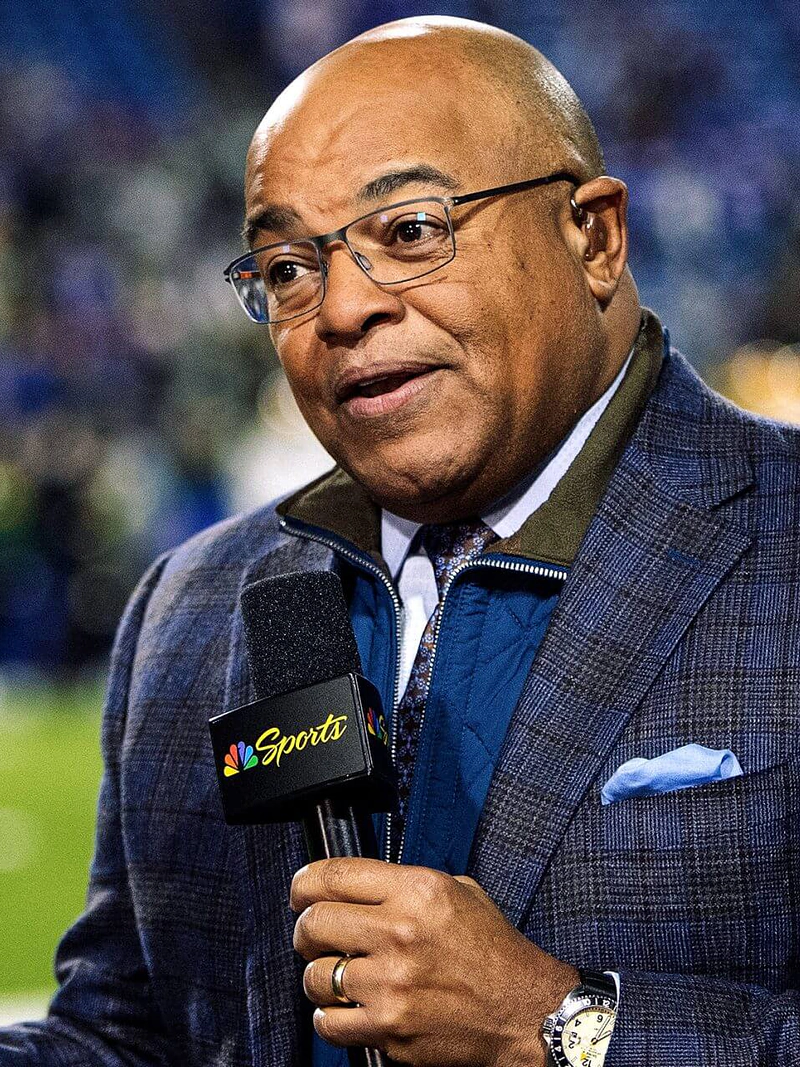
Attr: NyTimes - The Athletic
| 5 Quotes | |
| Born as | Michael Todd Tirico |
| Occup. | Journalist |
| From | USA |
| Spouse | Deborah Tirico |
| Born | December 13, 1966 New York City, New York, USA |
| Age | 59 years |
| Cite | |
Citation Formats
APA Style (7th ed.)
Mike tirico biography, facts and quotes. (2026, February 11). FixQuotes. https://fixquotes.com/authors/mike-tirico/
Chicago Style
"Mike Tirico biography, facts and quotes." FixQuotes. February 11, 2026. https://fixquotes.com/authors/mike-tirico/.
MLA Style (9th ed.)
"Mike Tirico biography, facts and quotes." FixQuotes, 11 Feb. 2026, https://fixquotes.com/authors/mike-tirico/. Accessed 25 Mar. 2026.
Early Life and Background
Michael Todd Tirico was born December 13, 1966, in New York City and grew up in Queens, a borough where block-by-block diversity and daily commuting rituals trained the eye to read people quickly. In a city defined by argument, speed, and performance, he absorbed the cadence of talk - the way fans narrate games as if they are family history, and the way a neighborhood can turn a Saturday matchup into civic theater.His family life and early identity were shaped by the complicated social weather of late-1960s and 1970s New York, when race and class were openly contested and media images carried extra weight. Tirico has spoken in adulthood about being biracial, raised by his mother and later learning more about his father's background, an experience that sharpened his sensitivity to belonging and perception - not as an abstract idea, but as something negotiated in schools, workplaces, and on-air spaces where the audience believes it knows you on sight.
Education and Formative Influences
Tirico attended Bayside High School in Queens and then Syracuse Universitys S.I. Newhouse School of Public Communications, graduating in 1988. Syracuse in the 1980s was a factory for modern sportscasting: fast highlights, sharper production, and the rising power of ESPN to turn niche leagues into national narratives. He worked at campus outlets including WAER and learned the craft in reps - calling games, interviewing athletes, and writing to deadline - while studying the newsroom discipline that separates a durable broadcaster from a charismatic fan.Career, Major Works, and Turning Points
Hired by ESPN in 1991, Tirico became one of the networks defining versatile voices, moving from SportsCenter to NBA coverage and then into major event hosting. His long run as the play-by-play voice of Monday Night Football on ESPN (2006-2015) proved he could manage not just games but the cultural noise around them, and he became a steady presence on golf and tennis, including coverage of the Masters and major championships. In 2016 he left ESPN for NBC Sports, a strategic shift into broadcast tentpoles: he succeeded Bob Costas as NBCs prime-time host for the Olympics (debuting as prime-time host at PyeongChang 2018), became a lead NFL voice on NBC including Sunday Night Football, and helped anchor NBCs broad sports identity in an era when streaming and fragmented audiences threatened the old appointment-viewing model.Philosophy, Style, and Themes
Tiricos style is built on preparation that stays mostly invisible: a calm, unhurried delivery; an ability to translate strategy without talking down; and a reluctance to make himself the headline. He is most effective when he frames an event as a human crossroads rather than a stats page, and his best broadcasts feel reported, not merely called. He has repeatedly insisted that “Preparation gives you freedom. When youve done the work, you can be present for whats happening.” The line is not motivational fluff so much as a window into his psychology: he manages pressure by converting uncertainty into study, so that live television becomes less a gamble and more a controlled opening for attention.That attention tends to drift toward meaning - why an athlete is taking a risk, how a crowd changes the temperature of a moment, what a city needs from its team - which is why his hosting has often been as valued as his play-by-play. He has summarized the deeper aim with “The story is always bigger than the score”. Underneath is a moral stance about journalism: performance matters, but it matters most as evidence of character, labor, and context. Even his ambition is described less as conquest than readiness: “Thats a life lesson in there: its about what you do when you get your shot”. In Tiricos telling, a career is a series of auditions where the only stable advantage is the work you do before anyone is watching.
Legacy and Influence
Tirico helped define the modern American sports journalist as a multi-sport, multi-platform professional - equally credible in the booth, at the desk, and in the biggest event-host chair. His career maps onto the eras central transitions: ESPNs cable dominance, the rise of personality-driven studio shows, and the Olympics as an all-night narrative machine. For younger broadcasters, he represents a template of range without gimmick: a voice that earns trust through consistency, curiosity, and an insistence that the audience deserves context as well as excitement, even when the moment is moving too fast for anyone to fake understanding.Our collection contains 5 quotes written by Mike, under the main topics: Motivational - Sports - Training & Practice - Career.
Other people related to Mike: Ron Jaworski (Athlete)
Source / external links