
Mikhail Bakunin Biography Quotes 37 Report mistakes
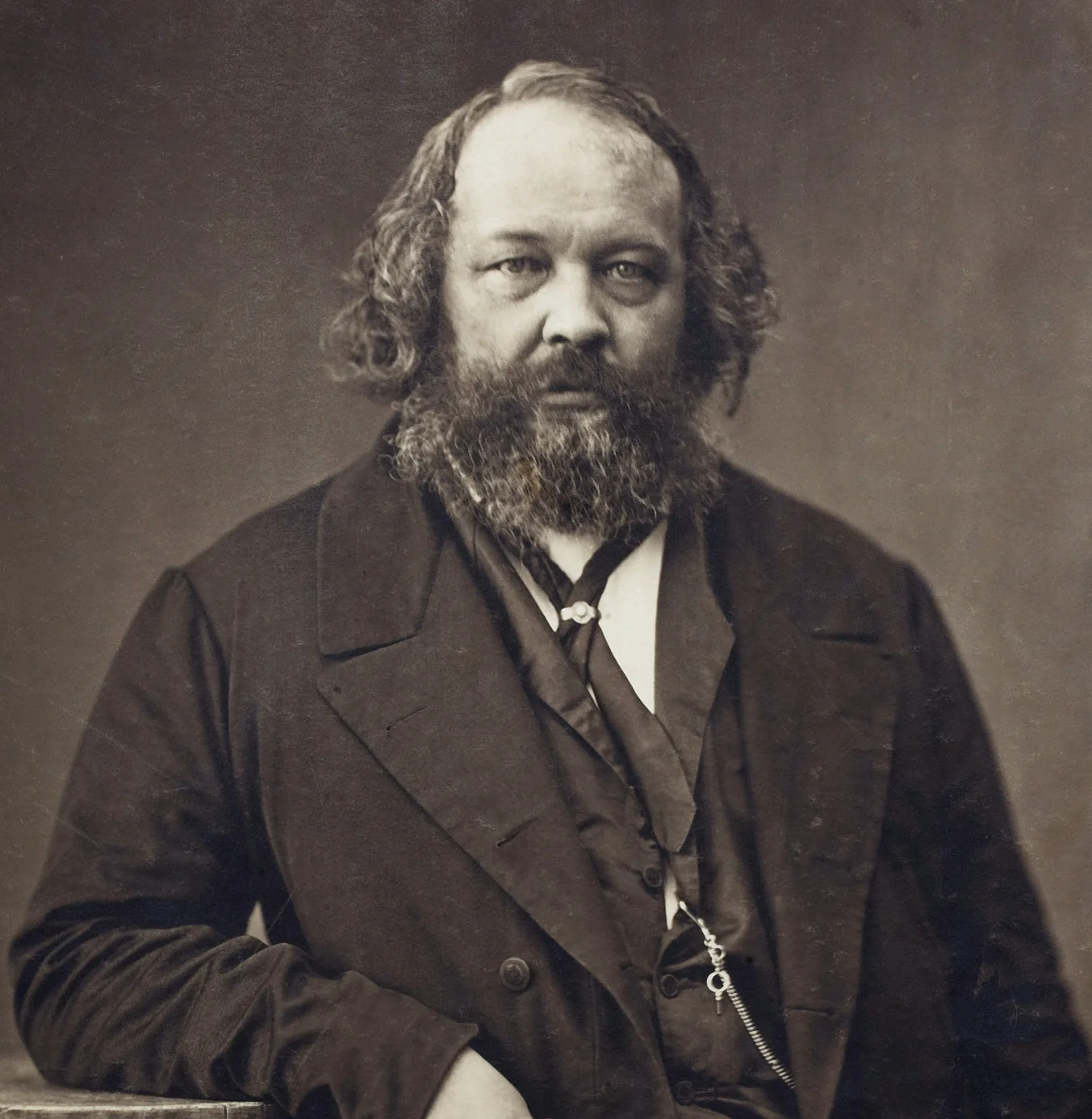
| 37 Quotes | |
| Born as | Mikhail Alexandrovich Bakunin |
| Occup. | Revolutionary |
| From | Russia |
| Born | May 30, 1814 Pryamukhino (near Torzhok), Russian Empire |
| Died | June 13, 1876 Bern, Switzerland |
| Aged | 62 years |
| Cite | |
Citation Formats
APA Style (7th ed.)
Mikhail bakunin biography, facts and quotes. (2026, February 2). FixQuotes. https://fixquotes.com/authors/mikhail-bakunin/
Chicago Style
"Mikhail Bakunin biography, facts and quotes." FixQuotes. February 2, 2026. https://fixquotes.com/authors/mikhail-bakunin/.
MLA Style (9th ed.)
"Mikhail Bakunin biography, facts and quotes." FixQuotes, 2 Feb. 2026, https://fixquotes.com/authors/mikhail-bakunin/. Accessed 5 Mar. 2026.
Early Life and Background
Mikhail Alexandrovich Bakunin was born on 30 May 1814 at Pryamukhino, a family estate in Tver Province, in the long shadow of Napoleonic war and the tightening autocracy of Alexander I and Nicholas I. His father, a landed noble with Enlightenment tastes, ran an intellectually lively household that mixed French manners with Russian provincial realities; his mother came from an aristocratic line and died while Bakunin was still young. The estate world trained him to see hierarchy as both intimate and suffocating: obligation, patronage, and obedience were not abstractions but daily structure.Sensitive, physically imposing, and socially magnetic, he grew into a man torn between the privileges that formed him and the moral disgust they later provoked. The Decembrist revolt of 1825 - crushed yet whispered about for decades - was part of the air he breathed, a reminder that conscience and state power could collide. That early awareness of rebellion as a tragic calling helped set the emotional pattern of his life: impatience with gradualism, faith in rupture, and a need to turn inner dissatisfaction into public action.
Education and Formative Influences
In 1832 Bakunin entered the Artillery School in St Petersburg and was commissioned in the Imperial Army, but the barracks intensified his loathing of discipline for its own sake; he resigned in 1835 and moved to Moscow, where he joined the Stankevich circle and plunged into German philosophy. Hegel, Fichte, and Schelling gave him a vocabulary for historical becoming, while the Russian intelligentsia taught him that ideas were lived as risk. In 1840 he left for Berlin, absorbing the Young Hegelian ferment; by 1842-43 he was in Dresden, Zurich, and Paris, meeting radicals and Polish emigres and shifting from metaphysics to revolutionary politics.Career, Major Works, and Turning Points
Bakunin emerged publicly with "The Reaction in Germany" (1842), then became a roaming agitator in the European crisis years. He participated in the Prague Slavic Congress (1848), helped drive the Dresden uprising (1849), and was arrested, condemned to death, reprieved, and handed to Russia. Imprisoned in the Peter and Paul Fortress and then Shlisselburg, he wrote a coerced "Confession" (1851) to Nicholas I, a document of survival rather than surrender. Exiled to Siberia in 1857, he escaped via Japan and the United States to London (1861), reentering the movement with ferocious urgency. In the 1860s and 1870s he organized secret networks (including the International Brotherhood), fought for insurrectionary federalism, and battled Karl Marx within the First International, culminating in his 1872 expulsion. His mature works - "Federalism, Socialism, and Anti-Theologism" (1867), "God and the State" (written 1871, published posthumously), "The Paris Commune and the Idea of the State" (1871), and "Statism and Anarchy" (1873) - crystallized his anti-authoritarian socialism. He died on 13 June 1876 in Bern, Switzerland, worn down by illness, debts, and the long costs of exile.Philosophy, Style, and Themes
Bakunin's inner life was powered by a volatile mix of compassion and rage: empathy for the crushed, contempt for the complacent, and a perpetual fear that any new authority would reproduce the old. His anti-statism was not merely doctrinal but psychological, forged in prisons and in the intimate knowledge of how institutions colonize conscience. The state, to him, was a machine that trained dependence, so he framed freedom as a widening of lived autonomy against centralized command: “Where the state begins, individual liberty ceases, and vice versa”. The sentence carries his core suspicion - that power, once concentrated, converts even good intentions into domination.His prose moved like a man speaking at speed: polemical, rhythmic, full of moral certainties and sudden tenderness for the anonymous poor. He rejected revolutionary blueprints because he believed the habit of ruling begins in the imagination. “Anyone who makes plans for after the revolution is a reactionary”. That was less a refusal of organization than a refusal of vanguard substitution, the moment when planners start treating people as material. Even his most notorious formulation - “The passion for destruction is also a creative passion”. - reads as self-portrait: he experienced negation as liberation from paralysis, a way to break the spell of inevitability. Yet beneath the fire was a consistent ethic: voluntary association, federalism from below, and a materialist critique of church and state as twin educators in submission.
Legacy and Influence
Bakunin helped found modern anarchism as a mass-oriented, collectivist current, distinct from both liberal individualism and Marxist state socialism. His clash with Marx in the First International set a fault line that still structures the left: centralization versus federation, party discipline versus spontaneous self-organization. He inspired generations of militants in Spain, Italy, and Russia, and his critique of bureaucratic power proved prophetic in an age of revolutionary states that hardened into new hierarchies. His life - aristocrat turned exile, philosopher turned conspirator, prisoner turned organizer - remains a case study in the costs of refusing to separate moral freedom from political method, and in the enduring allure and danger of believing history can be forced to open by will.Our collection contains 37 quotes written by Mikhail, under the main topics: Witty One-Liners - Motivational - Justice - Music - Sarcastic.
Source / external links